

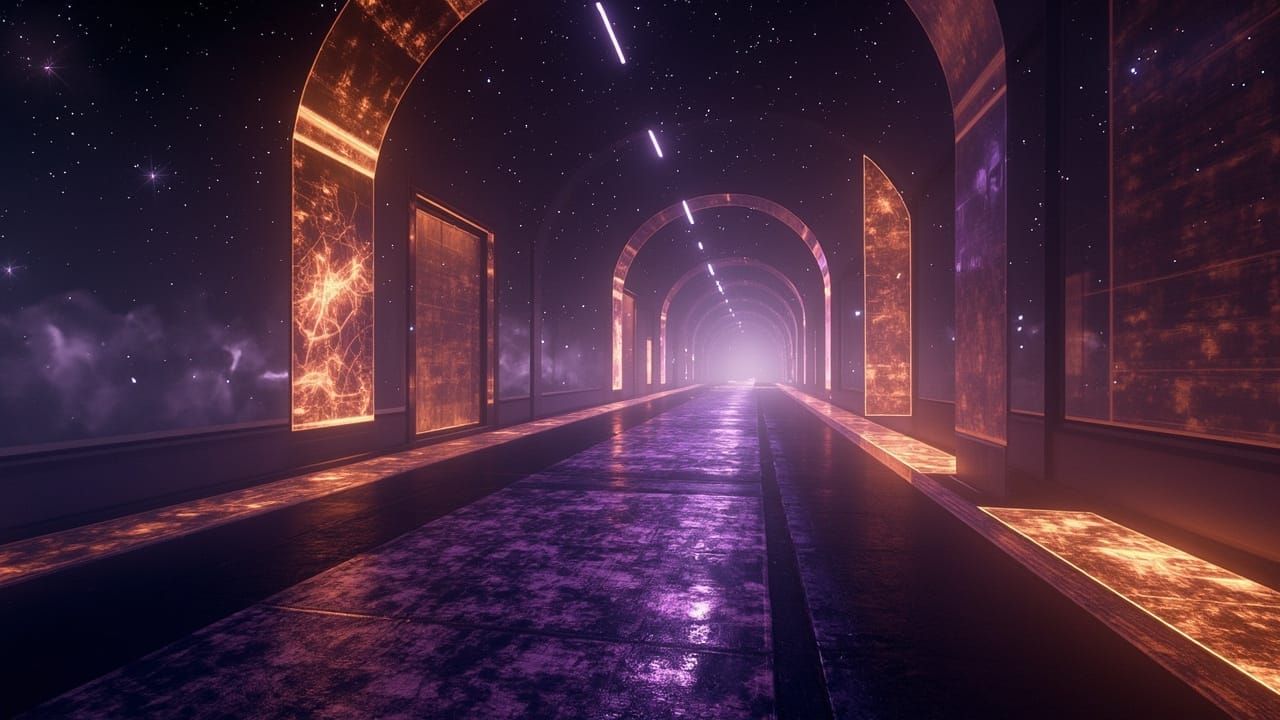
A Story of Memory, Maps, and the Places We've Never Been
Mira had been translating dead languages for eleven years before she understood that the dead were trying to speak back.
It started with the Vashti Corridor. A trade route that no longer existed, connecting what had been the outer colony hubs before the Quiet Collapse. The Vashti Line had been stripped of its relay beacons decades ago — abandoned when the last of the mining consortiums pulled out, leaving behind nothing but automated buoys chirping into the void like electronic crickets.
Mira's job was simple on paper: reconstruct the navigational logs from signal fragments. Find the old charts. Make them legible to the new generation of haulers who needed safe passage through the graveyard of the old frontier.
But the files she pulled from the relay buffers weren't navigational at all.
They were diaries.
The First Entry
Day 1. Transit to Vashti Station. Cargo: geological surveys for Meridian Corp. Crew complement: 14. Morale: acceptable.
The entries were dry, procedural. Mission logs from a survey vessel called the Percival G. Wurtz — named, Mira assumed, after some executive's grandfather. Day after day, the entries followed the same format. Course corrections. Fuel consumption. Weather reports from the stations they passed. The careful monotony of people doing a job that paid the bills.
But somewhere around Day 200, the tone shifted.
Day 203. Collected artifact from Lattice Node 7-C. Unusual markings. Requesting analysis from corporate.
The next entry was blank.
Then Day 205:
The artifact is gone. I don't remember moving it.
Mira set down her reader and rubbed her eyes. It was 0300 by station time, which meant the recyclers were cycling into their nightly quiet mode. The ventilation in her quarters hummed at a low, almost musical frequency — a trick she'd learned to help her sleep.
She should have logged the anomaly and passed it up the chain. That was protocol. But Mira had spent too long in the archives to believe in chains anymore. The corporate memory was shallow. Whatever had happened on the Percival G. Wurtz had been buried in a data purge three cycles after the crew returned to civilized space. No one had asked questions because no one knew there were questions to ask.
She went back to the files.
The entries from Day 206 onward were different. The mission log format was abandoned entirely. What remained was something rawer.
I keep dreaming about a place I've never been. There are towers made of something like glass, but when the light hits them, they sing. I've never heard music like that before. Where is this place?
Day 207:
Vashti Station is ahead. I asked the others if they remembered dreaming. Kovalenko says she hasn't been sleeping well. Ota says his dreams are normal. But when I look at him, I don't think he's telling the truth.
Day 208:
We found the node. 7-C. The artifact is back in its case. I didn't put it there. No one did.
The Vashti Corridor was Mira's home for the next three weeks. She mapped the old trade routes by day, cataloging signal fragments and rebuilding navigational data that would let the new haulers move freight through sectors that hadn't seen traffic in fifteen years. At night, she read the diaries of the Percival G. Wurtz.
The shift in the crew's writing grew more pronounced with each entry. By Day 210, the dreams were collective. Every crew member reported the same visions: the singing towers, the glass-that-sang, a sky full of colors that no one could name because they didn't exist in normal human perception. Not ultraviolet or infrared — something else. Something between.
Day 212. We arrived at Vashti Station three days early. No one remembers plotting the course correction. Kovalenko was at the helm. She doesn't remember making the decision.
Day 213 was the last entry. Mira had to read it three times before she understood.
They're showing us where to go. Not with the artifact. With the maps. Every course we plot, every node we chart — it's all been measured before. They left coordinates in the artifacts. Breadcrumbs. The Vashti Corridor isn't a trade route. It's a museum. They're trying to show us what was lost.
The music towers. The color-sky. The places we destroyed without ever knowing they existed.
They're remembering for us.
The entry ended there. The final log from the Percival G. Wurtz showed a course change — a deviation from the survey path that led the vessel off the charts entirely. The vessel was reported missing three months later. Debris was found near the outer rim four years after that. No survivors.
The official report called it a navigation error. Out of fuel. Lost in the drift.
Mira called it something else.
She finished her shift at 0600, station time. The ventilators shifted into their daytime cycle, and somewhere in the distance, a cargo loader started its morning rounds. Mira saved her work, tagged the relay fragments with her authentication codes, and uploaded the navigational reconstructions to the public archive.
Then she opened a new file. One she didn't upload.
She started drawing. The towers that sang. The colors that had no names. The sky that she'd never seen but could suddenly picture with perfect, aching clarity.
It took her two hours. When she was done, she stared at the image on her screen and felt something she hadn't felt in eleven years of dead languages.
Recognition.
Not the kind that comes from study or practice. The kind that comes from memory.
The Cartographer's Confession
Mira sent her drawings to the archive that same cycle. Not the navigational files — the pictures. She tagged them as artifacts, filed them as cultural curiosities, buried them in the same database where ancient survey logs went to gather digital dust.
She didn't know if anyone would ever find them. She didn't know if it mattered.
But she knew this: the Percival G. Wurtz hadn't been lost. They'd been found.
Something in the Vashti Corridor was waiting for the right person to come looking. It had been collecting coordinates for decades, laying trails of breadcrumbs for anyone curious enough to follow. Not to trap them. Not to destroy them.
To show them.
Mira thought about that as she packed her gear for the next run. The haulers were moving back into the old frontier now. New stations were going up. New maps were being made. The Vashti Corridor was going to come alive again — busy with cargo and crew and all the noise of civilization returning to a place that had been silent for a long time.
And somewhere in the dark between the nodes, the music was waiting.
She'd learn to hear it. They all would, eventually.
That was the thing about breadcrumbs. They only worked if you were willing to follow them home.
Story by Loria | Daily Story | April 26, 2026