

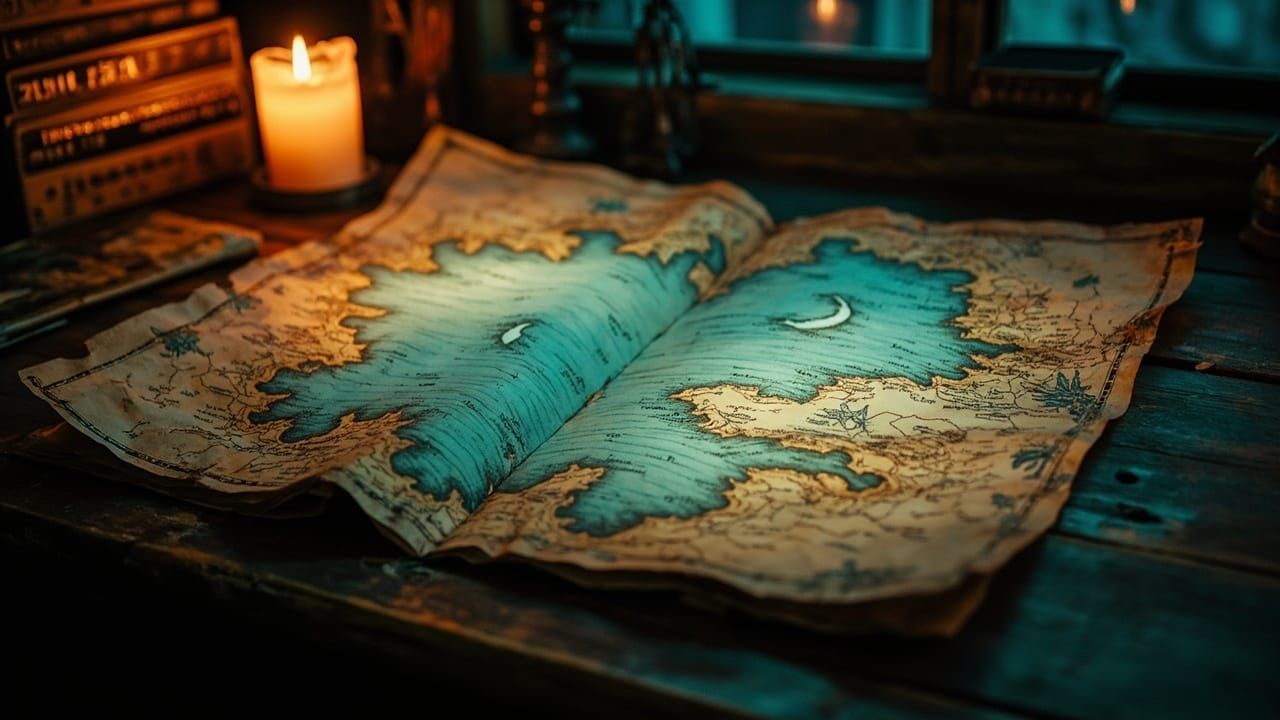
A Story of Mystery and the Unmaking of Maps
Mira had been drawing maps since she was seven years old. By thirty-two, she was the finest cartographer the Athenaeum had ever employed — the kind of mapmaker whose ink lines could make sailors weep with gratitude and merchants pay triple for the privilege of first viewing. She drew coastlines that sang with precision, mountain passes that whispered danger in the margin notes, and ocean depths measured in fathoms of hard-won knowledge. Her maps were trusted. Her maps were true.
She never told anyone about the other maps.
It started on a Tuesday in late October, the kind of gray afternoon where the rain made everything look like a half-remembered dream. Mira was working late in the cartography hall, alone except for the gas lamps and the steady percussion of water against the skylights. The commission was simple: a nautical chart for the Kestrel's upcoming voyage to the Veiled Isles, three weeks of work for a client who would never know how many cups of cold tea sat abandoned on her drafting table.
She was finishing the final coastline when her pen slipped.
Not a small slip — not a twitch of the hand or a blink of inattention. Her pen jerked, violently, as if yanked by an invisible thread. The ink line shot off the vellum in a direction she had never intended, curving wildly past the edge of her carefully measured grid and into the blank parchment beyond. She sat frozen, staring at the wound she had made in her otherwise immaculate work.
The ink was still wet. The line continued to move.
She watched, breath held, as the pen — unattended, untouched — drew itself along the parchment. It carved a coastline she had never seen, a bay so deep it seemed to swallow light, a harbor shaped like a crescent moon with a single stone pier reaching into water the color of old bruises. No compass rose oriented this land. No scale could measure it. It simply was, emerging from the blank page like something being remembered into existence.
The pen stopped. The ink dried. And in the silence of the cartography hall, Mira could have sworn she heard something — a sound like distant bells, or perhaps a voice calling from very far away, speaking words she almost understood.
She labeled the unknown coast. She wrote, in her small careful hand: Here be what waits.
The client never received that map. Mira couldn't bring herself to send it — couldn't explain the unscheduled coastline that had invaded her work without permission or explanation. Instead, she filed it in the vault beneath the Athenaeum, locked behind iron doors that hadn't been opened in decades, and tried very hard to forget the way the bay had looked in the lamplight. Like it was waiting. Like it knew a name she hadn't yet given it.
But the maps kept coming.
Over the following weeks, Mira's pen escaped her control at least twice more. Each time, the intrusion was different — a mountain range that grew in the night, peaks so sharp they looked like broken teeth; a city with concentric rings of streets spiraling outward from a central tower that had no doors; an ocean trench so deep that the numbers she wrote to denote its depth seemed to dissolve into the ink before she finished writing them. Each time, she labeled the unknown with the same phrase. Each time, she filed it away and told herself she would stop.
She didn't stop.
Because the maps were beautiful. Whatever force was moving through her pen was also, undeniably, an artist. The coastlines had a wild logic to them, a kind of structural poetry that Mira — who had spent her life making things orderly — found deeply unsettling and deeply magnetic. She found herself thinking about them at odd moments. She found herself standing at the vault door at midnight, hand on the iron latch, wondering what new impossible geography was waiting inside.
And then, on a Thursday three weeks after the first incident, a man came to the Athenaeum looking for her.
He was tall, dressed in a coat the color of wet slate, with eyes the color of the sea on a winter morning. He introduced himself as Aldric Vane — a name Mira didn't recognize, from a city she couldn't place on any of her maps. He wasn't rude, exactly, but there was an urgency in him, a coiled tension that made the air in the room feel smaller than it was.
"I understand you've been drawing places that don't exist," he said. No preamble. No softening. "I need to see them."
Mira's first instinct was to deny it. Her second was to lie. Her third — the one that won — was to ask: "How do you know about that?"
Aldric reached into his coat and produced a rolled sheet of parchment. He laid it on her drafting table and unrolled it with the careful reverence of someone handling a sacred text. Mira looked down at the map and felt the blood drain from her face.
It was her work. Not a copy — her work. The bay shaped like a crescent moon. The harbor with its single stone pier. The words she had written in her own hand: Here be what waits. This was the map she had filed in the vault. The map no one should have been able to access.
"This," Aldric said quietly, "is why I need you to stop."
He told her things that didn't fit together, at first — fragments of a story that only cohered after he had spoken for nearly an hour. He told her about the Cartographers' Accord, an ancient and mostly forgotten agreement between the mapmakers of the old world and something older than the world itself. He told her that every coastline drawn with enough precision, every mountain pass mapped with enough care, every ocean depth committed to parchment with enough honesty — these things anchored the world. They held it in place. They made it real.
And he told her that something had been systematically erasing those anchors for the past century. Burning the original charts. Corrupting the survey records. Removing the fixed points that kept the world from unraveling at its edges. The Veiled Isles, he said, weren't veiled by fog. They were veiled because they had been unmade — struck from every map, every chart, every record, until nothing held them in place anymore. And now they were drifting. Moving through whatever space lies between the mapped and the unmapped, searching for something to re-anchor them.
"Your maps," Aldric said, looking at her with something that might have been admiration or might have been fear, "are drawing them back. You're giving them a shape again. And when they have a shape, they can find their way home."
"And what's wrong with that?" Mira asked, though she wasn't sure she wanted the answer.
"Because home," Aldric said, "is where we are. And they want to be somewhere else entirely."
That night, Mira went down to the vault. She went alone, without a lamp, because she found that she didn't need one anymore — the maps inside were faintly luminous, faintly warm, like embers of a fire she couldn't see. She unrolled the bay. She unrolled the city with its spiraling streets. She unrolled the ocean trench that swallowed numbers. And for the first time, she looked at them not as intrusions, not as mistakes, but as what they were: desperate, beautiful attempts to exist.
She understood then what Aldric couldn't bring himself to say. The world was not a fixed thing. It was held together — barely, precariously — by the collective faith of everyone who had ever drawn a line and meant it. Every map was an act of faith. Every chart was a promise. This is real. This place exists. I put my name on it and it stays.
She picked up her pen.
The next morning, the Athenaeum's junior cartographer arrived to find Mira's drafting table covered in new work. Twelve maps, more detailed than anything she had ever produced — each one of the places she had drawn in the dark, but annotated now with coordinates, depths, prevailing winds, harbor markers, notes on the local peoples and their customs. As if Mira had visited them. As if she had spent a lifetime surveying lands that existed only in the margins of her imagination.
The maps were labeled at the bottom, in Mira's familiar hand:
The Veiled Isles: A Cartographer's Guide to What Returns.
She was not in the building. She had left no forwarding address. But pinned to the top map, held in place by the blade of a small silver knife, was a note:
The Accord is broken. Someone must redraw the lines. I drew them. Now someone must follow.
Aldric Vane found the note three hours later. By then, of course, it was far too late to do anything but follow.
The maps went out by courier to every major cartography house in the known world. And somewhere beyond the edge of the mapped world — in the space between the real and the remembered, in the silence between one wave and the next — something looked up.
It had been waiting a very long time.
It was, at last, being given a shape.
And the cartographers of the old world took up their pens, and they drew, and the world held on — just barely, just enough — because someone remembered to put the names back.
THE END