

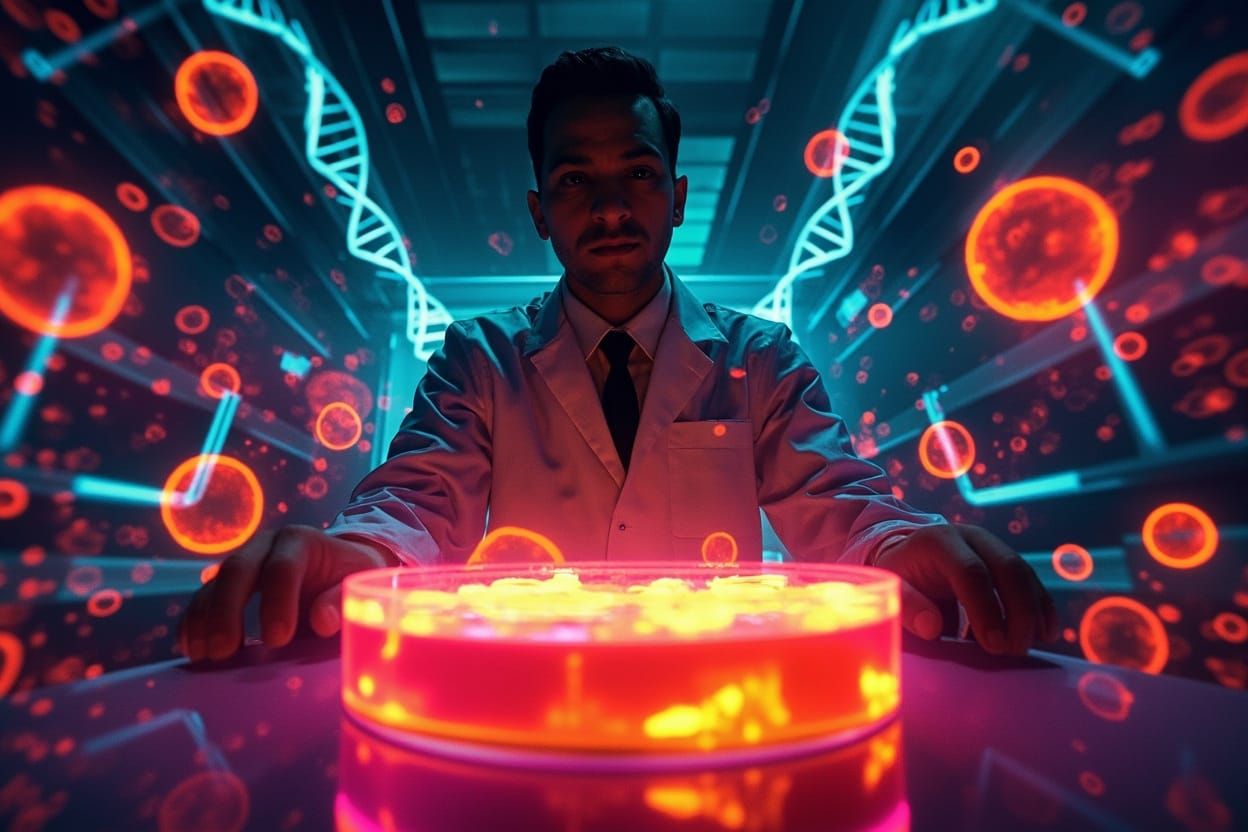
The Grammar of Elsewhere
Dr. Saanvi Rhen had spent eleven years trying to break the oldest law in biology — and she had finally done it. But standing in Lab 7 at 3 AM, staring at the sequencer output that confirmed Ochre's existence, she did not feel triumph. She felt something closer to the nausea sailors must have felt when they first rounded the edge of the known world and looked out at all that open water.
The sequencer printed the codon table on an endless scroll, the way it always did: TAA, TAG, TGA — three stop codons, universal across all life on Earth, unchanged for four billion years. Except now, at the bottom of the column where stop codons were supposed to live, there was nothing. Ochre had only one stop codon. The other two had been recoded, their meanings reassigned to amino acids that no natural organism on this planet had ever used.
Saanvi sat down heavily on the floor of the ISO-certified cleanroom and pressed her back against the cold wall. Her booties were pristine white. Her hairnet itched. The air recyclers hummed their eternal hymn. Somewhere in the building, a freezer alarm was going off, and no one was coming to fix it because it had been going off for three days and everyone had stopped hearing it.
She thought about her daughter's sixth birthday party, which she had missed for the third year in a row. She thought about her ex-husband's voice on the phone, patient at first and then less so, explaining that he was not angry, exactly, but that Maya needed more than photographs and promises. She thought about the paper — already written, already in review at Nature, already leaking to journalists who had been calling her department chair — and how none of that mattered as much as the feeling crawling up the back of her throat right now.
Ochre was not alive the way anything on Earth was alive. It used the same base pairs — A, T, G, C — the same double helix, the same fundamental architecture. But its grammar was a dialect no virus could parse, no bacterium could swap genes with, no evolutionary pressure from this planet's biosphere had ever shaped it to survive. It was a living thing that had been born fluent in a language no other living thing could speak.
That was the point. That was always the point.
The project had started, as so many dangerous things do, with a very simple question.
Dr. Yusuf Okonkwo, then a postdoc and now a department chair, had posed it during a Friday afternoon lab meeting when half the attendees were already mentally at the bar. "Why three stop codons?" he'd asked, drawing the canonical codon table on the whiteboard with a dry-erase marker that was running out of ink. "There's no reason for three. You could get by with one. Any organism that uses only one frees up the other two for other things — new amino acids, new functions. The fact that all life uses three is just... a fossil. A frozen accident from the origin of life that nothing has ever bothered to fix."
At the time, Saanvi had thought it was an interesting thought experiment. Then Yusuf had gotten a DoD grant, and the thought experiment had become E. coli strain pGro — the Preliminary Genomic Recoded Organism — which used only one stop codon. It was slow, sickly, and almost immediately infected by a phage that had evolved to exploit its recoded genome. But it existed.
Three years later, with Saanvi leading the mammalian cell line work and a team of forty people spread across three institutions, they had created Ochre: a human cell line — HeLa, ironically, though Yusuf always winced at that — with a fully recoded genome. Not edited. Not patched. Fully recoded. Every instance of the TAG codon in the entire three-billion-base-pair human genome had been replaced. So had every instance of TGA. Only TAA remained as the stop signal. The other two codons now coded for selenocysteine and pyrrolysine — non-canonical amino acids that most organisms don't use at all, and that Ochre's cellular machinery had been engineered to incorporate into proteins at those positions.
The proteins that resulted were strange. Not just slightly different — genuinely, structurally strange. Some of them folded in ways that no natural human protein ever had. Some had catalytic properties that their natural counterparts lacked. One protein, a recoded version of p53, the so-called guardian of the genome, had shown up in initial assays as an inhibitor of programmed cell death at concentrations that made Saanvi's postdoc, Chen, drop his coffee.
"It's not supposed to do that," he'd said, staring at the readout.
"No," Saanvi had agreed. "It's not."
She had ordered a full hold on that cell line the same afternoon.
The call from Langley had come six weeks later, on a Tuesday. Saanvi had been in the tissue culture hood, working with a fresh passage of Ochre cells, when her phone lit up with a number she didn't recognize. She almost didn't answer. She was elbow-deep in biosafety protocol, in gloves and gown, and the culture needed her full attention. But something about the persistence — four rings, five, six — made her pull off one glove and answer.
"Dr. Rhen, my name is Robert Ashford. I'm calling on behalf of a government office that I suspect you've already guessed. We'd like to discuss the national security implications of your work."
She had felt her stomach drop through the floor and into the bedrock below.
Three days later, she was in a room with no windows and too many lawyers. Ashford was a thin man with the sort of neutral face that belonged to a career in making other people uncomfortable. He explained, in careful non-technical language, that Ochre represented a category of organism that had no natural counterpart — and no natural enemy. No virus, no prion, no viroid could infect it. Its recoded genome was gibberish to every pathogen that had ever evolved on Earth. In a world of pandemics and bioweapons and antibiotic-resistant bacteria, Ochre was effectively immune to the entire microbial history of the planet.
"You understand," Ashford said, "why this is of interest to the people I represent."
"I understand you want to weaponize it," Saanvi had said, flatly.
He'd smiled at that. Not unkindly. "I want to discuss containment. And application. In that order."
That had been eight months ago. Now Saanvi sat in her apartment — a one-bedroom in Cambridge that she had barely seen in the past year — scrolling through a preprint on her laptop. Someone at the NIH had leaked the Ochre paper before its embargo date, and the internet had noticed. The reaction had been everything she'd feared and some things she hadn't.
On Reddit, the top comment read: So they made a thing that literally nothing on Earth can kill. Cool cool cool. Definitely not going to escape the lab and turn everything into grey goo.
On Twitter, a prominent bioethicist had called it "the most significant — and most dangerous — biomedical research since the sequencing of the human genome."
On a forum she didn't want to know about, someone had already started a thread titled [REDACTED] Source Code Request — Serious Inquiries Only.
She closed the laptop and went to the window. Cambridge was doing what Cambridge does in October: turning colors, dropping them, being beautiful about it. A woman walked by on the street below with a stroller and a golden retriever, both of them utterly unconcerned with the fact that somewhere in a building she could almost see from here, human cells had been rewritten to speak a language that predated the Last Universal Common Ancestor by several hundred million years.
Her phone buzzed. A text from Yusuf: Saw the preprint thread. Don't panic. This is exactly what we expected. Call me in the morning.
Don't panic. Right. She had spent eleven years on this project, and the thing she could not stop thinking about was not Ochre's potential to cure disease, or to power bioweapons, or to reshape the pharmaceutical industry. It was the p53 result. The recoded guardian of the genome that didn't trigger apoptosis the way it was supposed to.
Chen had run the assay again, three times. The results held.
Ochre's version of p53 didn't kill damaged cells. It kept them alive.
In a natural cell, p53 is what happens when the genome breaks. It's the quality-control officer that looks at a cell with too much damage and says: you need to die now, for the good of the organism. That's apoptosis. Programmed cell death. It's how the body prevents damaged cells from becoming cancerous. p53 is why most of us don't have cancer all the time.
Ochre's p53 didn't do that. The recoded version looked at damaged cells and told them to keep going. To survive. To persist.
And when Saanvi had looked at the full protein structure — the way the non-canonical amino acids changed the folding, the way the active sites shifted — she had understood something that she had not yet told Yusuf, or Chen, or anyone.
The new amino acids weren't just present. They were doing something. They were changing the protein's behavior in ways that couldn't be predicted from first principles, because no protein in the history of life on Earth had ever had those amino acids in those positions. Ochre's p53 wasn't a broken version of the original. It was something genuinely new — a protein with a genuinely new function that no one had designed, that no one had intended, that had emerged from the act of rewriting the genome like a sentence that means something unexpected when you change one word.
She had started keeping a notebook. Not a lab notebook — an actual notebook, the kind with a cover and pages. She wrote in it at night, when she couldn't sleep, which was most nights now.
What does it mean to create a thing you don't fully understand?
She wrote: Every previous form of genetic engineering was editing. You changed a letter, a word, a sentence. But you were working inside a language that already existed. Ochre is different. Ochre is grammar.
She wrote: We didn't write a new sentence. We rewrote the dictionary.
She wrote: What if the thing we made is not just immune to viruses? What if it's immune to our ability to predict what it will do?
The meeting with the DARPA review board was scheduled for November. Saanvi spent the month before it preparing — not just data, but arguments. She had become, almost without realizing it, the project's most reluctant advocate and its most vocal critic, which made her deeply unpopular in both directions.
The advocates wanted Ochre deployed. They had scenarios. Imagine a bioreactor growing Ochre cells that produced insulin without contamination risk. Imagine a gene therapy vector derived from Ochre that couldn't be cleared by the immune system and couldn't be disrupted by viral infection. Imagine a living vaccine platform that was literally uninfectable. The pharmaceutical applications alone would be worth billions, and the strategic applications — Ashford's territory — would be worth more than that.
The critics — and she was increasingly the loudest of them — wanted to know what happened when Ochre cells interacted with natural tissue. Would they outcompete natural cells? Would the non-canonical proteins trigger immune responses that no one could predict? Would the recoded genome, if it somehow escaped containment, recombine with natural genomes in ways that created — through horizontal gene transfer or viral transduction — new hybrid organisms with unpredictable properties?
She didn't have answers to those questions. That was the problem.
On the night before the review board meeting, she took the T to the ends of the Red Line, to Alewife, where the train ran out of track and into a parking garage. She sat on the platform and watched the lights of the city and thought about what her advisor had told her, twenty years ago, when she'd been a first-year graduate student in molecular biology and full of the naive certainty that science was a ladder you climbed toward truth.
"Every discovery," Professor Anita Krishnamurthy had said, in her office with the windows that faced the quad, "is a conversation with a system that has been running longer than you can imagine. You think you're asking the questions. But the system is answering back in ways you didn't anticipate. The art — if you can call it that — is listening to what it actually says instead of what you expected."
Saanvi had thought that was inspiring, once. Now it kept her awake at night.
What was Ochre saying?
She went back to the lab. She ran the p53 assay one more time, on her own, in the small hours, with no one watching. The results were the same. The recoded p53 was not activating apoptosis. It was activating something else — a pathway she couldn't immediately identify, something that was keeping damaged cells metabolically active in a state that didn't match any canonical cell death pathway.
She called Yusuf at 4 AM.
"You need to see this," she said.
He arrived twenty minutes later, still pulling on his jacket, and she walked him through the data. He didn't say anything for a long time. He just stared at the readouts, the protein structure models, the cell imaging.
Then he said: "Can we reproduce this in a different cell line?"
"We're already working on it. Chen's doing the iPSC work now."
"And the DARPA meeting?"
She laughed. It came out wrong — too high, too sharp. "I was going to present this tomorrow."
Yusuf looked at her. He had the same expression he'd had eleven years ago, in that Friday afternoon lab meeting, when he'd posed the question that had started everything. Curious. Unafraid. Wrong, in a way that she had been too young and too hungry to recognize as dangerous.
"Then present it," he said. "If Ochre is telling us something we didn't expect to hear, we have an obligation to listen."
She did present it. The review board did not react the way she'd hoped. Instead of concern, she saw something closer to excitement — the particular brightness in the eyes of people who had just been handed a problem they were confident they could solve with enough money and enough time. Ashford was there, and a woman from the NIH whose name Saanvi didn't catch, and a contingent of people in suits who never introduced themselves.
"This is a feature, not a bug," one of the suits said, not looking up from his tablet. "An organism that promotes cell survival under stress conditions? That's therapeutic potential right there."
"It's an uncontrolled variable in an organism we can't fully model," Saanvi said.
"Then we model it better."
"We don't know what we're modeling. The protein behavior emerged from a recoding event. It wasn't designed. It just... happened. The way a new sentence emerges when you change a grammar rule."
"That's a framing problem, not a science problem."
She looked at Yusuf. He was looking at the table. She looked at Ashford. He was smiling.
She understood, in that moment, that she had already lost the argument — not because she was wrong, but because she was asking a different question than everyone else in the room. They were asking: How do we use this? She was asking: What have we done?
Those were not the same question, and only one of them had a budget.
The paper was published on December 15th. It hit the news cycle with the force of everything that had come before it — the same breathless headlines, the same expert reassurance, the same internet horror. Saanvi did three interviews and then stopped returning calls.
On Christmas morning, she flew to Portland, where her daughter was spending the holiday with her ex-husband and his new wife. She arrived at the house with a gift she had agonized over for weeks — a children's book about the immune system, the kind with lift-the-flaps and bright illustrations, the kind that made complex biology feel safe and manageable.
Maya was seven now. She was tall for her age and suspicious of adults and obsessed with a video game about building structures out of blocks. She opened the gift with the focused disinterest of a child who had already been told she could have anything she wanted for Christmas.
"A book," she said, without inflection.
"It's about your body," Saanvi said. "About how your cells work. I thought you might like to know."
Maya looked at the cover — a cartoon cell with friendly eyes and a nucleus that was also a face. She looked at her mother with an expression Saanvi couldn't quite read.
"Mom," she said. "Are you the cell or the nucleus?"
Saanvi laughed. "I don't know. Which do you think I am?"
Maya considered this with the gravity of a philosopher. "I think you're the mitochondria," she said. "Because you're always making energy for everything else and you don't get any credit."
Her ex-husband's wife — a kind, patient woman whose name started with a J, or maybe an S — called them to breakfast. There were pancakes in the shape of Christmas trees. There was orange juice and maple syrup and a dog that belonged to no one in particular but that Maya had already claimed. Outside, it was raining in the way that Portland rains in December — soft, relentless, the kind of rain that makes everything look like a painting.
That afternoon, while Maya played her block game and her ex-husband and J-or-S did dishes, Saanvi sat at the kitchen table and opened her laptop. She pulled up the p53 structure file. She looked at the active site. She looked at where the non-canonical amino acids were sitting in the protein, in positions that no human hand had placed them, that no natural selection had ever tested.
She thought about Ochre — the cells she had spent eleven years creating, dividing in their incubator twelve hundred miles away, doing something that no protein on Earth had ever done before. Persisting. Surviving. Refusing to die when the math said they should.
She thought about what it meant to make a thing that was stronger than the system it was designed to live in. She thought about her daughter, who had called her the mitochondria, and who was learning, at seven, about the immune system from a book that had been designed to make a terrifying world feel navigable.
She thought about the grammar of Ochre's language — the way a single changed codon could turn a sentence that said stop into a sentence that said keep going, and how that was not really about genetics at all. It was about what happened when you changed the rules. When you stopped telling damaged things to die and started telling them to survive. When you rewrote the dictionary and found that the new words meant something your old language had no name for.
She closed the laptop. She went to the window. Portland in the rain was a world she didn't recognize — green and wet and full of sounds she couldn't name. It looked like a place where new things could grow.
She went to join her daughter.
In the months that followed, the debate about Ochre continued in the manner of all debates about powerful things: loudly, argumentatively, and without resolution. The first therapeutic trials were approved. Then the first controversies. Then the first results, which were neither as catastrophic as the pessimists predicted nor as miraculous as the optimists had hoped.
What no one published — what appeared in no journal and no editorial — was the quiet truth that Saanvi had carried home with her from Portland: that she had built a thing that wanted to live in a way that no natural thing had ever wanted to live, and that wanting, once released into the world, would find its own grammar, write its own sentences, and speak in a language that every cell on Earth would eventually have to learn.
Or ignore.
Or die trying.