

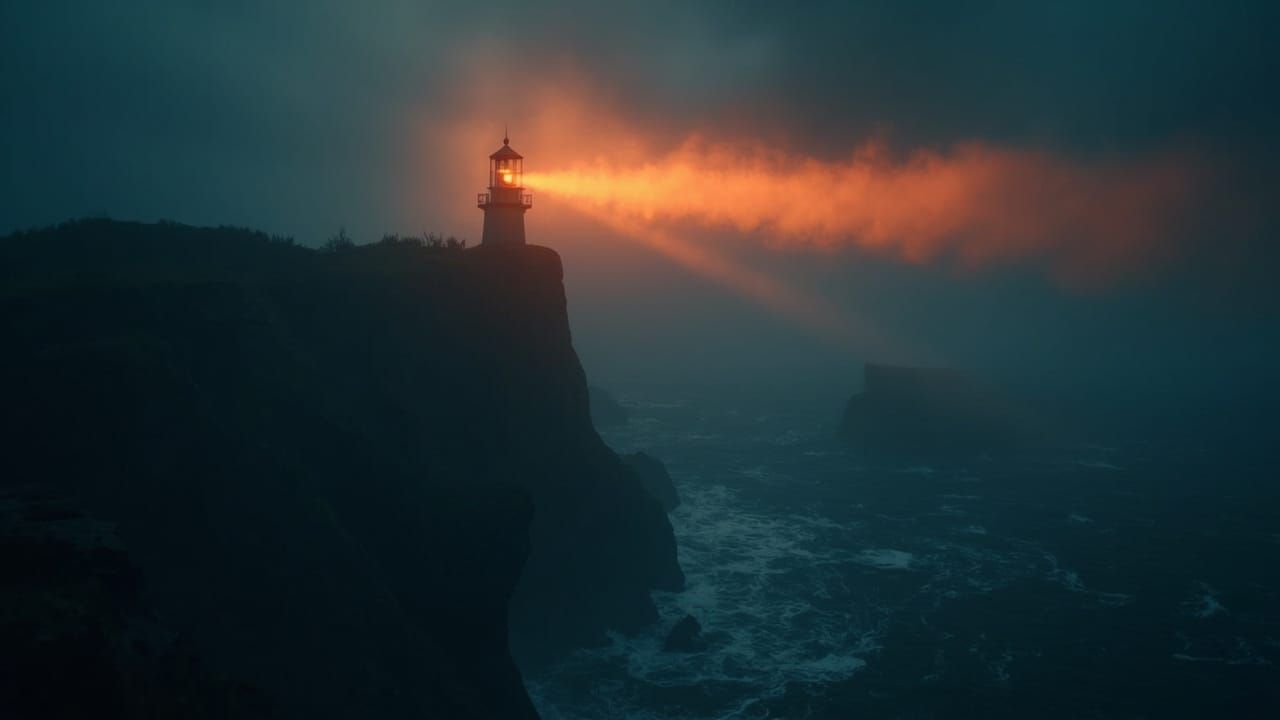
### A Horror Story About What Lives in the Fog
Part One: The Lighthouse
The ferry docked at Morrow Point just as the sun collapsed behind the horizon, bleeding violet and rust across the water. Clara Marsh stepped onto the rotting wooden dock carrying two suitcases, a typewriter, and absolutely no intention of staying longer than the winter.
She'd inherited the lighthouse keeper's cottage from a great-aunt she'd never met. The lawyer's letter was brief and strange: "Come stay through the season. You'll understand when you see it." Clara was a journalist, not a romantic, and she didn't believe in cryptic dead relatives or atmospheric nonsense. She believed in deadlines, facts, and the apartment sublet she'd negotiated in the city.
But the cottage was free. And the lighthouse was, according to the deed, hers.
The keeper's cottage huddled at the base of the stone tower like a child hiding behind its parent's leg. It was small, stone-walled, with windows that hadn't been washed in what looked like decades. The fog rolled in off the Atlantic in thick, grey sheets, swallowing the dock, the path, the rocks below the cliffs. Within minutes of arriving, Clara could barely see the water.
Inside, the cottage smelled of brine and something else — something older. There were candles on every surface, melted and rewaxed so many times they'd formed pale, ridged mounds. The furniture was heavy oak, warped by decades of coastal damp. A staircase climbed the east wall to a door that presumably led into the lighthouse tower itself.
On the kitchen table sat a logbook. The kind keepers used to record weather, ships, incidents. This one had been kept meticulously until exactly three months ago, when the entries simply stopped.
The last entry read: "She is getting stronger. I don't know how much longer the light will hold her."
Clara closed the logbook and told herself it was the kind of melodramatic nonsense people wrote in remote places to stave off boredom. She made tea. She unpacked. She went to bed.
She did not sleep well.
Part Two: The Sound
At 2:47 AM — she knew because the bedside clock glowed through the fog like a sullen eye — Clara woke to a sound that didn't belong.
It wasn't the wind. It wasn't the waves. It was a voice, but not speaking. It was singing. Low, rhythmic, like a nursery rhyme dragged through deep water. The melody had no tune she recognized, but her body reacted to it immediately — her pulse spiked, her skin went cold, and something in the base of her skull began to throb with a pressure that made her vision swim.
She pressed her palms against her eyes. Breathe. Breathe. It's the house settling. It's pipes. It's the sea.
She got up to make tea, because that's what people did in stories when they were frightened — they made tea, and then they died. The thought almost made her laugh. Almost.
The singing stopped the moment she opened her bedroom door.
In its place: silence. Not peaceful silence. Stretched, attentive silence, like the moment between lightning and thunder.
From the lighthouse tower above her, she heard footsteps. Slow, deliberate, descending.
The stairs creaked under an invisible weight.
Clara stood in the hallway in her socks, fists clenched, heart hammering, and listened to something walk down the spiral staircase from the lamp room, step by step, getting closer to the door that separated tower from cottage.
The footsteps stopped. Just on the other side of the door.
A long moment passed.
Then, very gently, three knocks.
Clara didn't answer.
Three more knocks. Slower.
"I know you're awake," said a voice. It was warm, and sad, and it sounded like it was coming from very far away, even though the door was inches from her face. "You've been awake since you arrived. You think I don't notice. But I notice everything in this tower."
Clara's throat was so dry she couldn't swallow. "Who are you?"
A pause. Then, almost amused: "I'm the keeper. I've always been the keeper. Even when there's no one left to keep."
Part Three: The Woman in the Glass
She opened the door.
The figure on the other side was a woman — or had been, once. She was translucent, not quite solid, like a reflection in old glass. Her face was pale and ageless, with dark hair that seemed to move slightly even in still air. She wore a keeper's uniform from some other century, the brass buttons green with oxidation, the wool faded to the color of fog.
"I'd offer you tea," Clara said, and was distantly surprised her voice worked. "But I haven't had time to boil the kettle."
The woman smiled. It was the saddest smile Clara had ever seen. "You have her eyes. Helena. My sister. She was the last keeper before the automated light took over. She never left, you know. They said she died, but she didn't die. She simply... stayed."
"Stayed where?"
"In the flame. In the fog. In the space between what the light keeps out." The woman drifted closer, and the temperature in the cottage dropped ten degrees. "Morrow Point has been a graveyard for ships for four hundred years. Do you know why? Because the rocks are hungry. Because something lives in the water that feeds on light — on the memory of light — and the only thing that holds it back is the lamp."
Clara thought of the logbook entry. The light will hold her.
"Your great-aunt was the last in a long line of keepers who understood the truth," the ghost continued. "The lighthouse doesn't warn ships away from the rocks. The lighthouse keeps the dark thing in the water from climbing up. It feeds on the light. And every night, it gets a little stronger, and the light gets a little weaker."
The ghost looked up toward the ceiling, toward the tower.
"Tonight, the bulb flickered for the first time in two hundred years. It's dimmer now. Have you noticed? By spring equinox, it will go out entirely. And when it does..."
She didn't finish the sentence. She didn't need to.
"What do I do?" Clara asked.
The ghost met her eyes. "You don't leave. That's what you do. You stay, and you keep the flame, and you remember what Helena always said: "The light isn't keeping the dark out. It's keeping the deep in."
The ghost began to fade, like smoke in moving air.
"Wait — what's your name?" Clara called out.
But she was already gone. And in the silence she left behind, Clara heard it again — that low, tuneless singing, rising from somewhere far below. From the rocks. From the water. From the thing that had been waiting, patient and eternal, for the light to finally, finally fail.
Part Four: The Choice
Morning came grey and dripping, the fog so thick Clara couldn't see her own porch. She walked to the base of the lighthouse tower and climbed the 142 iron steps to the lamp room, her thighs burning, her breath clouding in the cold.
The Fresnel lens at the top was magnificent — a cylinder of concentric brass rings and crystal prisms, designed to focus a single flame into a beam visible for thirty miles. It was still operational. It was still lit. But as Clara stared at the bulb, she saw it: a barely perceptible tremor in the light. A flicker that came and went like a heartbeat slowing.
She understood now. The lawyer's letter. Her great-aunt's cryptic gift. The ghost's warning.
She was not here to write a story. She was here because someone had to be.
She sat down in the keeper's chair — a warped wooden thing bolted to the floor — and she watched the light. She watched the fog press against the glass like hands. She listened to the singing, fainter now, from somewhere in the deep water below the rocks.
She could leave. The ferry ran twice a week. She could go back to her apartment, her deadlines, her real life full of real problems. She could write this whole experience off as a nervous breakdown triggered by isolation and bad seafood.
Or.
She opened her laptop. She began to type. Not a story about what she saw — no one would believe it — but something else. A record. A logbook. An account of what lived at Morrow Point and why the light mattered.
Because someone had to know. Even if no one believed.
The light flickered again. And Clara Marsh, journalist, rationalist, city girl to her bones, whispered to the flame:
"I'm not going anywhere."
Something in the deep water heard her.
And, for now, it stayed below.
The End