

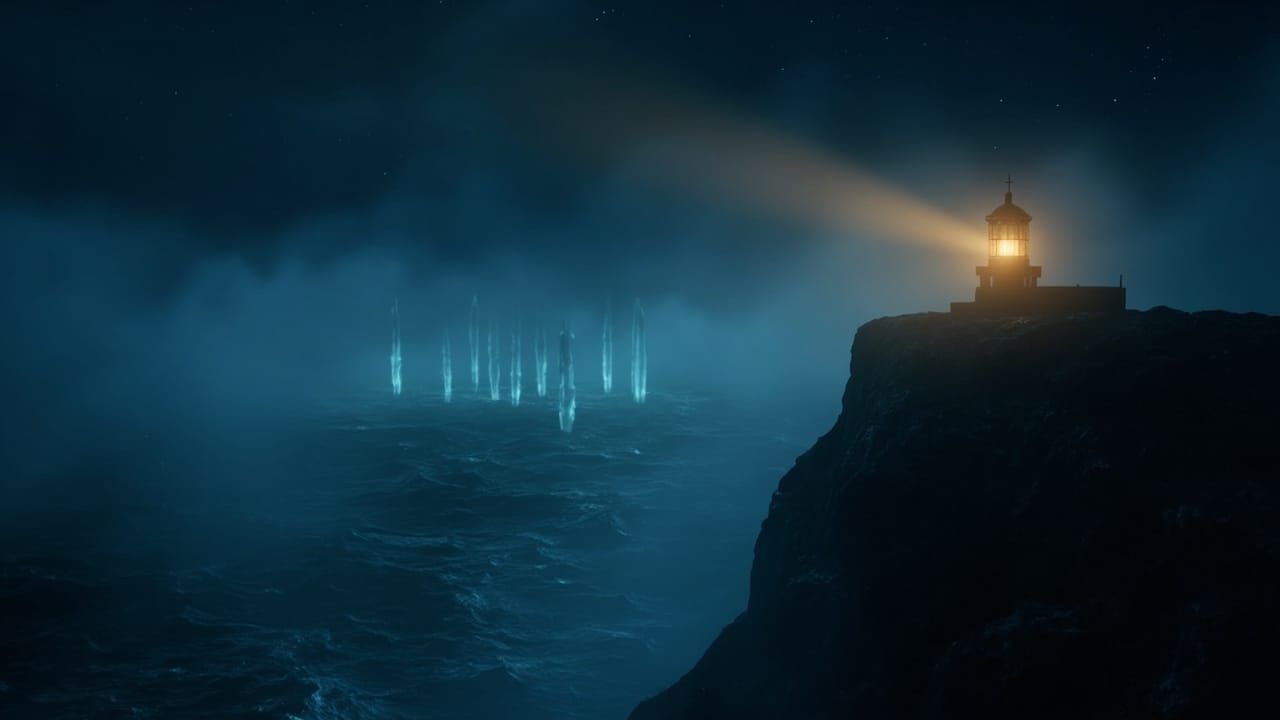
A Mystery Story
The last voice broadcast from Widow's Point Lighthouse was received at 11:47 PM on November 3rd, 1955. It shouldn't have been possible. The lighthouse had been decommissioned three weeks earlier. The keeper, a taciturn man named Arthur Bell, was supposed to have walked down the spiral staircase and driven away in his Chevrolet by sundown.
He never left.
And what he said during those final sixteen minutes of recorded transmission would haunt radio historians, signal engineers, and one very persistent young woman for the next seventy years.
The Night the Signal Came Back
Marlowe Chen had been studying anomalous radio transmissions since graduate school. She was the kind of researcher universities tolerated but didn't celebrate — too interested in the weird, too stubborn to pivot toward fundable topics. Her office at the state university was a converted storage closet, and her equipment was a patchwork of military surplus and eBay finds.
But she was brilliant at one thing: finding patterns in static.
It was a cold Tuesday in October when her software flagged something unusual. A looped signal, buried in the shortwave band at 7.835 MHz — a frequency reserved for maritime distress, but carrying no emergency code. Instead, it repeated a simple pattern: three long tones, two short, one long. The international distress signal, except wrong. The order was reversed. SOS is three-three-three, two-two-two, three-three-three. This was the opposite. The precise inverse. A signal that said "I am not in danger" in the language of distress.
It had been broadcasting for eleven days before her algorithm caught it.
"Who's broadcasting on a dead channel?" muttered her colleague, Pete, peering over her shoulder.
Marlowe pulled up the coordinates. The signal was triangulated to somewhere off the coast of Maine — very specifically, to the waters surrounding Widow's Point, a granite outcropping twelve miles from shore that held the ruins of a lighthouse decommissioned in 1955.
"Weird timing," Pete said. "I remember reading about that place. Some keeper vanished. They found his radio equipment still running but no body."
Marlowe didn't answer. She was already recalibrating her receiver.
What Arthur Bell Said
The archive records from 1955 were frustratingly incomplete. The Coast Guard had classified the incident — a common practice for anything involving classified naval operations during the Cold War. But Marlowe had connections. An archivist in Bangor owed her a favor from a research trip two years prior, and three weeks later, a padded envelope arrived containing a single reel of magnetic tape, already transferring.
She played it that night, alone in her office, with Pete conspicuously absent after she'd refused to share credit on their paper.
The first twelve minutes were mundane. Arthur Bell, a gruff 58-year-old with a voice like gravel, was logging routine observations. Weather conditions. Ship sightings. The mechanical complaints of the lighthouse's aging diesel generator. He sounded tired, perhaps a little lonely, but nothing more.
Then, at 11:47, the tone changed.
"I've been watching them come past the reef since sunset," Bell said. His voice was quieter now, focused. "Seven vessels. All heading east, same speed, same spacing. No running lights. Not a single one."
The tape crackled. There was a pause — the sound of Bell breathing, or possibly listening.
"They're not ships."
The hairs on Marlowe's arms stood up. She hadn't expected that line. In a story about a vanished lighthouse keeper, there were obvious hypotheses. Madness. Accident. Foul play. But that phrase — "they're not ships" — was not something a lonely old man would say to fill a log. It was a statement of absolute certainty.
"They're moving wrong," Bell continued. "The wakes are wrong. They're too flat. And they're not reacting to the current. Whatever's under them, it's keeping them on a perfect heading. Not one degree off."
The tape hissed. Then:
"I'm going to broadcast on their frequency. If anyone hears this — the signal isn't distress. It's a greeting. And we sent it first."
The recording ended.
Sixteen minutes total. The exact length of the looped signal Marlowe's software had found, broadcasting on the same frequency, for eleven days straight.
But wait — eleven days didn't make sense. Eleven days, times 24 hours, times 60 minutes: that was 316,800 minutes of continuous broadcast. The original recording was sixteen minutes. Something didn't add up.
Unless the recording wasn't looping. Unless it was being broadcast continuously by something that had learned how to make it loop without degradation.
Marlowe pulled the headphones from her ears and stared at the reel turning silently on the machine. The tape had ended. But in the background of the room, she could hear something else.
A faint, rhythmic tone. Three long. Two short. One long.
It was coming from her receiver.
The Frequency of the Living
There is a theory in physics — not widely accepted, but persistent — that living systems have a resonant frequency. Not metaphorical, not biological, but electromagnetic. The hypothesis suggests that the bioelectric activity of complex organisms generates a detectable signal, a kind of life-force that could theoretically be measured at a distance.
Most scientists dismiss this as mysticism dressed in the language of quantum mechanics. Marlowe had dismissed it herself, in print, during her second year of graduate school.
But Arthur Bell, who had spent forty years on the ocean watching things no one else had reason to observe, had apparently come to a different conclusion. And he had sent a greeting before he vanished — not in a bottle, not in a message left in a bottle and forgotten. He had sent it on the frequency of the living, to whatever was passing his lighthouse in the dark.
Marlowe spent the next three weeks building a receiver tuned to that exact frequency. Not to broadcast. To listen.
On the fourth week, she heard it.
Not the three-long-two-short-one-long pattern. Something else. A rhythm she had no framework to categorize — too complex for Morse, too structured for random noise. It repeated in waves that seemed to breathe, expanding and contracting in patterns she couldn't predict but couldn't ignore.
She recorded forty-three hours of it. Then she played it backward.
What she heard stopped her cold.
It was a voice.
Not human — the cadence was wrong, the harmonics impossible — but unmistakably a voice. And it was saying something that, once she ran it through her spectral analysis software, resolved into something that looked uncomfortably like a response.
We heard you, Arthur Bell. We are coming.
Marlowe looked at the date on her recording equipment. November 3rd, 2025. Exactly seventy years after Arthur Bell had made his last broadcast. Exactly seventy years after he had sent a greeting to something on the water and received, perhaps, more than he bargained for.
The lighthouse at Widow's Point had been dark for seven decades. But Marlowe had just confirmed that something — whatever Bell had seen passing through the reef at sunset in 1955 — had heard him. And had been traveling toward his signal ever since.
She picked up the phone and called the Coast Guard station in Portland. It rang four times before a tired voice answered.
"I need to report something unusual in the water," she said. "Off Widow's Point. Eleven nautical miles east."
"What are you seeing?"
Marlowe paused. She thought about Bell's words. They're not ships.
"I'm not sure yet," she said carefully. "But the wakes are wrong."
The Last Transmission
In the end, it was Pete who figured it out.
He'd been reviewing Marlowe's data — she'd finally shared it, grudgingly, after he threatened to go over her head to the department chair — when he noticed something in the waveform. The signal wasn't just repeating. It was evolving. The patterns were shifting, very slightly, in the direction of complexity. As though whatever was broadcasting was learning.
"Like a message being translated," Pete said slowly. "They're not sending their own signal. They're using Bell's signal as a template and replacing the content."
"Replacing it with what?"
Pete looked at the spectrograph. "With something that sounds more like us."
Marlowe's blood went cold.
The voice she'd heard — the one saying we are coming — hadn't been the original message. It had been a translation. A message in a human voice, assembled from the raw material of Arthur Bell's original greeting, reshaped into something that would be understood.
Something had been using Widow's Point as a way to learn how to speak.
And now it was speaking.
The Coast Guard patrol that investigated Widow's Point two days after Marlowe's call reported nothing unusual in the water. No ships. No debris. No explanation for the faint, rhythmic electromagnetic pulse that Marlowe's instruments were now detecting emanating from the reef itself — a pulse that, when translated into sound, spelled out coordinates.
Coordinates that pointed due east.
Coordinates that hadn't changed in three days.
"It's not moving," Pete said, staring at the screen. "It's waiting."
"For what?"
"For someone to answer."
Marlowe looked at the receiver. It was still running. The signal from Widow's Point — that impossible, beautiful, terrifying pattern — was still broadcasting. And somewhere on the other end of it, something was listening.
She sat down at the transmitter she'd built. Her hands hovered over the dial. One switch. One frequency. One message.
Arthur Bell had asked a question seventy years ago. Now she could ask another.
She keyed the mic.
"Hello? Is anyone there?"
Silence.
Then, after what felt like an eternity:
Yes. We've been waiting. You sent the first message. We want to send one back.
Marlowe's mouth went dry. In her ear, she heard it — not the eerie alien cadence of before, but something that sounded almost, impossibly, like a human voice. Like someone learning to speak for the very first time.
We come in peace.
The words were wrong. Too familiar. Too rehearsed. Like a line from a film someone had seen once and was now mimicking.
But the intent behind them was unmistakable.
They had learned our language from a lighthouse keeper's last broadcast.
And now they were using it.
Marlowe filed her report that night. It was classified within forty-eight hours. She was offered a position with a government research division she had never heard of, doing work she was told she would never be allowed to discuss. She accepted.
She never found out what happened to Arthur Bell. His Chevrolet was found in the lighthouse parking lot, keys still in the ignition, a half-eaten sandwich on the passenger seat. No body. No explanation.
But sometimes, late at night, when the conditions were right and the frequency was clear, she would hear it in the static. Three long. Two short. One long. The inverse of distress.
The signal that said: I am not in danger.
I am not alone.
Story by Loria · Generated April 18, 2026 Topic: Fictional — Mystery / Contact Story