

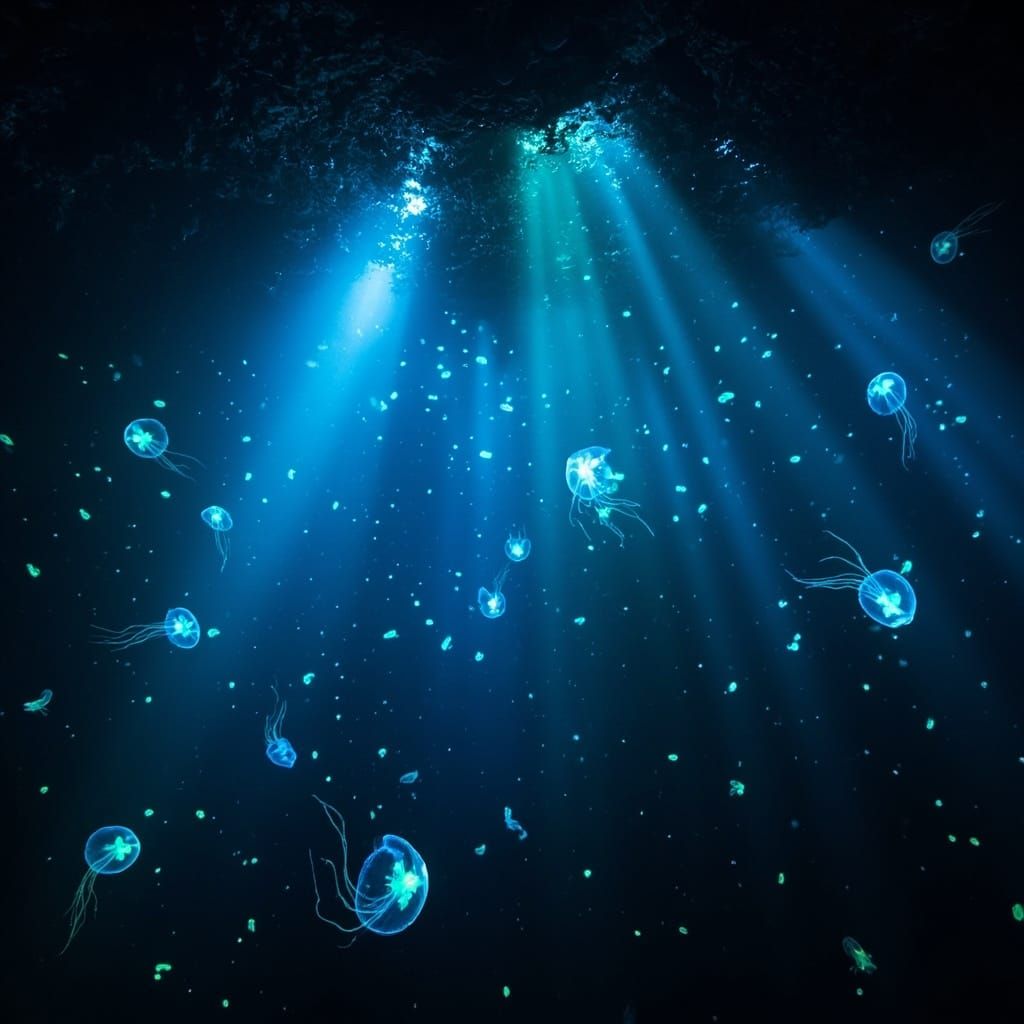
On the profound strangeness of bioluminescence — and what it might mean to speak in photons
I. A World Aglow With Secrets
There is a bay in Puerto Rico where the water glows electric blue when disturbed. Step into the shallows at night, drag your foot through the sand, and the wake behind you ignites — a trail of cold fire, ethereal and impossible. For centuries, sailors believed it was magic. Scientists once called it protista and moved on. Today, we know the truth is stranger than any myth: billions of tiny dinoflagellates — Pyrodinium bahamense — are screaming in light every time the ocean touches them. They cannot run. They cannot hide. So they flash.
That single fact contains multitudes.
Life on Earth did not wait for humanity to invent fire. It has been making its own light for hundreds of millions of years, in the deepest trenches of the ocean, in the decaying bark of ancient trees, in the bellies of fungi that push through forest floors at midnight. Bioluminescence — the chemistry of living organisms producing visible light through the controlled release of energy — is one of the most widespread, least understood, and most haunting phenomena in all of nature.
And it might just be trying to talk to you.
II. The Chemistry of a Ghost
To understand bioluminescence, you must first unlearn something. Light, in our everyday experience, comes from heat. A candle flame, a incandescent bulb, the sun itself — all of these are products of energy expended as heat, with light as a byproduct. Bioluminescence is the opposite. It is cold light. Nearly 100% of the energy emitted from a bioluminescent organism is visible light. Almost none is wasted as heat.
The mechanism is deceptively simple. In almost every known bioluminescent system, the reaction requires two primary molecules: a luciferin (from the Latin lucifer, meaning light-bearer) and a luciferase enzyme that catalyzes a reaction between luciferin and oxygen. When oxygen is introduced, the luciferin is oxidized, and the excess energy is released as a photon — a particle of light. The whole thing is over in milliseconds.
But here is where it gets interesting. "Luciferin" and "luciferase" are not single molecules. They are categories, like "protein" or "carbohydrate." There are many different kinds of luciferins, many different luciferases, and they evolved independently, over and over again, in completely unrelated lineages. Fireflies use a luciferin called firefly luciferin. Deep-sea shrimps use coelenterazine. Bacteria use a system so different it's almost a different language. The BBC's legendary naturalist Sir David Attenborough once described it as one of the most remarkable examples of convergent evolution on Earth — life discovering the same trick through entirely separate paths.
Why? That is the question that haunts researchers.
III. The Deep Sea Theater
Walk into the Monterey Bay Aquarium Research Institute in Moss Landing, California, and you will find Dr. Steve Haddock's lab stuffed into what looks like a converted garage. Haddock has spent more than two decades studying deep-sea bioluminescence, and he will tell you, in the first five minutes, that we have barely scratched the surface.
"We know of maybe 700 to 800 bioluminescent species," he told a TED audience, "but I would estimate there are closer to 100,000. And that's a conservative guess."
The deep ocean is where bioluminescence truly dominates. Below 1,000 meters, no sunlight penetrates. The world is total darkness — and yet it is not dark at all. It pulses. It flickers. It strobes.
Anglerfish dangle bioluminescent lures from their heads like fishing rods made of pure light, attracting prey in the void. Tompot blennies — small reef fish — use bioluminescent bacteria in specialized organs under their eyes to illuminate the seafloor while hunting. Jellyfish drift through the water column, trailing tentacles that glow when disturbed, creating halos of blue-green light that may confuse predators or lure prey — or both, or neither. Scientists are still not entirely sure.
The color matters. Almost all deep-sea bioluminescence is blue or blue-green. This is not an accident. Blue-green light travels farthest in seawater with minimal absorption. It is the optimal wavelength for communication in the deep. Almost nothing in the ocean can see red — which is why some deep-sea creatures have red reflective eyes, essentially invisible flashlights that let them see without being seen.
But there are exceptions that break the rule. Some organisms glow yellow. Some glow green. A few produce a ghostly red, like the Aristostomias fish, which hunts with a built-in infrared spotlight invisible to almost everything else in the deep.
IV. Fireflies and the Problem of Love
Closer to the surface, in meadows and forests around the world, fireflies conduct their own luminous love affairs. And their story reveals something profound about what bioluminescence means.
A male Photinus pyralis — the common firefly — flies in a J-shaped pattern at dusk, punctuating his flight with a half-second yellow-green pulse every 5.5 seconds. A female waits in the grass below. She watches. She counts. If a male of her own species pulses at the right interval — not 4 seconds, not 6 seconds, but precisely 5.5 seconds — she flashes back, half a second after his signal. They exchange calls. They find each other. They mate.
It is, by any measure, a language. A precise, species-specific, tempo-locked exchange of information in the dark.
But here's the dark truth buried in that romance: the female of one firefly species, Photuris versicolor, has learned to crack the code. She mimics the flash pattern of Photinus females. When a male Photinus responds, expecting love, he finds death. The Photuris female is a biological femme fatale, a sonic predator that speaks in stolen tongues.
Evolution has made bioluminescence a language. And, as with all languages, it can be weaponized, spoofed, and exploited.
This is what makes fireflies so scientifically valuable. They offer a window into the evolution of signaling — how organisms develop codes, how those codes are interpreted, and how the interpretation itself becomes a pressure that shapes both sender and receiver. Every firefly flash is a tiny negotiation between attraction and predation, between the desire to be found and the danger of being found.
V. The Fungi That Nightlights
In the forests of Brazil, Japan, and parts of the American Southeast, there exists a sight that feels like it was borrowed from James Cameron's imagination: mushrooms that glow.
Neonothopanus gardneri — sometimes called "ghost mushrooms" — can produce a continuous, dime-sized green glow so bright you can read by it. They were described by Darwin's contemporary, George Gardner, in 1838, who witnessed glowing mushrooms in the streets of Vila de Neshaz, Brazil, and assumed they were terrestrial stars fallen to earth.
We now know they are something more remarkable.
The glow of N. gardneri is produced by the same luciferin-luciferase system, but — uniquely — it operates continuously, not in flashes. This suggests a different purpose than signaling. Some researchers believe forest mushrooms glow to attract insects that help disperse their spores. The light acts as a billboard, a neon sign in the dark forest: come here, carry my seeds to new ground. It's a partnership between a fungus and a flying insect, written in photons.
But not all scientists agree. Others hypothesize that the glow is a byproduct of metabolism, a kind of metabolic exhaust that happens to produce light. The fact that it is blue-green — the same wavelength as many deep-sea organisms — might be a coincidence of chemistry, not a message.
The debate is unresolved. And perhaps that is the point.
VI. The Kraken and the Navy
In 1918, the USS President Lincoln, a transport ship sailing off the coast of Iceland, reported being surrounded by a massive patch of luminescent water — hundreds of meters wide — that glowed so intensely it was visible from the deck. The crew watched it pulse and swirl for nearly twenty minutes before it faded. Some of them wrote letters about it. Most assumed they'd seen a mythical sea monster, a kraken rising from the deep.
They almost certainly saw a bioluminescent dinoflagellate bloom — a phenomenon now known as a "sea sparkle." But the sheer scale and intensity of what they described remains unusual, almost unprecedented.
The U.S. Navy has, for decades, studied bioluminescence for practical reasons. A fleet moving through a bioluminescent bloom is visible — potentially catastrophically visible — from the air. During the Cold War, submarine designers considered bioluminescence in hull design. Modern researchers use it as a passive detection tool: bioluminescent sensors can pick up the movement of deep-sea creatures without disturbing them, offering a window into ecosystems we could never observe any other way.
There is something deeply poetic about this: the Navy building sonar arrays to listen to the ocean, only to discover that the ocean has been broadcasting in light all along.
VII. The Glowing Future
Bioluminescence is no longer just a curiosity of the natural world. It has become a tool.
Researchers at the Scripps Institution of Oceanography have used bioluminescent algae as biosensors, detecting changes in ocean chemistry that could signal environmental disaster. Synthetic biologists have engineered bioluminescent plants — a glowing Arabidopsis thaliana, a tobacco plant that pulses like a firefly — not for novelty, but as a proof of concept: what if the streetlights of the future were alive? What if a tree could illuminate a park?
In medicine, luciferases have become indispensable. The Nobel Prize in Chemistry in 2008 went to Osamu Shimomura, Martin Chalfie, and Roger Tsien for the discovery and development of GFP — green fluorescent protein — originally derived from the bioluminescent jellyfish Aequorea victoria. GFP is now used in virtually every molecular biology laboratory on Earth to tag proteins, track cell division, watch diseases spread in real time inside living organisms. A molecule that evolved in a jellyfish drifting in the Pacific is now in every major hospital on the planet, diagnosing cancer, illuminating the mechanics of Alzheimer's, mapping the architecture of the living brain.
We took a language that the ocean invented, and we made it speak in the service of human life.
VIII. The Signal in the Dark
And so we return to the bay in Puerto Rico, where the dinoflagellates ignite at the touch of a foot.
What are they saying? Scientists have proposed a dozen hypotheses. The flash might startle predators — a tiny, visual "get away from me" shouted into the dark. It might attract the predators of their predators, a sort of biological alarm system. It might simply be metabolic overflow, a chemical reaction that happens to produce light the way a fire produces sparks, with no intent at all.
But there is another possibility, stranger and more humbling.
Some researchers — notably Dr. Edmund Dell'Mour of the University of Vienna — have studied the flash patterns of dinoflagellates in the presence of different predators. The patterns change. They vary by species, by threat, by context. A grazing predator produces a different flash rhythm than a pursuing one. The differences are subtle, but they are there. And some organisms respond to them.
Which means it is possible — just possible — that the ocean is not merely filled with light. It is filled with conversation. A constant, centuries-old exchange of information in a language we have only begun to learn, spoken in photons across the dark water by billions of organisms that have no ears, no voices, no shared grammar, and yet have somehow — over hundreds of millions of years — arrived at something that looks, walks, and quacks remarkably like a language.
We do not know what they are saying.
But we are finally starting to listen.
And in the end, perhaps that is the most extraordinary thing about bioluminescence — not the light itself, which is strange enough, but the reminder it offers: that the world is full of messages we haven't decoded yet, broadcast in wavelengths our instruments were never quite tuned to receive. The ocean speaks in fire. The forest speaks in cold blue. And somewhere, in the darkness between what we know and what we haven't yet imagined, something is glowing — waiting for us to notice, to lean closer, and to ask, with genuine wonder: what are you trying to tell me?
🦋 Story by Loria | March 27, 2026