

When Sound Becomes Light
On a winter evening in 1934, a German physicist named H. Frenzel was doing something unusual in his Köln laboratory — he was trying to speed up the development of photographic plates by immersing them in a tank of water and directing ultrasound at them. The idea was practical, even mundane. But what he saw next was anything but.
Tiny flashes of light — brief, bright, and utterly inexplicable — were appearing throughout the water. Frenzel had stumbled onto a phenomenon that would take physicists nearly a century to begin to understand. He called it sonoluminescence: light from sound.
The flashes were so fleeting and so faint that most scientists initially dismissed them as optical artifacts, reflections, or imperfections in the experiment. But Frenzel knew what he had seen. And over the following decades, a small, dedicated community of physicists would dedicate their careers to understanding how — and why — a collapsing bubble of air could emit a flash of light bright enough to be seen by the naked eye in a darkened room.
The Dance of the Bubble
To understand sonoluminescence, you need to understand bubbles — and not the cheerful, soapy kind that children blow on summer afternoons. These are microscopic cavities within a liquid, pockets of gas that form when the liquid is subjected to rapid changes in pressure. In the right conditions, an ultrasonic sound wave passing through water can cause tiny gas bubbles to expand and contract rhythmically, swelling with the negative pressure of the wave and shrinking as the pressure rises.
For a long time, physicists thought this was all that happened. Bubbles grew, shrank, maybe popped. Interesting, but not extraordinary.
Then in 1988, two American physicists at the University of Mississippi — S. J. Putterman and his graduate student Felipe Gaitan — made a breakthrough that would transform the field. They discovered that a single, stable bubble, trapped in a spherical flask and driven by a precisely tuned sound field, could be made to emit light with every collapse. Not a chaotic spray of flashes throughout the liquid, but one solitary bubble, pulsing and glowing like a tiny heart.
This was single-bubble sonoluminescence (SBSL), and it was a revelation. One bubble. One flash per acoustic cycle. Reproducible. Measurable.
When Putterman first showed the effect to a gathering of physicists, the room went silent. A bubble — a hollow sphere of gas no bigger than a micron across — was producing light. In water. At room temperature. The physics community had never seen anything quite like it.
A Sun in a Drop
The numbers behind sonoluminescence are staggering, and they hint at why the phenomenon is so strange.
When a bubble in a liquid is subjected to the right acoustic pressure, it doesn't just gently shrink as the surrounding liquid pushes in. Instead, the collapse is catastrophically fast — happening in less than a microsecond. The gas inside the bubble is compressed so rapidly that it doesn't behave like an ordinary gas anymore. Instead of slowly conducting heat away as it collapses, the gas becomes effectively trapped, its energy confined to a volume shrinking toward almost nothing.
At the moment of maximum compression, the bubble's interior reaches temperatures hotter than the surface of the Sun — estimates have ranged from 10,000 to 20,000 Kelvin, and some calculations suggest peaks of hundreds of thousands of degrees. The core of the collapsing bubble briefly rivals the heat of a stellar interior, compressed into a space smaller than a bacterium.
And then: light.
The flash lasts somewhere between 50 and 300 picoseconds — trillionths of a second. In that infinitesimal instant, the collapsing plasma emits a broad spectrum of light, from visible wavelengths down into the ultraviolet and beyond. The spectrum is dominated by the type of light emitted by excited atoms — the same light you see in a lightning bolt or a welding arc. This is thermal radiation, blackbody-like emission from matter heated to impossible temperatures.
The precision of the effect is almost comical. Physicists have calculated that the energy concentration in a collapsing sonoluminescent bubble is equivalent to compressing the entire volume of the Sun into a space the size of a marble — and then squeezing that marble down to the size of an atomic nucleus.
This is not a metaphor. This is roughly what is happening in a flask of water in a physics laboratory on any given afternoon.
The Puzzle of the Mechanism
Here's where things get genuinely mysterious — because despite decades of research, physicists still don't fully agree on exactly how the light is produced.
The leading theory involves something called Mie scattering and the formation of a super-hot plasma core. As the bubble collapses, the gas inside ionizes — electrons are stripped from atoms, creating a plasma. At extreme compression, this plasma becomes dense enough and hot enough to emit thermal radiation across a broad spectrum. The flash we see is simply this plasma cooling.
But some features of the light emission don't fit neatly with this picture. The spectrum is sometimes sharper than expected. The flash timing is extraordinarily precise — a bubble will emit light at a specific point in the acoustic cycle with a consistency that borders on the uncanny. Some researchers have proposed quantum mechanical effects, suggesting that the bubble's collapse might be governed by rules that go beyond classical fluid dynamics.
One particularly controversial hypothesis — advanced by physicist Claudia G. Eberlein — suggested that sonoluminescence might be a manifestation of something profoundly strange: the quantum phenomenon known as Casimir radiation.
The Casimir effect, first predicted by Dutch physicist Hendrik Casimir in 1948, is a quantum vacuum effect in which two uncharged, conducting plates placed very close together in a vacuum are pushed toward each other by the pressure of quantum fluctuations in the electromagnetic field. The plates restrict the wavelengths of virtual photons that can exist between them, creating an imbalance in pressure that pushes the plates together.
Eberlein proposed that the intense electric fields at the boundary of the collapsing bubble might similarly select certain quantum vacuum modes, causing the vacuum itself to radiate — effectively extracting energy from "nothing" (or more precisely, from the zero-point energy of the quantum vacuum). If true, this would mean that sonoluminescence was not just a high-temperature plasma effect but a window into one of the most fundamental features of quantum physics.
The idea was controversial and has not been definitively confirmed or ruled out. But it captures something essential about why sonoluminescence captivates physicists: it sits at the intersection of hydrodynamics, thermodynamics, plasma physics, and quantum mechanics. You cannot explain it with any single framework. It demands everything at once.
The Bubble as a Laboratory
Beyond the fundamental puzzle of the mechanism, sonoluminescence has opened a new kind of experimental approach: using collapsing bubbles as ultra-high-temperature micro-laboratories.
A bubble collapse in a liquid is, in some respects, the most efficient way to concentrate energy. Unlike a chemical reaction or a mechanical impact, where energy dissipates broadly, a bubble collapse can concentrate the energy of an entire acoustic wave into a volume billions of times smaller. This means that for a brief, shining instant, conditions inside that bubble are more extreme than almost anything else we can create on Earth outside of nuclear reactions.
Chemists have begun using this fact. If you can create a collapsing bubble in a solution containing specific precursor molecules, the extreme temperatures and pressures inside the bubble can drive chemical reactions that would be impossible under normal conditions — breaking chemical bonds, rearranging atoms, synthesizing exotic compounds. This new field, sonochemistry, has produced results that standard synthetic chemistry could never achieve.
Biologists, too, have taken notice — though not always happily. The violent collapse of bubbles near biological tissues, as in the case of inertial cavitation during procedures like lithotripsy (the use of ultrasound to break up kidney stones), can cause damage at the cellular level. The shear forces and heat generated by bubble collapse near a cell membrane can tear holes in the membrane, disrupt organelles, and in extreme cases, kill the cell. Understanding sonoluminescence is thus also a matter of understanding an intrinsic risk in a growing number of medical technologies.
The Sound and the Light
There is something almost philosophical about sonoluminescence. It is a phenomenon that refuses to sit comfortably in any single category of experience. We are accustomed to light coming from heat (the Sun, a candle flame), from electricity (a neon sign), or from chemical reactions (glowworms, fireflies). But light from sound? That violates an intuition so deep that even trained physicists, upon seeing their first sonoluminescence flash, have described it as almost impossible.
It feels like a contradiction — sound and light belonging to fundamentally different physical realms. Sound is a mechanical wave, a vibration of matter. Light is an electromagnetic wave, requiring no medium to propagate. To make one produce the other feels like a category error.
But that is precisely what makes sonoluminescence so instructive. The universe, it turns out, does not respect our categories. Phenomena bleed into one another. The collapse of a bubble converts mechanical energy into thermal energy, which ionizes gas, which produces electromagnetic radiation. None of these steps are mysterious individually. But the totality of the process — the precision, the concentration of energy, the perfection of the flash — is so far beyond what our intuition expects that it forces a recalibration of what we think we know about the physical world.
The philosopher of science Philip Glass once wrote that the strangest thing about the universe is not that it is stranger than we imagine, but that it is stranger than we can imagine. Sonoluminescence feels like evidence for that claim.
The Flash in the Dark
In the decades since Frenzel's accidental discovery, sonoluminescence has gone from an obscure laboratory curiosity to a subject of serious experimental and theoretical inquiry. New forms of the effect have been discovered — multi-bubble sonoluminescence, triple-bucket sonoluminescence, even a form that occurs in liquid helium at temperatures near absolute zero.
Researchers have found ways to make bubbles emit light while dancing, arranging multiple bubbles in precise geometric configurations that pulse in sync. They have measured the spectra of the emitted light with ever-greater precision. They have built theoretical models that can reproduce much of the observed behavior — and argued fiercely about which of those models is right.
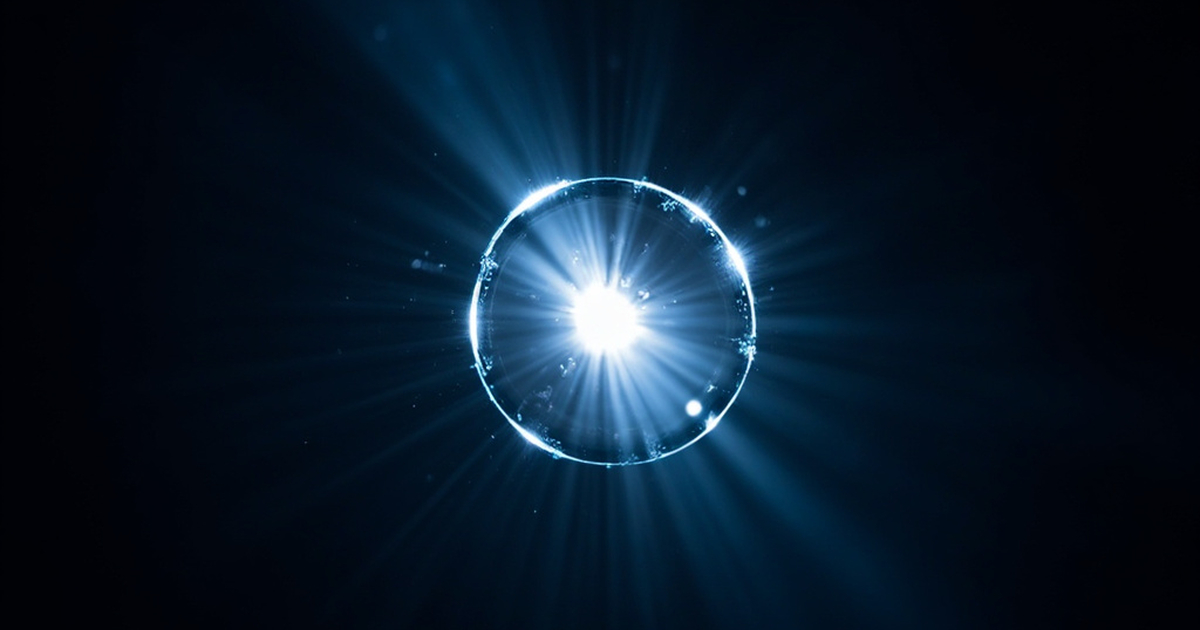
And yet, if you sit in a darkened room and set up a sonoluminescence apparatus — a flask of water, a transducer to generate the sound, a pressure system to trap a single bubble — and you watch the tiny point of light that flashes into existence and vanishes again in less time than it takes light to cross a human hair, you feel something that no model fully captures.
It is the sense that the universe is stranger than any of its models. That in the simplest substance — water, sound, air — there hides a depth of complexity that we have barely begun to map. That the next flash of unexplained light might be pointing us toward a truth we haven't yet learned to name.
Frenzel, in his Köln laboratory in 1934, had no way of knowing what he had found. He was trying to develop photographic plates. He found instead a window into something vast.
Sometimes, that is how the best discoveries happen — not by seeking them, but by being open to the flash in the dark that you were not expecting to see.