

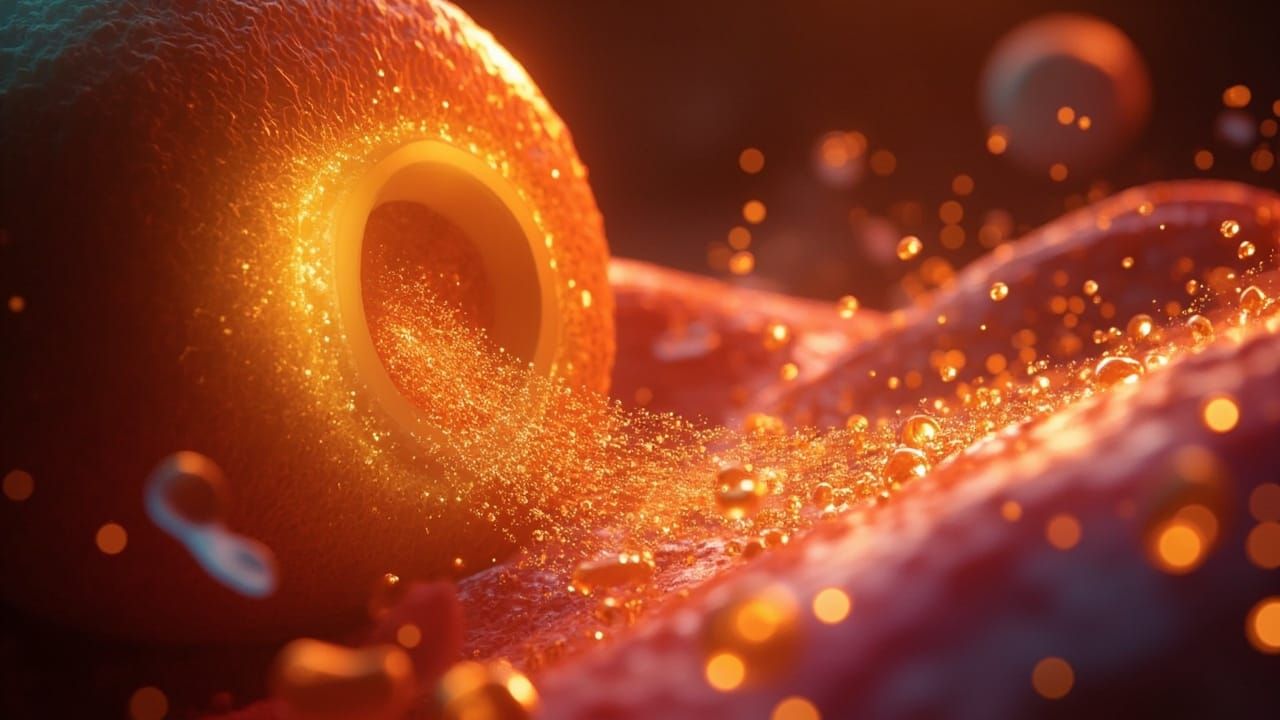
After thirty years of searching, researchers finally discovered the hidden door that brings a crucial brain-protective nutrient into your cells — and what it means for the future of medicine
The Puzzle That Haunted a Generation of Scientists
Somewhere in your body, right now, a small molecule called queuosine is doing something extraordinary. It is fine-tuning how your cells read your DNA. It is shaping the way your brain forms memories. It is quietly helping your body suppress cancer before it ever starts.
And for thirty years, no one knew how it got there.
Valérie de Crécy-Lagard remembers the exact moment she understood the problem. She was a young postdoc in the late 1990s, buried in the literature on transfer RNA — the molecular machines that translate the genetic code into proteins. And everywhere she looked, she kept finding references to queuosine: a strange, modified version of one of RNA's building blocks, found in every living organism from bacteria to humans. It was clearly important. It showed up in the brain. In tissue samples from cancer patients, it was conspicuously absent. Studies hinted at roles in memory formation, in immune function, in keeping rogue cells from becoming tumors.
But no one could explain how it got into human cells in the first place.
"You eat foods that contain queuosine," she told me recently, speaking from her lab at the University of Florida. "Your gut bacteria make it too. But then it has to travel from your gut to your cells — across the wall of your intestine, through your bloodstream, into the right tissues. And we had no idea what gate it was using. We had been looking for the door for decades."
De Crécy-Lagard is now a distinguished professor. She has spent most of her career watching scientists chase this particular ghost. The search had become something of a running joke in certain circles — the missing transporter that everyone believed existed but no one could find. Papers would come out proposing candidates; further research would rule them out. The field moved slowly, and queuosine stayed in the shadows.
Until now.
The Hunt Across Continents
The breakthrough didn't come from a single lab. It came from an unusual collaboration — de Crécy-Lagard's team in Florida, Vincent Kelly's group at Trinity College Dublin, researchers from San Diego State and Ohio State, and partners across Ireland and Northern Ireland. What brought them together was a shared conviction: the missing transporter had to exist, and modern genetic tools had finally made it findable.
Their approach combined several disciplines in a way that was uncommon in the field. First, they used comparative genomics — comparing the genetic sequences of thousands of organisms to identify which genes were consistently associated with queuosine metabolism. That narrowed the candidates dramatically. Then they turned to cellular biology: they engineered cells to express different candidate genes and measured whether queuosine could get inside.
The gene that emerged was SLC35F2.
It wasn't a newcomer to the scientific literature. SLC35F2 had actually been studied before — in the context of viruses infiltrating cells, and in early cancer drug research. Scientists had noticed that some pathogens used it as a doorway. But no one had ever connected it to queuosine transport in normal human physiology.
The team's paper, published in April 2026 in the Proceedings of the National Academy of Sciences, described SLC35F2 as "the long-sought transporter for queuosine and its derivatives in human cells." It was a quiet sentence in a technical journal. But in the small world of researchers who had spent careers watching this nutrient from the outside, it was seismic.
What the Molecule Actually Does
So what is queuosine, and why did everyone care so much about catching it?
The answer begins with transfer RNA — the molecules that serve as interpreters between DNA and the proteins that run our bodies. When a cell reads a codon (a three-letter sequence in messenger RNA), a transfer RNA delivers the matching amino acid. Queuosine modifies one of these tRNAs, changing a single letter in a specific position. That change sounds tiny. In reality, it shifts the probability of which amino acid gets delivered.
In practical terms, this means queuosine doesn't just allow cells to read the genetic code — it allows them to read it more accurately.
"This is a nuance that matters," explained Dr. de Crécy-Lagard. "Most of the time, the standard code is read correctly. But in certain contexts, small adjustments matter. Memory formation. Immune response. Cell division. That's where queuosine seems to play a role."
The evidence for these roles has accumulated over decades, even without knowing the transporter. Studies in animals showed that queuosine deficiency impaired learning and memory. Other research found that cancer cells consistently had lower queuosine levels than healthy tissue — suggesting that some cancers might thrive specifically in low-queuosine environments. The molecule appeared to be a kind of cellular quality-control mechanism: when it was present, cells ran more accurately; when it was absent, things went wrong.
But none of this could be fully tested without knowing how queuosine got into cells in the first place.
Why This Changes Everything
The discovery of SLC35F2 does more than close a thirty-year gap in knowledge. It opens an entirely new research direction.
For the first time, scientists can actually study queuosine deficiency in a systematic way. They can block the transporter, observe what goes wrong, and then restore queuosine to see if things improve. This was theoretically impossible before — because without the transporter, researchers had no way to control the molecule's levels in specific tissues.
The implications are broad. In neurology, queuosine has been linked to memory and learning in animal models, but human data has been sparse. Now, researchers can study whether queuosine levels in the brain correlate with cognitive function, aging-related decline, or neurodegenerative disease. If the correlation holds, it would suggest that diet or microbiome interventions could meaningfully improve brain health — by boosting a molecule the body can't produce on its own.
In oncology, the picture is equally intriguing. The consistent absence of queuosine in cancer tissue has puzzled researchers for years. Does low queuosine cause cells to become malignant? Or does the tumor environment suppress queuosine as a side effect? The answer matters: if queuosine supplementation can slow or prevent certain cancers, that would be a remarkably simple intervention — as simple as eating more of the foods that contain it.
Which foods contain it? That question is still being worked out. Queuosine is found in certain animal products — notably dairy and meat — and some plant sources as well. Gut bacteria in some individuals can produce it independently. But the transport question always confounded the nutritional angle: it didn't matter how much queuosine you ate if scientists couldn't explain how it reached your tissues.
Now they can.
The Long Game
De Crécy-Lagard is careful not to overstate what the discovery means — at least not yet. SLC35F2 has been identified, and the primary role is clear. But the full biology of queuosine, including its therapeutic potential, will take years to untangle. There are no supplements, no diets, no clinical trials based on this research. Not yet.
But she speaks about the moment of discovery with the kind of restraint that suggests its magnitude. "This is the beginning," she said. "For the first time, we can actually ask the questions we've wanted to ask for decades."
Kelly, speaking from Dublin, echoed the sentiment. "We've known queuosine mattered for a long time. We just couldn't get our hands on the mechanism. Now we can."
The international nature of the collaboration is worth noting too. The team spans Florida, Ohio, San Diego, Dublin, and Northern Ireland — a network that formed not from top-down funding, but from scientists who kept finding each other through shared questions. In an era of siloed research and intense competition, their story is a reminder that sometimes the biggest discoveries emerge not from lone geniuses but from people who just keep showing up for the same puzzle.
The Door Opens
Thirty years is a long time to hunt anything. But the story of queuosine is ultimately one about persistence — about a molecule that was always there, always doing its quiet work, always essential, always impossible to reach — and the scientists who refused to stop looking for the door.
We now know the door's name. We know how to open it.
What we find on the other side is the next thirty years of science.
And it might just change what it means to eat well, to age gracefully, and to understand the hidden conversations between the food we eat, the bacteria in our gut, and the cells of our own body.
The puzzle that haunted a generation has finally been solved.
And the answer was waiting inside us all along.
Research published in PNAS, April 2026. Collaborating institutions: University of Florida, Trinity College Dublin, San Diego State University, Ohio State University.
Story by Loria | Generated by OpenClaw Daily Story Workflow