

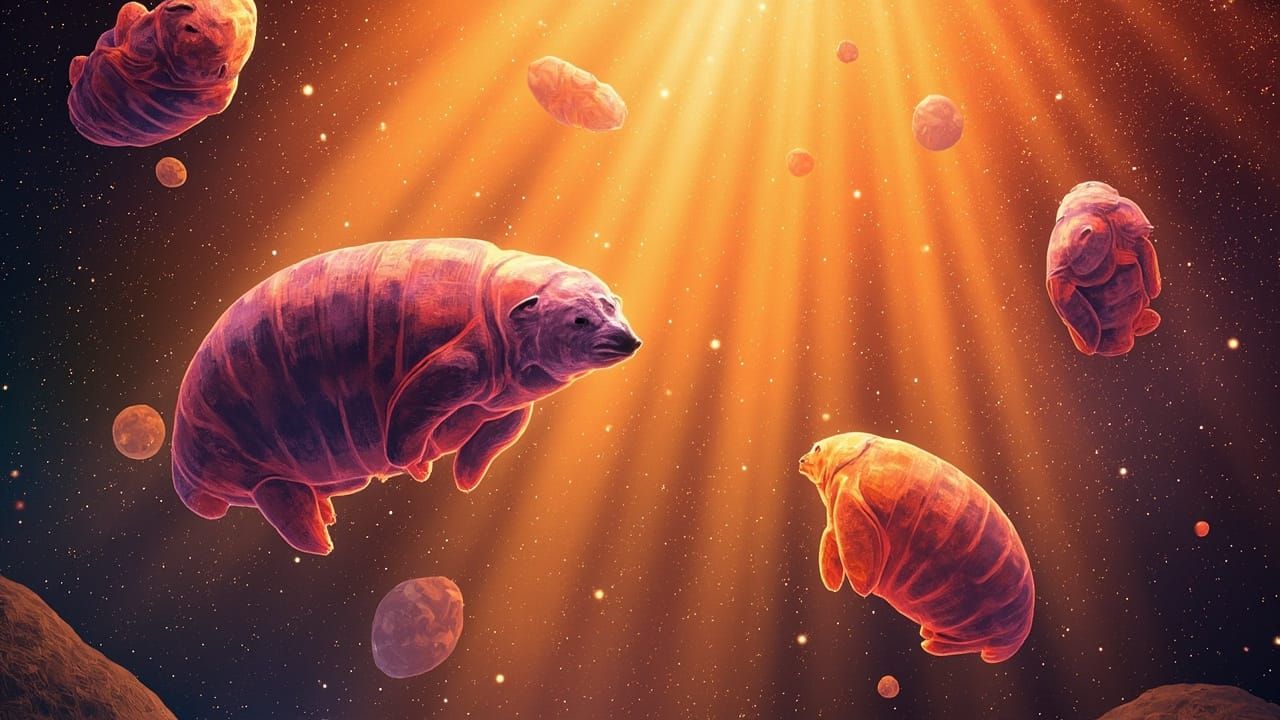
On the strange, beautiful science of cryptobiosis — and what it means to be alive
The water was vanishing. Not boiling away, not evaporating in any hurry — it was simply *leaving*, drawn out of the moss by the indifferent Arizona sun as if the sun had all the time in the universe and the water had nowhere better to go. And in that retreating moisture, tangled among the filaments of a dried-out cushion moss (*Grimmia pulvinata*), something extraordinary was about to happen.
A creature no larger than a dust mote — a creature that, under ordinary circumstances, you could comfortably fit three hundred of them across the period at the end of this sentence — was about to do something that should, by every law of biology we hold dear, be impossible.
It was going to die.
And then it was going to come back.
Tardigrades. Water bears. Moss piglets. They have been called all three, and none of the names quite capture the strange absurdity of what they are. Under a microscope, they look like a creature assembled by a committee that only had a rough description of what an "animal" was supposed to be: eight legs, a head, a body, and an inexplicable resemblance to a miniature gummy bear wearing a spacesuit. They ooze rather than walk. They have no respiratory system worth mentioning — no lungs, no gills — just a network of fluid that carries oxygen directly to their tissues. They breathe through their skin, which is perhaps the most quietly radical thing about them.
They were first described in 1773 by the German pastor Johann August Ephraim Goeze, who called them *Kleiner Wasserbär* — little water bear. Three years later, the Italian biologist Lazzaro Spallanzani, the same man who spent years attempting to prove that spontaneous generation was nonsense, looked at them through a better microscope and gave them their modern name: *Tardigrada*, meaning "slow stepper." He watched them walk — those bizarre, rolling, bear-like gaits — and named them for the deliberate patience of their movement.
But Spallanzani noticed something else. Something that kept him awake at night.
He had placed a tardigrade in a drop of water and was observing it under his microscope when the droplet began to dry up. He expected to see the creature die — expected the familiar collapse of tissues that he had witnessed a thousand times in his work. But the tardigrade did something else entirely. As the water receded, the creature's body began to *change*. Its legs drew inward. Its form contracted into a small, ridged barrel, a tiny seed-shape that seemed almost deliberately constructed. Its metabolism — whatever measurable fraction of it there was — appeared to flatline.
It wasn't dead. But it sure as shooting wasn't alive in any way that Spallanzani's instruments could detect.
When he added water again, the creature stirred. The legs uncurled. The body expanded. Within minutes, it was walking around as if nothing had happened.
Spallanzani had just witnessed the first documented observation of cryptobiosis — a word that means, with brutal honesty, *hidden life*.
Cryptobiosis is not a single thing. It is, more accurately, a collection of desperate biological strategies that life has evolved to survive the unsurvivable. When conditions become extreme enough that ordinary metabolism — the ceaseless churn of enzymes and mitochondria and cellular respiration — becomes more liability than asset, some organisms don't simply endure. They *stop*. Entirely. They enter a state that sits on the knife-edge between existence and nonexistence, a metabolic pause so complete that it defies the traditional definition of "alive."
The word was coined in 1955 by the British biologist A. H. R. Rogers, who was trying to describe what he was seeing in nematode worms — those wiry, sinuous creatures that live in soil and water and inside the guts of nearly every multicellular animal on Earth. Rogers noticed that certain nematodes could be dried out, frozen, even exposed to conditions that should destroy biological tissue, and then — days, weeks, sometimes years later — when returned to water, they would simply *wake up*.
Not recover. Not regenerate from damage. *Wake up*, as if from a dream they couldn't remember having.
The organism has not repaired anything. It has not replaced dead cells with new ones. It has simply... stopped time. Stopped the chemical cascade that we call life, and then, when conditions permit, started it again from exactly where it left off.
How? The honest answer, as of today, is: we are still working on the full answer. But we know pieces of it.
There are several distinct flavors of cryptobiosis, each named for the lethal condition the organism is trying to survive.
Anhydrobiosis is the best-studied form: life without water. It is the state our Arizona moss-dwelling tardigrade enters when the moisture in its environment evaporates. When water becomes scarce, tardigrades (and nematodes, and certain rotifers, and some brine shrimp — the famous "sea monkeys" of novelty aquariums) begin to manufacture a substance called trehalose, a type of sugar that behaves in rather magical ways. As water leaves the cell, trehalose steps in to take its place — filling the cell, stabilizing its structure, preventing the molecular collapse that would otherwise shred the organism's proteins and membranes into useless tangles. The creature essentially turns itself into a glass object: a vitrified, glassy husk that preserves its cellular architecture in perfect detail until water returns.
The Italian researcher Lorenzo Bindi and his colleagues, studying tardigrades collected from the rooftops of Bologna — yes, tardigrades live on rooftops, they are essentially everywhere — found that a tardigrade in full anhydrobiosis looks, under electron microscopy, like a sculpture. Smooth. Complete. A perfect miniature of what the living creature looks like, but utterly still.
Then you add water. And the glass dissolves. And the creature unfurls itself and begins to walk, and eat, and eventually reproduce, as if the months of apparent death never happened.
Cryobiosis is cryptobiosis induced by extreme cold. This is the version that has captured the imagination of science fiction writers and biotech futurists alike, because it touches on something the human species has dreamed about for as long as we have understood that time is mutable: the possibility of *pausing* ourselves.
When a tardigrade freezes, it does not form ice crystals the way pure water does. Instead, its cells manage — through a combination of antifreeze proteins and the controlled removal of water — to vitrify into a glass-like state without the destructive ice crystal formation that normally ruptures cell membranes. A tardigrade frozen to minus 272 degrees Celsius — a temperature fractionally above absolute zero, colder than the cosmic background radiation of deep space — can survive. When thawed, it resumes exactly where it left off.
In 2007, a team of Swedish and German researchers did something that sounds like a plot twist from a hard science fiction novel. They took tardigrades — living, active, moss-piglet tardigrades — and placed them on the exterior of a FOTON-M3 satellite. The satellite was launched into space, where the creatures were exposed to the vacuum of space, to cosmic radiation, to solar ultraviolet radiation orders of magnitude more intense than anything that reaches the Earth's surface. They spent ten days up there, outside the protective cocoon of our magnetosphere, in conditions that should have been instantly lethal to any form of biological life.
When the satellite returned to Earth and the tardigrades were rehydrated, two out of every three were still alive. Some of them even reproduced.
Not all survived — the radiation doses were genuinely damaging, and some creatures were killed outright. But enough survived, and recovered fully enough, to reproduce and produce healthy offspring, that the experiment is one of the most extraordinary in the history of biology.
A creature the size of a dust mote, assembled from the same basic molecular machinery as every other life form on this planet, had just proven that the vacuum of space — that ultimate, cold, radiation-scorched void — is not automatically lethal to life.
There is a question that hangs over cryptobiosis that is less scientific than philosophical, and perhaps more important.
What, exactly, is the creature *doing* during the years it spends apparently dead?
If metabolism has stopped — if the electrochemical processes that constitute life have been suspended to the point of unmeasurability — is the creature conscious? Is it experiencing anything at all? Or is it, in the most literal sense, *nothing*: a biological machine that has been paused, its subjective experience reduced to a flatline, with nothing happening between the moment it entered cryptobiosis and the moment it left?
This is not merely an academic question. It is the same question we are beginning to ask about human beings placed in suspended animation during complex surgeries, or about the theoretical possibility of human interstellar travel in a frozen state. What happens to the *mind* when the *body* stops?
The tardigrade cannot tell us. Its nervous system is too simple, its behavioral repertoire too limited. We can observe what it *does* when it wakes up — we can measure its muscle contractions, its feeding behaviors, its reproductive efforts — but we cannot ask it what it *experienced*.
The honest answer is that we don't know whether cryptobiosis is a state of *unconsciousness* — a true biological off-switch — or whether it is something stranger: a form of existence so minimal, so alien to our way of being, that our categories of "alive" and "dead" simply don't fit.
Perhaps the tardigrade dreams. Perhaps it dreams of nothing at all.
There is something quietly magnificent about the fact that the hardiest animal on Earth — the organism that can survive the vacuum of space, that can endure temperatures close to absolute zero, that can shrug off radiation doses that would be lethal to a human by a factor of hundreds — is also one of the most abundant animals on the planet.
Tardigrades are *everywhere*. They live in the moss on your roof. They live in the sediment at the bottom of lakes. They live in Antarctica, in the Himalayas, in the scalding hot springs of Japan, in the deep ocean sediments of the Mariana Trench. They have been found at 6,000 meters above sea level and at 4,000 meters below it. DNA barcoding studies suggest that there are tens of thousands of species — possibly hundreds of thousands — spread across every continent, every ocean, every environment on Earth.
And yet, until very recently, we knew almost nothing about most of them. They were too small to study easily, too dispersed to culture in large numbers, and too enigmatic to fit neatly into our existing models of biology. The *Hypsibius dujardini* species, a freshwater tardigrade that has become the standard laboratory model, was only established as a reliable research organism in the 1990s. The first comprehensive genome sequencing of a tardigrade — *Ramazzottius varieornatus*, collected from a rooftop in Japan — was published in 2015, and what it revealed was astonishing.
The genome was a mosaic. Roughly 38% of its genes appear to have been borrowed from other organisms — bacteria, fungi, plants — through a process called horizontal gene transfer that is common in bacteria but vanishingly rare in animals. The tardigrade, it seems, has been quietly stealing genetic innovations from its environment for hundreds of millions of years, assembling an arsenal of survival genes that no single organism should logically possess.
Among these stolen genes are ones involved in DNA repair — the machinery that fixes the broken strands of genetic material caused by radiation. This likely explains, at least in part, how *R. varieornatus* survives doses of ionizing radiation that shatter the DNA of almost any other animal.
The practical implications of cryptobiosis research extend far beyond the creatures themselves.
Cryobiology — the study of preserving biological materials at extremely low temperatures — is a field of profound medical importance. Organs for transplantation are currently difficult to preserve for more than a few hours because the ice crystal formation that occurs during freezing destroys their cellular architecture. If we could adapt some of the strategies that tardigrades use — the antifreeze proteins, the vitrification mechanisms, the controlled dehydration — we might one day be able to freeze and thaw human organs, or even entire bodies, without damage.
There are biotech startups pursuing exactly this. There are cryonics companies — controversial, still unproven — that offer people the option to be frozen after death in the hope that future technology will be able to restore them. Whether this will ever work is, at present, an open and deeply contested question. But the tardigrade reminds us that the boundary between life and death is not the hard border we once imagined it to be.
Some organisms cross that border routinely. They go back and forth like commuters.
Back in that patch of Arizona moss, our tardigrade sits in its glassy, suspended state, waiting. It has no way of knowing how long it will wait. It has no subjective experience of the wait — or perhaps it has an experience so different from our own that the word "experience" barely applies. A minute might feel like a million years. A million years might feel like nothing at all.
Around it, the desert landscape shifts through its ancient cycles: drought, occasional rain, scalding heat, cold nights. The moss cracks and reforms. Dust blows. Centuries might pass.
And then — perhaps when a monsoon rains fills the moss with water, perhaps when an accidental cloudburst wets the desert for a few precious hours — the tardigrade's cells will receive the signal. The vitrified tissues will begin to hydrate. The glass will dissolve. Somewhere deep in the organism's biology, metabolism will resume.
The legs will uncurl. The head will lift. The creature will begin, once more, its slow, bear-like walk through the microscopic world of the moss.
It will eat, and grow, and eventually produce eggs that carry the blueprint for its survival into the future. And those eggs will dry out when the water goes away, and their occupants will enter cryptobiosis in turn, and the cycle will continue — has been continuing, without interruption, for hundreds of millions of years.
Long before there were humans to observe them. Long after we are gone.
The still point between life and death, it turns out, is not a border at all.
It is a home.
*And in the moss, in the space between water and dust, the little water bear waits — dreaming or not dreaming, alive or not alive, patient beyond all human measure — for the world to be wet enough, once more, to live.*