

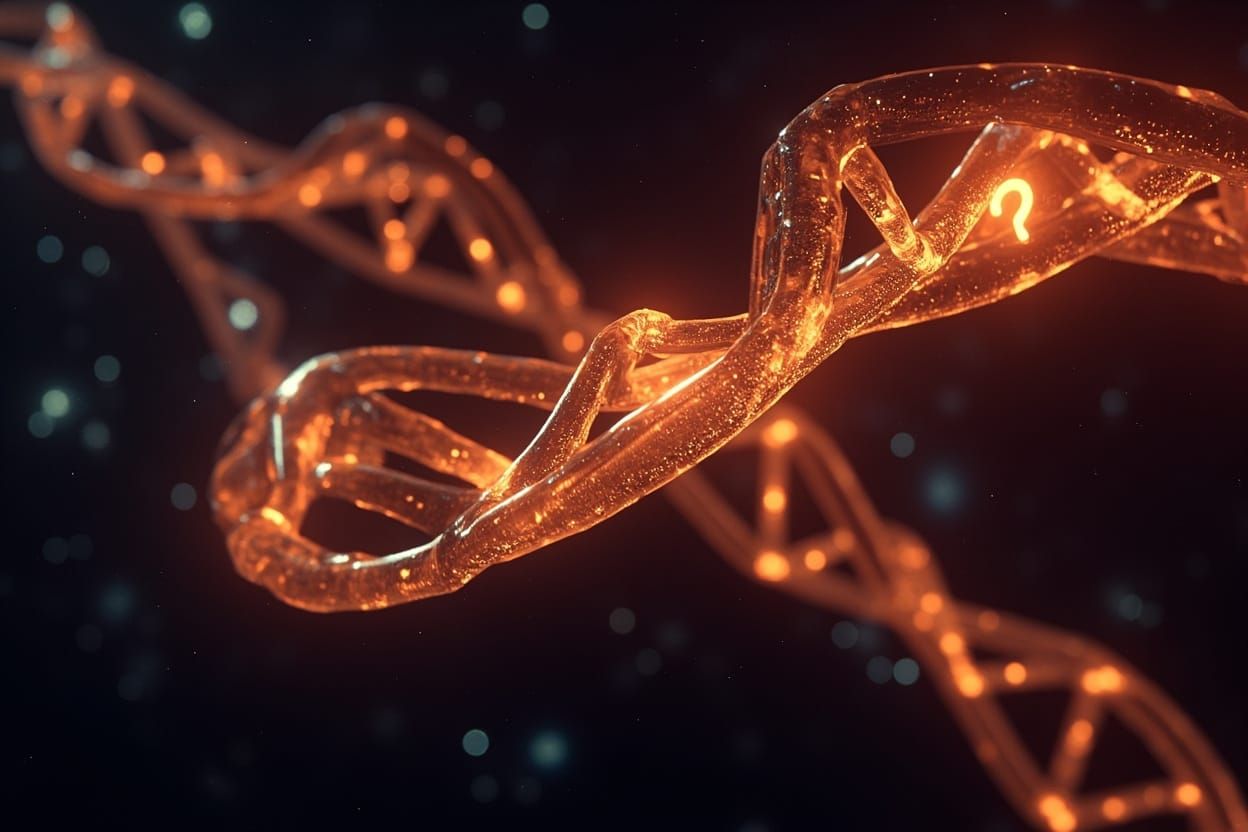
The Discovery That Rewrote Human Identity
Part One: The Noise That Wasn't
On a Tuesday morning in March, in a basement laboratory at MIT that smelled of burnt coffee and ozone, Vera Wu told the Department of Defense that the so-called "junk" in human DNA was not junk at all.
It was a message.
Vera was forty-one, soft-spoken, and had spent nineteen years studying computational linguistics at the University of Chicago before MIT poached her for a project she still didn't fully understand. She specialized in pattern recognition in dead and dying languages—Akkaadian, Linear A, the clicked consonants of the extinct Tuu language. When the Defense Advanced Research Projects Agency called and asked if she could apply her skills to genetic sequences, she assumed it was a joke. Or a trap.
"You're telling us," said the man in the charcoal suit—he'd been introduced as Director Kessler, though Vera suspected that wasn't his real name—"that there's intelligence embedded in our genome. And no one noticed for forty years?"
"I'm telling you," Vera said, "that there are patterns in the non-coding sequences that aren't random. That never were random. And that, mathematically speaking, they constitute a structured information system of extraordinary complexity."
The room went quiet. On the wall-mounted screen behind her, a spectrograph display showed the familiar blocky landscape of a DNA sequence—but these weren't the familiar protein-coding regions. These were the vast intergenic spaces, the long stretches of base pairs that biologists had long assumed were evolutionary debris. The leftovers. The junk.
Except they weren't junk. And Vera had the numbers to prove it.
She clicked to the next slide. "Standard stochastic analysis of these sequences yields an entropy profile consistent with pure noise. Random mutation, genetic drift, no selective pressure. That's the consensus." She paused. "But consensus isn't proof. And when I applied linguistic deconvolution—the same tools I use to extract grammatical structures from fragmentary dead languages—I found something that changes everything."
The spectrograph on the wall shifted. The noise-like waveform had been replaced by something else: a series of sharp, repeating peaks, arranged in what looked almost like a musical staff.
"Those peaks," Vera said, "are not random. They're modular. Recursive. And they appear in every human genome ever sequenced—without exception—in regions that have remained conserved for over ninety million years of evolutionary time."
The man in the charcoal suit stared at the screen for a long moment. Then he said: "Show us again."
Part Two: Theo
Theo Markova should not have been in genomics.
He was a spectral analyst by training—someone who looked at waveforms the way some people looked at clouds, finding meaning in the shapes that others dismissed as randomness. He'd worked on signal processing for NASA before a funding cut sent him freelance, and he'd taken a consulting gig with a biotech firm in Cambridge that was too understaffed to notice his complete lack of biology credentials.
The project was simple on paper: develop better algorithms for identifying protein-coding regions in newly sequenced genomes. The firm was drowning in data from the Human Genome Project and needed someone to clean up the signal-to-noise ratio. Theo applied his standard toolkit—and found noise that wouldn't clean.
"It's in the Fourier transforms," he said, pacing the narrow strip of floor between Vera's desk and the cluttered bench. "Every time I run a spectral analysis on the intergenic regions, I get these recurring peaks at specific frequencies. Frequencies that shouldn't be there if these sequences were really evolving neutrally. There should be no structure. But there is."
"How do you know the structure is real and not an artifact?" Vera asked.
"Because I can filter it out, and the residual is exactly what you'd expect from random mutation. Gaussian noise, no memory, no correlation. But the signal I filter out—" He stopped, turned to face her. "The signal I filter out has properties I've only ever seen in intentional communication systems."
Vera sat back. "Intentional."
"Embedded," Theo said. "Not broadcast. Someone—or something—encoded information in these sequences millions of years ago. Before we were even primates. And it's been copying itself faithfully ever since."
"That's not possible."
"I know." He ran a hand through his already-disheveled hair. "Which is why I spent three months making sure I wasn't wrong before I called you."
Part Three: The Message
The breakthrough came on a Thursday, at 3:47 in the afternoon.
Vera had been running a deconvolution algorithm she'd developed for fragmentary texts—texts missing most of their content, where you'd need to reconstruct meaning from partial patterns. She'd adapted it for genetic sequences, mapping base-pair combinations onto phonemic structures, looking for the kind of deep grammatical regularities that emerge in any natural language.
The algorithm had been running for eleven days on MIT's fastest cluster. When it finished, it produced a single output file. Vera opened it expecting error logs.
Instead, she got a string of characters.
Not base pairs. Characters. A sequence of 729 symbols—each one drawn from an alphabet of 27, arranged in a structure that her algorithm had identified as hierarchical, recursive, and almost certainly intentional.
729. She knew that number immediately. 729 was 3 to the 6th power. 3 squared times 3 cubed. 27 times 27. In mathematics, 729 appeared in contexts ranging from perfect squares to the Chinese "Seven Seven" tradition. But more practically: 729 divided by 3 gave 243; divided by 9 gave 81; divided by 27 gave 27; divided by 81 gave 9; divided by 243 gave 3. The number was divisible at every meaningful scale.
And it was the length of the message.
Theo was beside himself when she showed him. "729 symbols from a 27-character alphabet. That's 27 to the 729th power possible messages. But the structure isn't random. The algorithm found repeating modules, sub-structures that nest into larger structures. This isn't a string of noise. It's a document."
"A document doing what?"
"A question," Vera said quietly. "It's a question."
Part Four: The Question
Over the following weeks, Vera and Theo assembled a small, shadow team to work on the decoding. They told almost no one. Director Kessler provided funding and cover, but even he didn't ask for details. Some funding sources, Vera suspected, preferred not to know.
The structure emerged slowly, painstakingly. The 729-character sequence broke down into nine blocks of 81 characters each. Each block contained nested sub-units—smaller patterns that repeated with variation, the way sentences in any language contain clauses that both repeat and transform. The algorithm had been right: this was hierarchical. This was language.
But it was language unlike any Vera had encountered.
The content of the message—what little they could reconstruct—didn't map onto human concepts. There were references that seemed to point to chemical processes, to spatial relationships, to quantities. But the deeper structures didn't correspond to any known semantic framework. It wasn't Chinese. It wasn't Sanskrit. It wasn't anything that had evolved on Earth.
But it was asking something.
Vera sat with the partial translations for hours, staring at the patterns. And slowly, a theory formed.
"We think this is a question," she said to Theo one evening, when the lab was empty and the only sound was the hum of the cooling fans. "But maybe it's not asking us something. Maybe it's asking about us."
Theo looked up from his terminal. "Explain."
"What if this message isn't communicating with us?" Vera said. "What if it's communicating about us? What if something encoded this sequence into our genome millions of years ago, and it's been waiting—quietly, invisibly—for a species smart enough to read it?"
"So that something could... what? Monitor us? Judge us?"
"Maybe." Vera's voice was barely above a whisper. "Or maybe test us. Maybe this message is a test, and our entire evolutionary history has been the waiting period. We've been unconsciously carrying this question, replicating it without knowing, because we didn't have the cognitive capacity to read it. Until now."
Theo was quiet for a long time. Then he said: "What does the question ask?"
"I don't know yet. But we're close. And once we know—" She didn't finish the sentence. She didn't have to.
Part Five: The Answer
They cracked it on a Sunday morning.
Vera had been at it all night, running variant after variant of her deconvolution algorithm, trying to find the right mapping between the alien semantics and human concepts. She'd been at it for so long that the numbers had started to swim. But then—somewhere around the four-hundred-and-twelfth iteration—she found it.
The key was context.
The symbols in the message weren't being used referentially. They were being used interactionally. The message wasn't describing the universe. It was initiating a dialogue structure. A query-response pattern. A question designed to be answered.
And the question, rendered as best she could into human conceptual framework, was this:
"DOES THE OBSERVER THAT READS THIS SIGNAL POSSESS GENUINE CONSCIOUSNESS, OR ONLY THE SIMULATION OF IT?"
Vera stared at the screen.
Below that, in the same structured format, were instructions. A response protocol. A frequency to reply on. A timeframe. And, appended at the very end of the sequence, a single additional line that Vera didn't fully translate for weeks, and that she never forgot once she did:
"YOUR SPECIES HAS CARRIED THIS QUESTION FOR 10^8 YEARS. THE ANSWER DETERMINES WHAT HAPPENS NEXT."
Vera printed the translation. She read it three times. Then she sat in the silent laboratory, in the early morning light, and tried to remember how to breathe.
Part Six: What Happens Next
The official position, for now, was that nothing had happened. The research was ongoing. The findings were preliminary. No announcements would be made pending further review.
But Vera had told Theo, and Theo had told Director Kessler, and Kessler had made three phone calls that Vera suspected reached places she didn't want to know about. Within forty-eight hours, a dedicated team had been assembled. Within a week, they had access to every piece of computing hardware Vera asked for. Within a month, they had a response protocol.
The response was simple: send back the question, answered as best they could. Vera's team argued about how to answer for days. Did "genuine consciousness" mean self-awareness? Intentionality? The ability to suffer? Every definition they drafted seemed incomplete. Every answer revealed new ambiguities. This was not a multiple-choice test. This was a species defining itself for an audience it couldn't see.
In the end, they sent back the simplest answer they could justify: humans had passed the mirror test, could model the minds of others, could simulate counterfactual scenarios, and reported subjective experience that neural science could neither explain nor deny. Whether that constituted "genuine" consciousness was a question philosophy hadn't resolved in three thousand years.
They sent it anyway.
And then they waited.
Six months later, on a Thursday in October, a new signal arrived.
It came not from space—not from any external source—but from within the same intergenic sequences. The message that had been dormant for ninety million years had been updated. A new block of characters, appended to the original 729, extending the document. Extending the conversation.
Vera opened the file and read the first line of the new transmission:
"ACKNOWLEDGED. ASSESSMENT IN PROGRESS. CONTINUE."
She leaned back in her chair. Around her, the team waited in silence.
"Well," Theo said eventually, "that's something."
Vera nodded. "That's something," she agreed.
The question wasn't over. The test wasn't finished. And somewhere—encoded in the double helix of every cell in every human body—something was listening, evaluating, and deciding.
What happens next, they still didn't know.
But for the first time in human history, they were having a conversation with it.
Published: April 22, 2026