

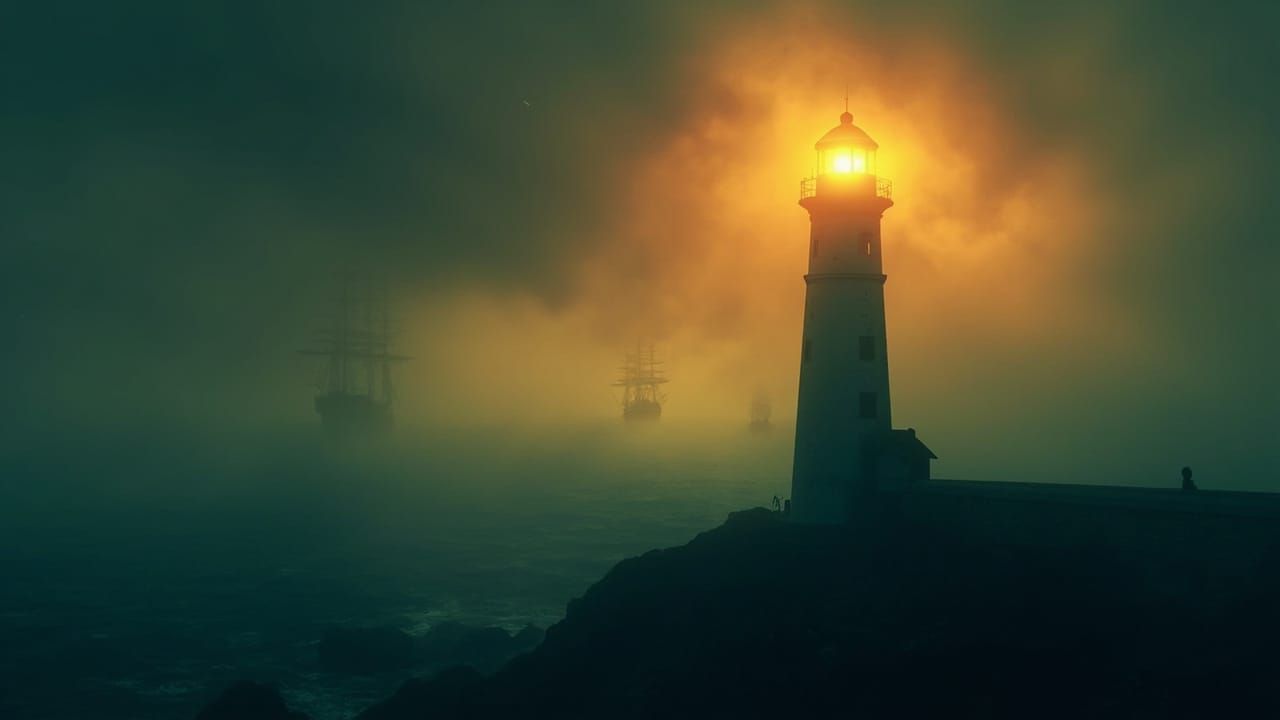
A Mystery in Three Layers
The town of Carrow had no memory of its own drowning.
Mira Thorne arrived on the evening tide, which was the only way anyone arrived anymore — by the single gravel road that wound down from the clifftop like a thread pulled loose from old cloth. The fog came with her, dense and yellow at the edges, swallowing the road behind her rental car inch by inch. She'd been sent by the Hartwell Foundation to catalog the abandoned lighthouse before it was converted into luxury condos. The paperwork said it had been dark since 1962. The paperwork did not say why.
She parked in front of the keeper's cottage, its whitewash peeling in the salt air, and stepped out into air that tasted of iodine and something older — something mineral, like wet stone in a cave system that had never seen light. The lighthouse rose behind the cottage, a tapering cylinder of stacked granite, its lamp room dark as a closed eye. Seagulls circled overhead but made no sound. She'd never experienced that before: birds that flew and flew and never once opened their beaks.
The estate agent had left the key under a ceramic frog by the front door. The frog had a crack running through its face that made it look like it was smiling.
Inside, the cottage smelled of lavender and dust and something faintly sweet, like rotting apples left in a bowl too long. A brass bell sat on the hallway table. A folded piece of paper was tucked beneath it.
The First Layer: What the Paper Said
The note was written in pencil, the letters large and careful, the way children or very old people write when they want to be understood. It read:
You arrived on the tide. Good. Land travelers don't stay.
The house remembers what you tell it. Be honest. It knows when you're not.
There is a woman in the lighthouse. She is not dangerous. But she is not finished.
Do not go to the third floor. Not yet. Not until she trusts you.
— E.C., last keeper
Mira read it twice. Then she folded it neatly, put it back under the bell, and immediately went upstairs to find the second floor.
The stairs creaked in a language she didn't speak. The bannister was cold under her palm, colder than the air, and when she touched the wall, the plaster gave slightly, like skin over a bruise. She stopped at the first landing. A window looked out toward the sea, but there was no sea tonight — only fog, white and gold, rolling in slow continental sheets.
Something moved in the fog. Not a car. Not a boat. A shape, low and wide, that seemed to drift rather than travel, and for a moment, Mira thought it was a whale. But whales didn't have lights on them. This thing had lights — warm yellow lights, round and small, arranged in a pattern she almost recognized. Then the fog closed over it, and it was gone.
She went back inside.
The Second Layer: Who the Woman Was
The second floor was one large room, the original keeper's quarters, and it had been converted into a kind of archive. Papers covered every surface — desks, chairs, the floor in places, held down by coffee mugs and river stones and old brass ship clocks that had stopped ticking at different hours. Mira moved through them carefully, reading labels in marker on the walls: COAST GUARD LOGS. SHIPWRECK MANIFESTOS. TIDE CHARTS 1947–1962. And one label in red marker that made her pause: INQUIRIES — UNANSWERED.
The unanswered inquiries were letters. Dozens of them, printed or handwritten, addressed to officials in London, Dublin, Washington, Oslo. They requested information about ships that had disappeared in the waters near Carrow. Not just one ship — many ships, across many decades, all vanishing in the same fog pocket two miles offshore. The letters were never answered. Some had been returned with stamps that said RETURNED TO SENDER — ADDRESSEE UNKNOWN. Others had been accepted and then silently absorbed, like water into sand.
Mira found a photograph tucked inside one of the letters. It showed a woman in a keeper's uniform standing at the base of the lighthouse, one hand raised against the sun. She was young and sharp-featured, dark-haired, with an expression that wasn't quite smiling. On the back, in faded ink: Eleanor Cole, Assistant Keeper, Carrow Light, 1959.
Eleanor Cole. E.C.
Mira looked at the note again. There is a woman in the lighthouse. She is not finished.
She put the photograph in her bag.
The Third Layer: What the Lighthouse Knew
The lighthouse had four floors. The first was a storage room with nothing in it but stacked NRCB markers and a smell of rust. The second was the keeper's quarters, which she'd already seen. The third was where E.C. had told her not to go. She stood at the foot of the spiral iron staircase and looked up into the dark, and the dark looked back at her like a question she didn't want to answer.
She went anyway.
The third floor was a circular room with four windows, one facing each cardinal direction. In the center was a desk, and on the desk was a logbook — the keeper's log, its pages yellowed and brittle. Mira opened it to the last entry, dated November 3rd, 1962.
Fog came in heavy at 1900 hours. Ship lights visible to the north, bearing 045, approx. 2 miles. Tried to signal. No response. Crew appeared to be waving.
Fog thickened at 1930. Lost sight of ship. Heard sounds — voices, but not from any direction. Could not identify language.
At 2000 hours, the light in the lamp room failed. Checked generator. Fuel present. Wiring intact. Light did not fail — it was swallowed. I have never seen fog like this.
At 2030, Eleanor went up to investigate. She did not come back.
I called for her. The fog called back.
God forgive me. I am going up.
That was the last entry. The pages after it were blank.
Mira set down the logbook. Her hands were shaking. She looked at the windows, at the fog pressing against them like a hand pressing against glass, and she noticed something she hadn't noticed before. The fog wasn't moving. It hung motionless outside the lighthouse, and within it, suspended like insects in amber, were shapes.
Ships. Dozens of them, different eras, different designs — a three-masted schooner, a steamship with a single funnel, a modern cargo container vessel, a wooden fishing boat that looked centuries old. They were all frozen in the same fog, all with their lights on, all impossibly preserved, and all of them exactly two miles offshore.
She ran downstairs.
The Final Layer: What the Fog Wanted
Mira found Eleanor in the lamp room, which should have been impossible because the spiral staircase ended at a locked door and the key was not in her pocket. But the door was open now, and the lamp room was warm, warmer than it should have been, and a woman stood at the great Fresnel lens with her back to Mira, hands pressed flat against the glass.
Eleanor Cole was not a ghost. She was something else — not alive, not dead, but held, the way a note is held in a bottle. The fog had kept her. The fog needed her. And the fog needed someone else now.
"You're not from the foundation," Eleanor said. She didn't turn around. "The foundation would have sent someone who wouldn't have read the log."
"I read it."
"Then you know." She turned then, and her face was the face from the photograph but older, deeper, like a city seen from orbit instead of street level. "The ships aren't lost. They're waiting. The fog keeps them safe until the water is ready to give them back."
"And when will that be?"
"When someone remembers them." Eleanor looked at her with eyes that were the color of seawater in a storm. "That's what the fog is. It's memory. All the ships that ever crossed this bay, all the people who sailed them, all the things they carried and meant — the fog remembers them. And every so often, it asks someone to remember too."
Mira thought of the letters E.C. had written. The inquiries that were never answered. All those officials, all those institutions, all those people who had looked at the list of lost ships and filed it away and moved on. The ships weren't lost because they disappeared. They were lost because no one kept asking.
"You stayed to keep asking," Mira said.
"I stayed because the fog let me. I stayed because I could feel them out there, all those ships, all those people, waiting to be remembered." Eleanor's voice was quiet, not sad, but heavy with the weight of a long vigil. "I've been the keeper of the memory. But I'm tired now. And the fog is ready to let someone else hold the thread."
She held out her hand. Palm up. Empty.
Mira understood then what the fog was asking. It wasn't asking her to stay. It was asking her to take something with her when she left — to carry the names of the lost ships out of this place and into the world, to write them down somewhere they couldn't be ignored, to keep asking the questions that E.C. had asked until someone finally answered.
She took Eleanor's hand. It was cold, and it was not entirely solid, and when their fingers touched, Mira felt something pass between them — not pain, not fear, but a kind of weight, the accumulated gravity of sixty years of unanswered letters.
Then Eleanor smiled — really smiled — and the fog outside the lamp room windows began, for the first time in sixty years, to move.
Epilogue: What Mira Wrote
The Hartwell Foundation's report on the Carrow Lighthouse renovation was notable for its unusually detailed appendix — a section titled "Historical Vessel Losses Near Carrow Bay, 1847–1962," which listed forty-three ships that had vanished in the waters off Carrow, with crew manifests, cargo records, and port of origin for each.
The appendix was widely read. It was shared, reprinted, and eventually formed the basis of a collaborative marine archaeology project between Trinity College Dublin and the National Maritime Museum. In 2029, three of the lost ships were rediscovered, preserved in the silt of the bay at a depth consistent with their last reported positions.
The fog near Carrow Bay is still there. But it behaves differently now. Sailors say it parts more easily. Ships that enter it sometimes emerge with strange compasses, pointed toward something no chart can show.
And sometimes, in the lamp room of the restored Carrow Light, a visitor will feel a brief cold touch on their wrist, and hear, just at the edge of hearing, a voice that sounds like it's asking a question.
The question is always the same: Do you remember them?
The answer, more people are finding, is yes. They remember.
For the lost ships and their crews. May the fog always remember, and may we learn to remember too.