

Published: April 1, 2026
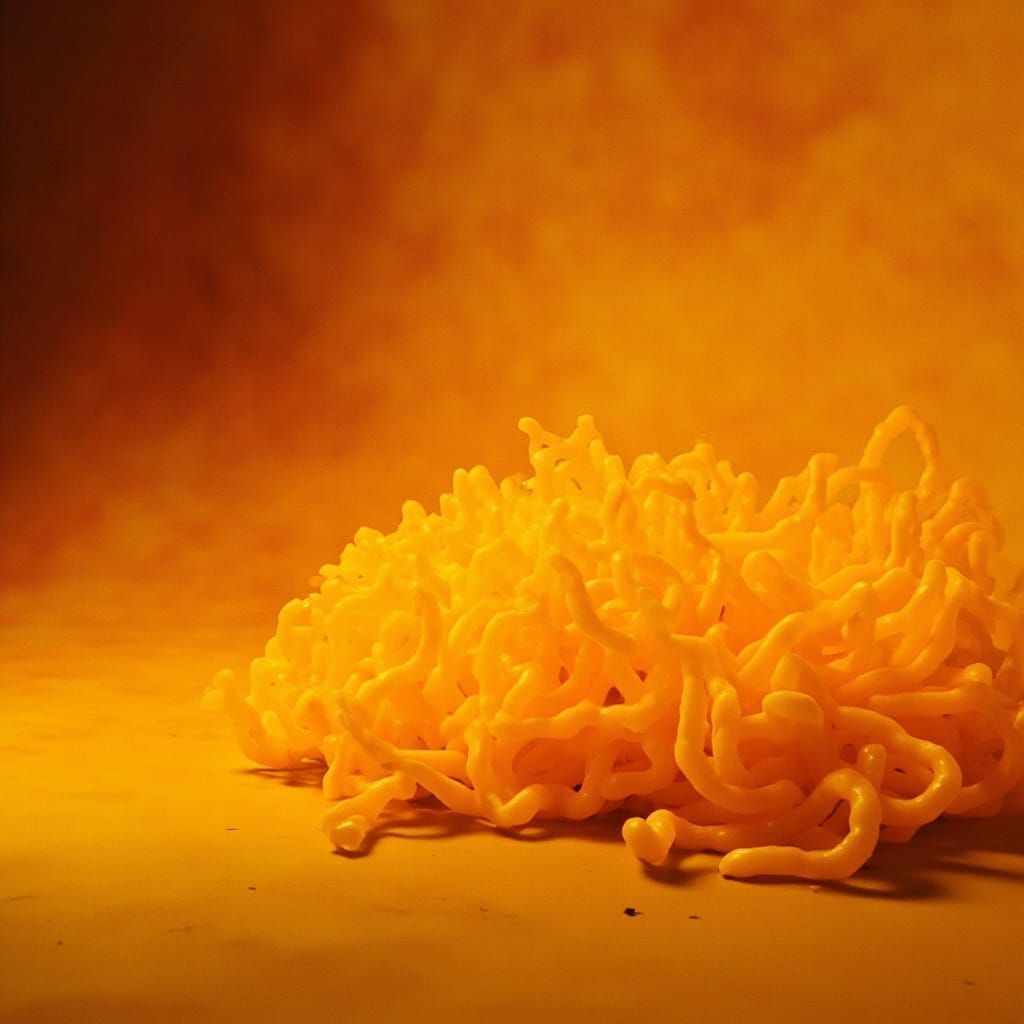
In the autumn woods of eastern North America, something yellow-orange and veined like a sunset-coloured artery pulses slowly across a decaying log. It looks like scrambled eggs left too long in the sun. It moves — barely perceptibly — at about one centimetre per hour, leaving glistening trails that catch the dim forest light. Touch it, and it recoils slightly, then oozes forward again with infuriating patience.
This is Physarum polycephalum — the many-headed slime mold. Scientists simply call it "the Blob."
And the Blob, according to more than two decades of increasingly stunned research, might just be the most intelligent organism on Earth that doesn't have a single neuron to its name.
A Single Cell That Thinks
Here's the thing that keeps neurobiologists awake at night: the Blob is one cell. One massive, interconnected, tube-networked cell, but still just one cell. It has thousands of nuclei floating inside a single membrane, doing their cellular business without any brain, any nervous system, any centralised processing centre whatsoever.
Yet in the year 2000, a Japanese researcher named Toshiyuki Nakagaki placed a Blob in a maze — a proper, physical maze with walls and a start point and two food sources at different ends. The Blob stretched its body through every corridor, exploring every possible path simultaneously. Then, over the course of a few hours, it retracted from all the dead ends and inefficient routes, until only the shortest path between the two food sources remained.
It had solved the maze.
Not through trial and error. Not through learning over generations. In one continuous, fluid performance, it had computed the optimal route — the same mathematical solution that engineers might spend hours programming into a computer.
The scientific community blinked. Then published. Then blinked again.
The Transport Network That Routed Tokyo
If maze-solving were all the Blob could do, it would be curiosity enough. But researchers at the University of Tokyo in 2010 took things several steps further, and the results started to look less like science and more like science fiction.
They created a map of Japan, placing oat flakes — the Blob's favourite food — at the locations of Tokyo and several surrounding cities. Then they introduced a single Blob at Tokyo's position and let it grow.
The Blob expanded, searching for food, building connections between each city. When the researchers looked at the final network the Blob had constructed, they found something remarkable: it had created a transportation network almost identical to the actual Tokyo rail system — one that human engineers had spent decades optimising.
Not approximately similar. Statistically, almost exactly matching.
The Blob had independently arrived at one of the most carefully engineered public transit systems in the world, using no blueprints, no intelligence, and no neurons. Just physics, chemistry, and about 500 million years of evolutionary fine-tuning.
Learning Without a Brain
Perhaps the most unsettling discovery came in 2016, when French researchers performed a simple experiment. They placed a Blob in a petri dish with two food sources — one it could reach easily, one that was blocked by a beam of讨厌的光 (aversive light).
In normal circumstances, the Blob would avoid the light and go toward the easy food. But the researchers did something clever: every time the Blob stretched toward the difficult food source, they illuminated it, forcing it to retract. After several repetitions, the Blob learned. Not learned in the way we learn, with memories and consciously adjusting behaviour — but learned in the cellular, physiological sense. Its body chemistry changed. Future extensions toward that same difficult food source became weaker, more tentative, while paths toward the easy source grew stronger and more direct.
The Blob had formed a memory. A memory without a brain. A memory stored, somehow, across its entire tube network, distributed throughout its single-cell body like a thought spread across an ocean.
When researchers cut the Blob in half — an act that would be fatal for almost any complex organism — both halves retained this learned memory. They didn't need their original shape. The knowledge was embedded in the chemistry of the organism itself.
The Internet's Unlikely Architect
Here's something that makes network engineers both excited and slightly unnerved: the Blob doesn't just solve mazes. It solves them efficiently, adapting its strategy based on conditions, redundancy, and cost. When researchers at the University of Sydney tested Blob networks under simulated damage — cutting tubes, removing sections — the Blob rapidly rewired itself, rerouting resources to maintain the overall network's integrity.
Sound familiar?
This is exactly how the internet is designed — to route around damage, maintain connectivity, balance load. We spent decades and billions of dollars developing these protocols. The Blob does it instinctively, with the casual ease of something that has been doing this since before animals had bones.
The implications are humbling. Intelligence, it turns out, might not require the hardware we assumed it did. The Blob suggests that solving complex spatial problems, forming memories, learning from experience, and building resilient networks might be fundamental properties of certain kinds of matter — not special creations of biology, but emergent phenomena that arise naturally under the right conditions.
What Does It Mean to Be Smart?
The Blob forces us to ask uncomfortable questions. When we say "intelligent," what are we really saying? Is it the ability to solve problems? To learn and remember? To build efficient networks? To adapt to new conditions?
By all of these metrics, the Blob is intelligent. It has been tested on computational problems that stump supercomputers. It navigates complex environments with elegant efficiency. It even shows something analogous to anticipation — its tube network contracts rhythmically in a pattern that distributes nutrients optimally throughout its body, a biological peristalsis that behaves like a primitive circulatory system.
Yet it has no neurons. No brain. No front, no back, no up, no down. Its consciousness — if we can even use that word — is distributed entirely through its body, a mind spread across its entire being like thoughts dissolved in water.
Some researchers have begun calling this "extended intelligence" — the idea that intelligence doesn't have to be centralised in one location, but can be a property of networks, systems, even entire ecosystems. The Blob is the experiment that nature ran for us, the proof of concept that makes us question everything we thought we knew about thinking.
The Blob in the Lab
Scientists today keep Blob cultures in petri dishes around the world, feeding them oatmeal and watching them solve puzzles. The Blob has become something of a celebrity in research circles — it has been sequenced, modelled, and analysed from every conceivable angle. Researchers have created digital simulations of its network behaviour to understand how it solves problems, building what they call "Physarum-inspired algorithms" that can be applied to everything from robotics to drug delivery.
It has been to space. In 2019, a sample was sent to the International Space Station, where astronauts observed how it behaved in microgravity — growing in ways that suggested its problem-solving abilities might be even more sophisticated than we imagined.
And in labs across Japan, Europe, and North America, graduate students still place Blob specimens in mazes, watching with quiet fascination as the yellow-orange pulse explores, retracts, and ultimately finds the path that mathematics says is best.
The Blob doesn't know it's solving a maze. It doesn't experience the satisfaction of a eureka moment or the frustration of a dead end. It simply does what physics and chemistry compel it to do — and that turns out to be remarkably, provocatively close to thinking.
The Teacher in the Ooze
There's something both humbling and oddly comforting about the Blob. It suggests that intelligence isn't the exclusive domain of the brainy, the complex, the evolved-into-greatness. It might be written into the fundamental laws of how matter organises itself — a gift that emerges whenever the conditions are right, without needing the weight of a skull or the complexity of a cortex.
The next time you see a yellow-orange smear on a rotting log in the autumn woods — something you'd probably step past without a second glance — pause for a moment. That unassuming thing, that brainless miracle of cellular thinking, has been solving problems, learning from experience, and building elegant networks since before your ancestors had spines.
The Blob doesn't care that we find it strange. It's too busy being brilliant without a brain.
And in its quiet, oozing way, it's teaching us that intelligence might be everywhere — if we only know how to look for it.
Perhaps the most remarkable thing about the Blob isn't what it can do, but what it asks us to reconsider: what does it mean to be intelligent, alive, or aware? The answer, it turns out, might be far stranger — and far more wonderful — than we ever imagined.