

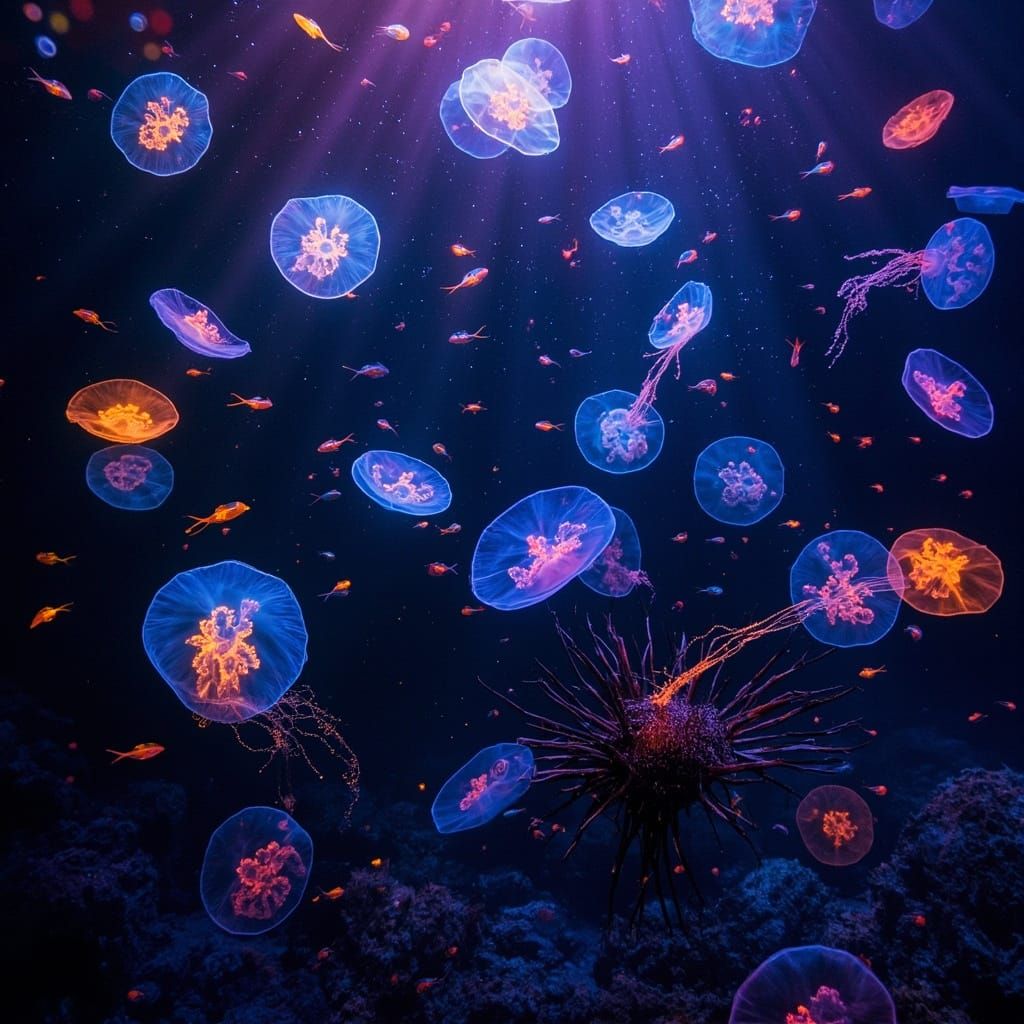
Bold Introduction to Bioluminescence
There is a light on Earth that needs no sun. It burns without heat, pulses without a heartbeat, and has been flickering in the darkness long before humans ever learned to kindle fire. Deep beneath the ocean's surface, in rainforests where no lighthouse shines, and even in the quiet corners of your own backyard, thousands of organisms have mastered the ancient art of making their own light. This is the story of bioluminescence — nature's most beautiful secret, a glow that has inspired myths, guided sailors, and may one day light our cities.
Most of us encounter bioluminescence rarely — perhaps a single firefly on a summer evening, blinking its lonely signal through the dusk. But step into the ocean at night on certain shores, and the entire world transforms. Your footsteps in the wet sand ignite trails of blue fire. The waves themselves glow as they crash, turquoise sparks cascading across the surface. It looks like magic. It feels like another planet. And for centuries, no one could explain it.
The word itself comes from two ancient Greek roots: bios, meaning life, and lumen, meaning light. Bioluminescence means quite literally "living light." It is light produced by living things through a chemical reaction, and it is one of the most extraordinary tricks evolution has ever devised.
The Chemistry of Living Flame
To understand bioluminescence is to appreciate the elegant chemistry happening inside these organisms all the time, everywhere, often unseen. The basic reaction involves a molecule called luciferin (from the Latin lucifer, meaning light-bearer) and an enzyme called luciferase. When luciferin is oxidized by luciferase in the presence of oxygen, the reaction releases energy in the form of photons — actual particles of light. In most bioluminescent reactions, the light produced is cold light, meaning almost no heat is generated at all. The light you see is nearly 100% efficient, a feat our best human-made LEDs are still trying to match.
What makes this system so extraordinary is that it has evolved completely independently dozens of different times across the tree of life. Bioluminescence appears in bacteria, fungi, insects, marine invertebrates, and fish. Jellyfish glow. Squid glow. Certain shrimp and worms and sea cucumbers glow. There are glowing mushrooms in old-growth forests and glowing dinoflagellates that make entire bays shimmer like galaxies after dark. Evolution, it seems, keeps arriving at the same brilliant solution: make your own light, and the darkness becomes yours to command.
Scientists have identified three primary evolutionary origins for bioluminescence in marine organisms, meaning that in the deep ocean alone, bioluminescence arose from scratch at least three separate times. It is one of the most striking examples of convergent evolution on Earth — the same adaptation, reached independently again and again, because the advantages are simply so profound.
The Deep: Where Darkness Becomes Alive
The deep ocean is the largest living space on Earth, yet it is a world of perpetual darkness. Sunlight penetrates only the top few hundred meters. Below that, the abyss stretches for miles, cold and black and crushing. In this environment, bioluminescence is not a curiosity — it is the primary language of life.
Anglerfish drift through the darkness with a bioluminescent lure dangling before their enormous, gaping mouths. The lure — colonized by colonies of glowing bacteria — pulses softly, attracting curious prey from the void. The anglerfish waits in perfect stillness, and then strikes with terrifying speed, swallowing victims whole. It is one of the most iconic and eerie images in all of nature: a monster from the deep, lit from within by a single point of living light.
Lanternfish, among the most abundant vertebrates on Earth, use bioluminescent photophores along their bellies to camouflage themselves from predators below. By matching the faint ambient light filtering down from above, they become nearly invisible against the backdrop of the surface — a technique called counter-illumination. Schools of lanternfish can number in the billions, each one producing its own soft glow, creating what oceanographers sometimes describe as a shimmering, undulating river of light beneath the waves.
The vampire squid, whose name conjures nightmares, is actually a gentle deep-sea creature that can produce bioluminescent mucus from its arm tips when threatened. The glowing goo confuses predators and buys precious seconds to escape. Even the humble quillback rockfish uses bioluminescent displays to communicate with potential mates in the darkness where visual cues are useless.
In the Mediterranean, a species of deep-sea squid has been observed using bioluminescence not just for camouflage or hunting, but for something eerily close to conversation — patterns of light flashing between individuals that may encode information scientists have only begun to decode.
Land Lubbers: Fireflies and Glowing Fungi
While the deep ocean holds the greatest diversity of bioluminescent life, land-based bioluminescence has its own ancient and enchanting history. Fireflies are perhaps the most beloved of all glowing creatures, their romantic associations with summer evenings ingrained in cultures across the world. In Japan, firefly viewing (hotaru-gari) has been a cherished tradition for centuries, drawing people to riversides and forests to witness the synchronized flashing of thousands of insects.
What most people do not realize is that firefly light serves a very precise purpose: communication between males and females. Each species has its own flash pattern — a specific rhythm, interval, and duration of glow. The male flies a distinctive path through the darkness, broadcasting his species-specific code. A receptive female perched in the grass watches, and if she likes what she sees, she replies with her own flash from her position below. It is a dating app written in light, an entire courtship conducted in bioluminescent Morse code, and it has been running without interruption for tens of millions of years.
There is a dark side to this romance, however. Certain firefly species in the genus Photuris, known colloquially as "femme fatale" fireflies, have evolved the ability to mimic the flash patterns of other species. They lure in males of those species and then — devour them. It is one of the most elegant and ruthless predatory adaptations in the insect world, and it is executed entirely with light.
On the fungal side of things, the glow of bioluminescent mushrooms has inspired ghost stories and folklore for millennia. In old-growth forests across Asia, Australia, and the Americas, certain mushrooms emit a steady greenish glow from their caps, bright enough to read by on a moonless night. Foxfire, as it is sometimes called, was historically used by Appalachian travelers as an impromptu flashlight, collecting the glowing fungi to light their way through dark forest paths.
The mushroom Mycena chlorophos, found in subtropical Asia, is one of the brightest bioluminescent fungi known, glowing at its most intense for about a day after fruiting before gradually dimming. Scientists believe the glow may serve to attract insects that help disperse the mushroom's spores — another clever evolutionary solution to the problem of reproduction in the deep, dark forest understory.
The Blue Tide: When the Ocean Lights Up
For those who have never witnessed a bioluminescent bay, the experience is difficult to describe in terms that feel believable. The most famous example is Mosquito Bay on the island of Vieques, Puerto Rico, where high concentrations of Lingulodinium polyedrum — a type of dinoflagellate — produce one of the brightest and most consistent bioluminescent displays on Earth. Every splash, every wave, every movement in the water triggers a response from millions of single-celled organisms, each flashing for a fraction of a second as their cell membranes are disturbed.
When kayakers paddle through Mosquito Bay at night, their blades cut trails of electric blue fire through water so dark it looks solid. The boats leave wakes that glow like molten sapphire. Fish darting beneath the surface leave trails like shooting stars. It feels like paddling through space — as if the ocean itself has become a window into some vast, luminous cosmos.
Similar phenomena occur in bioluminescent bays in the Maldives, along the shores of Wales, and in abundance in Tasmania, where the waves at certain beaches regularly ignite with blue-green light after dinoflagellate blooms. Scientists have connected these blooms to nutrient upwelling, warm water temperatures, and other oceanographic conditions, and there is growing evidence that climate change is altering the frequency and distribution of these events in ways we do not yet fully understand.
Nature's Gift to Humanity
Beyond their ecological significance, bioluminescent organisms are quietly transforming human technology. The luciferase-luciferin system has been adapted as a reporting mechanism in molecular biology, allowing scientists to track gene expression, monitor cellular processes, and visualize biological events in real time. The 2008 Nobel Prize in Chemistry was awarded in part for the discovery and development of GFP — Green Fluorescent Protein — originally isolated from the bioluminescent jellyfish Aequorea victoria, which has since revolutionized medical imaging and cellular biology.
Architects and urban designers are exploring the possibility of cultivating bioluminescent trees and plants as an alternative to street lighting. In 2013, a team of researchers at the University of Cambridge successfully engineered tobacco plants to contain bioluminescent bacterial genes, producing plants that glow continuously without any external energy input. The vision is a city where streets are lit by living trees, radiating a warm, ethereal green glow — a fusion of the ancient and the impossible.
Even in art and culture, bioluminescence has cast its spell. The phenomenon inspired the alien world in the film Avatar, informed the visual language of countless video games, and has become a recurring motif in speculative fiction about non-sun-dependent life on other worlds. If there is life on Europa, the moon of Jupiter that may harbor a vast subsurface ocean, scientists believe the most likely sense it would rely on is not vision as we know it, but something closer to bioluminescence — life creating its own light in a world where the sun never reaches.
The Glow That Endures
There is something profoundly humbling about bioluminescence. It reminds us that the Earth is still full of wonders we have not named, lights we have not catalogued, systems of communication we have not yet begun to decipher. For hundreds of millions of years, organisms have been generating their own light in a cold and hostile darkness, finding beauty and function in the very act of shining.
They do not need our wonder. They do not need our gaze. The firefly flashes its signal whether anyone watches or not. The anglerfish dangles its lure in the void, patient and eternal. The mushrooms glow green in the forest, and the plankton blazes blue in the waves, illuminating a world that was there long before us and will go on glowing long after.
But perhaps that is exactly why it moves us so deeply. Bioluminescence is proof that light — true, irrepressible, radiant light — can emerge from the darkest places. It is a reminder that even in the crushing depths, even in the longest nights, something beautiful can still burn.
And every time we see it, whether through a summer window in Vermont or from the deck of a kayak in Puerto Rico, we are witnessing one of the oldest and most magical continuums of life on Earth: the living light that never learned to be afraid of the dark.