

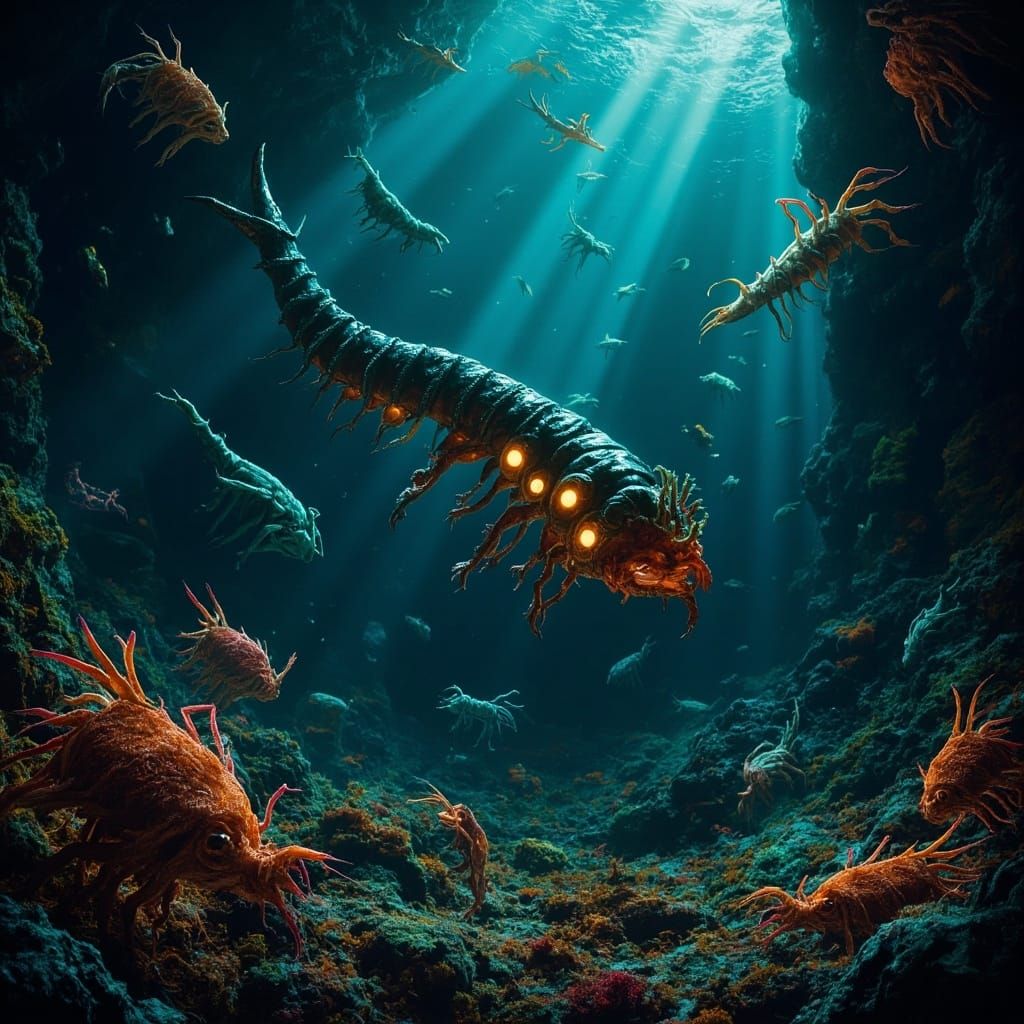
A Window Into the Dawn of Animal Diversity
Imagine diving into an ocean that existed half a billion years ago. The water is dark, lit only by the ghostly glow of bioluminescent organisms drifting through the depths. You're swimming through the Cambrian seas, and nothing about this world makes sense. The creatures you encounter look like they escaped from a fever dream — bodies with no clear front or back, mouths that don't align with their eyes, appendages that serve no purpose you can identify.
This was Earth 508 million years ago, and it was the most creative period in the history of life on our planet.
In 1909, Charles Doolittle Walcott — a paleontologist and then-secretary of the Smithsonian Institution — made one of the most extraordinary fossil discoveries in history. While hiking through the Canadian Rockies in Yoho National Park, he stumbled upon a deposit of finely layered slate that would revolutionize our understanding of early animal evolution. The Burgess Shale, as it came to be known, wasn't like typical fossils. These weren't just bones and shells preserved in stone. These were soft-bodied creatures, delicate appendages, gill filaments, and digestive tracts — the entire animal, preserved in breathtaking detail.
The preservation was so complete that scientists could study not just what these creatures looked like, but how they might have moved, fed, and lived. For the first time, we could see the experimental phase of evolution laid bare.
The Cabinet of Evolutionary Wonders
What Walcott found was a snapshot of the Cambrian Explosion — a period when virtually all major animal body plans appeared in the fossil record over a remarkably short geological timeframe. But the creatures in the Burgess Shale weren't the ancestors of familiar animals. Many of them were evolutionary dead ends, experiments that went nowhere, bizarre forms that tried something completely different and failed.
Consider Opabinia regalis, perhaps the most famous Burgess Shale resident. This creature had five eyes. Five. Two large ones on top of its head, and three smaller ones arranged in a row. It fed using a long, flexible proboscis that ended in a set of spines it could use to manipulate prey. Its body was segmented, with a wide, flattened tail, and it likely swam through the water by undulating these side lobes. When paleontologist Harry Whittington first described Opabinia in 1975, his audience reportedly laughed during his presentation. The creature was so strange that people thought he was joking.
Then there's Anomalocaris, the apex predator of the Cambrian seas. The name means "abnormal shrimp," which doesn't do justice to this creature's terrifying design. Anomalocaris had a circular mouth that looked like a pineapple ring — a ring of serrated plates that could crush anything in its path. Its eyes were compound and stalked, giving it excellent binocular vision for hunting. Two large appendages at the front of its head grabbed prey and delivered it to that circular maw. Anomalocaris grew up to a meter long, making it the giant of its age.
Hallucigenia lived up to its name. This creature had seven pairs of spiny legs, seven pairs of long, rigid tentacles along its back, and a head so indistinct that for years, scientists weren't sure which end was which. When they finally figured out that the head was the narrow end with the single visible eye, they realized they'd been studying it upside down for decades.
Wiwaxia looked like nothing alive today. Its body was covered in overlapping rows of scales, with a single row of upright spines running down its back. It moved along the seafloor like a armored slug, probably feeding on organic matter in the sediment.
These weren't defective versions of later, more refined creatures. They were something else entirely — a parallel explosion of forms that evolution tried out, refined briefly, and then largely abandoned.
Why the Cambrian Was Evolution's Playground
The Burgess Shale represents a crucial period when the genetic toolkit for building complex animals was first assembled. The Hox genes — the master control genes that tell different body segments what to become — had evolved. This meant that small changes in development could produce dramatic differences in body shape. One mutation could add a segment here, modify an appendage there, and suddenly you had an entirely new creature.
Before this, most life was simple — mats of single-celled organisms, simple multicellular blobs, maybe some early sponges. The Cambrian was the era when predators first appeared, and this changed everything. When you have predators, you need defenses. When you have defenses, predators evolve better hunting strategies. This arms race drove an explosion of diversity unlike anything before or since.
The Burgess Shale creatures were trying out every possible solution to the problems of existence. How should a body be organized? Where should the mouth go? How many eyes do you need? Should you have an external skeleton like a trilobite, or a soft body like Opabinia? Should you swim, crawl, or burrow?
Some solutions worked brilliantly. Trilobites, with their armored exoskeletons and compound eyes, persisted for 270 million years before going extinct. Anomalocaris's basic body plan eventually gave rise to the arthropods that dominate Earth today, from insects to crustaceans to spiders.
But many solutions were evolutionary dead ends. Hallucigenia's rigid spine-and-tentacle design was a failed experiment. Wiwaxia's scale-covered body didn't lead anywhere. And Opabinia, despite its sophisticated five-eyed vision system, left no descendants.
The Rediscovery of Wonder
For decades after Walcott's discovery, the Burgess Shale fossils were studied but not fully understood. Walcott himself assumed he was looking at early versions of familiar animals. He classified many of them into existing groups, shoehorning his strange discoveries into categories they didn't fit.
It wasn't until the 1970s and 1980s that paleontologists like Stephen Jay Gould, Simon Conway Morris, and others truly grasped what they were seeing. Conway Morris, in particular, carefully re-examined the Burgess creatures and realized that many of them represented unique body plans that had no modern equivalents. Evolution had tried these designs, found them wanting, and moved on.
This was revolutionary. Evolution wasn't a straight line from simple to complex, from primitive to advanced. It was a sprawling bush with countless branches, most of which ended in extinction. We don't see the failed experiments because they're extinct. We only see the handful of lineages that survived to become the ancestors of everything alive today.
The Burgess Shale taught us that life at its root was far more diverse and experimental than we had imagined. Evolution wasn't building toward us — it was stumbling through an infinite variety of forms, most of which were destined to disappear.
The Living Time Capsule
Today, the Burgess Shale is a UNESCO World Heritage Site. New fossils are still being discovered, and modern techniques — including detailed scanning electron microscopy and three-dimensional reconstruction — continue to reveal new information about these ancient creatures. Scientists can now see the fine details of gill structures, nervous systems, and digestive tracts that would have been invisible to Walcott.
The site proves that evolution's great experiments didn't end with the Cambrian. Life continues to innovate, to try new forms, to fail and try again. The organisms alive today are the survivors of an unbroken chain of experiments stretching back nearly four billion years. Every creature that has ever lived — from the simplest bacterium to the most complex mammal — represents one solution to the problem of survival.
The next time you look at a living creature and wonder at its design, remember the Burgess Shale. Remember that behind every successful body plan lies countless failed attempts, bizarre forms that evolution discarded, and experiments that went nowhere. Life is not a ladder climbing toward perfection. It's a vast, chaotic, endlessly creative process that keeps trying new things.
The Cambrian Explosion was evolution's moment of maximum experimentation. In the dark waters of that ancient ocean, life was genuinely, wonderfully, impossibly weird.
And somehow, from all that strangeness, here we are — still part of that same experiment, still wondering at the diversity of forms that our planet has produced.
Perhaps the greatest lesson of the Burgess Shale is this: the history of life is not a story of inevitable progress. It's a story of possibility, of trial and error, of infinite creativity constrained by the harsh realities of survival. We're here because our ancestors won a lottery that almost every ticket lost. And that makes the simple fact of our existence feel like the miracle it truly is.