

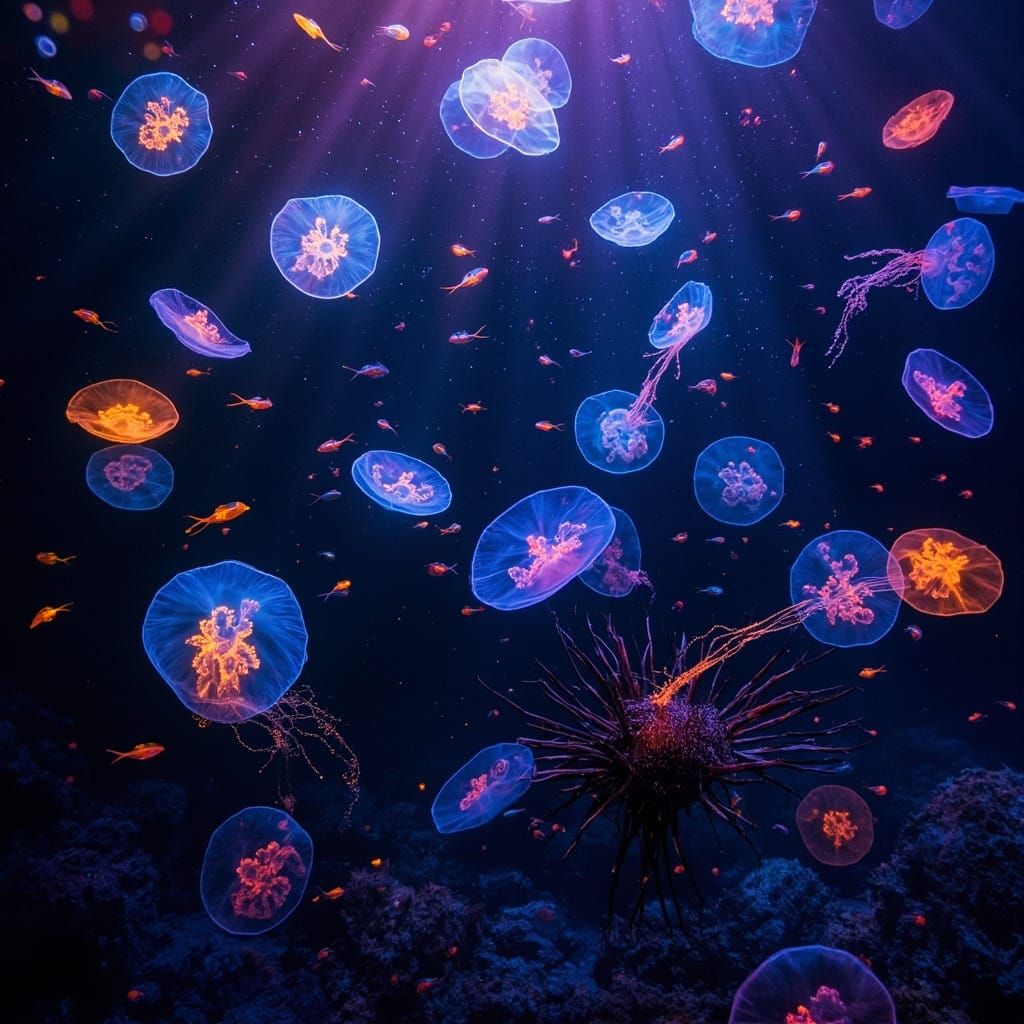
In the summer of 2009, a marine biologist named Edith Widder was watching a video feed from the deep ocean when something extraordinary happened. A remotely operated vehicle had descended into the Gulf of Mexico's midnight zone, some 2,000 feet below the surface, where sunlight becomes nothing more than a distant memory. The scientists were testing a new camera system designed to record the faintest flashes of bioluminescence when suddenly, the screen erupted in a cascade of green and blue lights — thousands of living organisms reacting to the ROV's presence, each one telling a story of survival written in light itself.
Widder later described that moment as "like watching a fireworks display in the deep." But what she was witnessing wasn't a spectacle put on for human amusement. It was communication, camouflage, courtship, and predation — all conducted through a language of light that evolution has been perfecting for over 540 million years.
The Chemistry of Wonder
Bioluminescence is fundamentally a chemical reaction, yet calling it merely chemistry does it a profound disservice. When a dinoflagellate cell is disturbed by water movement, an enzyme called luciferase catalyzes a reaction between the light-emitting molecule luciferin and oxygen. The result is a flash of blue-green light lasting mere fractions of a second — but it happens millions of times across a bloom of organisms, creating what we've come to call "sea sparkle" when waves crash on bioluminescent shores.
What makes this chemistry so remarkable is its independence. Unlike fireflies, which must eat specific foods to produce their luciferin, many deep-sea organisms synthesize their light-producing components internally. Some species have formed extraordinary symbiotic relationships with bioluminescent bacteria, providing them housing in exchange for their light-producing services. The Hawaiian bobtail squid, for instance, cultivates Vibrio fischeri bacteria in a specialized light organ, using the bacteria's bioluminescence to match the moonlight filtering down from above — effectively hiding its silhouette from predators hunting below.
The colors of bioluminescence are not random. Blue and green dominate in marine environments because these wavelengths travel farthest through seawater. Red bioluminescence is vanishingly rare in the ocean, which explains why some deep-sea creatures have evolved red photophores of their own — they can see red light while their prey cannot, giving them a terrifying advantage in the eternal darkness.
A Universe Beneath the Universe
Below 1,000 meters, the ocean transforms into something from science fiction. Here, in what oceanographers call the "midnight zone," the only light comes from living organisms. And what a light show it is. Scientists estimate that between 76 and 96 percent of deep-sea organisms are bioluminescent in some way. This isn't a curiosity of nature — it's the dominant mode of communication, navigation, and survival in the largest habitat on Earth.
The anglerfish dangles its illuminated lure like a fishing pole, drawing curious prey toward its cavernous mouth. The cookiecutter shark uses its subtle glow to disguise itself against moonlit waters above, then ambushes larger creatures with a bite that leaves a circular wound — hence its name. Dragonfish have developed infrared vision, allowing them to see the red bioluminescence of predators while remaining invisible to creatures that can only see blue and green.
But perhaps the most spectacular displays come not from predators, but from prey. When danger approaches, some organisms release clouds of bioluminescent mucus that illuminate the surrounding water in a brilliant flash — startling predators and momentarily revealing their silhouettes to larger threats. It's a case of "the prey becomes the predator," using light as both shield and signal. Schools of small fish sometimes synchronise their bioluminescent警报, creating ripples of light that disorient attackers and make it difficult to target any single individual.
Copepods, the tiny crustaceans that form the base of many marine food webs, produce individually invisible flashes that, en masse, create patterns that can be seen from space. These "marine snow" events, where billions of organisms flash in unison, may serve multiple purposes — communication, defence, or simply the mechanical result of identical cells responding to identical stimuli.
The Land Within the Dark
While the ocean dominates our understanding of bioluminescence, terrestrial versions have their own strange beauty. Thecave glowworms of New Zealand and Australia create the appearance of a starry night inside damp cave systems. These aren't worms at all, but the larvae of a fungus gnat species, and their light serves a brutally practical purpose: to lure small flying insects into their sticky threads. The blue-green glow of thousands of larvae creates a bioluminescent constellation that has become one of the world's most remarkable natural spectacles.
On certain nights in the Brazilian Atlantic Forest, the trails along the forest floor flicker with an eerie amber light. This is the work of Railroad Worms — the only terrestrial organisms known to produce red bioluminescence, in addition to the green glow from their bodies. The name comes not from any rail connection, but from the segmented appearance of their glowing body segments, reminiscent of train cars. Why they produce red light from their heads remains a mystery that scientists are still unraveling.
Fireflies remain the most beloved of all bioluminescent creatures, their romantic associations woven into human culture from Japan to North America. But their light is serious business. Different species have distinct flash patterns — some fly in J-shapes, others pulse in rhythm, still others flash twice in rapid succession. Females watch from perches, evaluating potential mates based on their light shows. And in a dark twist of evolutionary arms racing, some predatory Photuris fireflies have learned to mimic the flash patterns of other species, luring males to their doom.
The Human Connection
Humans have been fascinated by bioluminescence for millennia. Ancient Romans collected bioluminescent fish and used their mucous to create glowing decorations. Polynesian navigators may have used bioluminescent organism trails to detect fish or favorable currents. Medieval manuscripts were occasionally illustrated with glowing inks made from crushed fireflies — a practice that continued into the 20th century.
Today, bioluminescence is revolutionizing fields from medicine to environmental science. Scientists have engineered bioluminescent genes into bacteria, yeast, and even mammalian cells to track cellular processes in real-time. The glow of luciferase has become an essential tool in drug discovery, allowing researchers to detect the presence of specific molecules with extraordinary sensitivity. Tumors that might otherwise be invisible light up when tagged with bioluminescent markers.
In environmental monitoring, bioluminescent organisms serve as living pollution detectors. When exposed to contaminants, some species change their light output or cease glowing altogether. A company in California has developed bioluminescent panels that respond to air quality, creating living art installations that double as early warning systems for environmental hazards.
Architects in Singapore and Tokyo have begun incorporating bioluminescent algae into building facades, creating walls that glow softly at night and require no electricity. These living systems absorb carbon dioxide during the day and release their light at night, offering a glimpse of a future where our structures breathe alongside the organisms that share our world.
The Future Writes in Light
As climate change alters ocean temperatures and chemistry, scientists are racing to understand how bioluminescent ecosystems will respond. Some research suggests that warming waters may reduce the prevalence of certain dinoflagellate blooms, potentially dimming the famous "sea sparkle" of bioluminescent bays. Other studies indicate that shifting ocean currents may redistribute species in ways we're only beginning to understand.
Yet in this uncertainty lies opportunity. The more we learn about bioluminescence, the more we realize how much these living lights have to teach us. Each glowing organism represents millions of years of evolutionary refinement, a solution to the problem of survival refined across countless generations.
Edith Widder, the marine biologist who witnessed that spectacular display in 2009, went on to found the Ocean Research & Conservation Association. Her work uses bioluminescence not just as a subject of study, but as a tool — mapping the distribution of glowing organisms throughout the ocean, creating what she calls "a census of light."
Perhaps the most profound lesson of bioluminescence is this: in the deepest darkness, life finds a way to shine. Not despite the absence of light, but because of it. The creatures of the midnight zone have turned the eternal night into a canvas, painting their existence in the only medium available to them. Their light is not decoration but necessity — communication across impossible distances, attraction in the absence of anything to see, survival written in the oldest language on Earth.
As you read these words, somewhere in the deep ocean, a creature is flashing its light into the void. Perhaps it is searching for a mate, or evading a predator, or simply going about the ancient business of existence. But for one brief moment, in the largest habitat on our planet, life is making itself known.
And isn't that, in the end, what light has always been for?
This story was crafted for the Daily Story series. If you'd like to explore bioluminescence yourself, seek out a bioluminescent bay on a moonless night — few experiences can rival swimming through living starlight.