

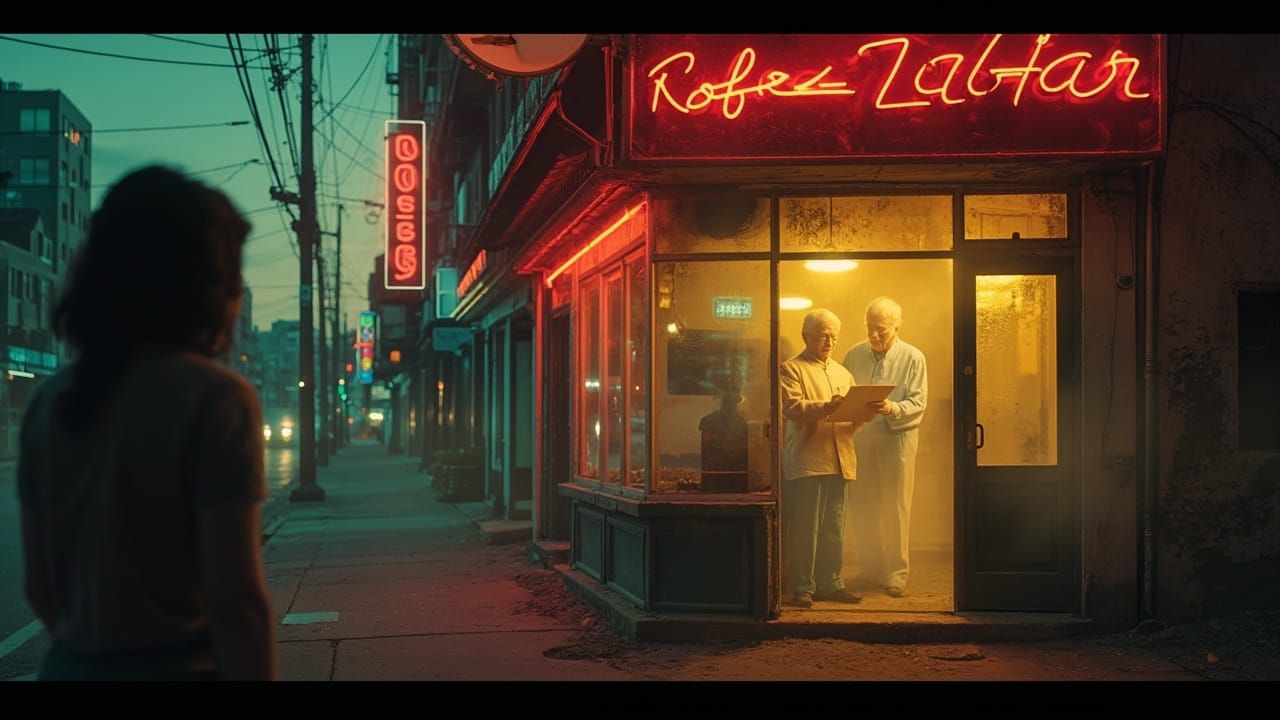
The street appeared only at4:47 AM.
Mira had learned to set her alarm for that specific minute—not a second before, not a second after—because that was when the city held its breath. The demolition drones finished their last rotation at4:46. The morning shift wouldn't start until 4:48. In that single golden window, for just sixty seconds, the erased places flickered back into existence like photographs developing in chemical baths.
She stood at the corner of Hester and Vine, where a coffee shop had stood until three weeks ago. Now there was only bare concrete and a construction fence promising luxury lofts. But Mira could see past the emptiness. She could see the ghost of the shopfront, its painted sign reading Rosie's, the wilting window box with its plastic flowers that had somehow been preserved in the echo. She could see an old man sitting at the counter, his face a blur of static, but his posture unmistakable—hunched over a cup, watching the door.
This was her gift. Her curse. The thing the neurologists called architectural persistence syndrome and the Cartographers called simply: sight.
"You're late," said a voice beside her.
Mira didn't flinch. She never startled anymore. She turned to find Solomon standing next to her, his white beard catching the sodium glow of the streetlights. He was seventy-three, one of the oldest Cartographers, and he'd been mapping the erased city since before Mira was born.
"Rosie's is back," she said. "But there's something wrong with it."
Solomon looked. His sight wasn't as sharp as hers—none of theirs were—but he could see the basics. "It's... brighter than usual. More solid."
"Because someone's in it."
They both watched. The old man at the counter hadn't moved. But as they watched, a second figure appeared in the doorway. A woman, her face obscured by the same visual static that softened all the echoes. She was carrying something—a box, a thick manila folder. She set it on the counter. The old man looked up.
Then the minute ended, and they were gone.
Mira's heart was pounding. In four years of mapping, she'd never seen an echo that active. Echoes were memories, yes, but they were passive—windows into what was, not reactions to who was watching. They didn't interact. They didn't carry things.
"What's in the folder?" Solomon whispered.
"I don't know. But it's been there every night this week."
The Cartographers met in the basement of a church that itself had been scheduled for demolition twice. Pastor Delgado knew what they were, what they could see, and he'd quietly refused to let the city tear it down. In exchange, they kept him informed of which buildings might be next. It was an alliance built on shared survival.
There were eleven of them total, spread across the city. Some could see echoes clearly; others only caught glimpses, peripheral flickers. Mira was the clearest. She was also the youngest, which meant she did most of the fieldwork.
"Willowmere," she said, spreading her map across the folding table. The group had gathered for the Thursday meeting, and she was presenting her findings. "That's what the old records say this neighborhood was called. Demolished in2071 to make way for the Meridian Expressway. Forty-seven buildings. A community of maybe three hundred people."
"Wiped clean," said Jin, a former architect who'd lost her sight in a car accident and somehow gained it back in a different form. "I remember when it happened. My mother cried for days. She'd grown up there."
"The echoes we're seeing," Mira continued, "they're all from Willowmere. Rosie's, the corner pharmacy, a tailor shop, a park that isn't there anymore. But they're all connected to that one spot—Hester and Vine. The old man at Rosie's has been appearing every morning for a week. And every morning, the woman brings him that folder."
Solomon was studying the map. "If the echoes are reacting to being watched, that suggests they're not just memories. They're... anchored somehow. Preserved."
"Preserved by what?"
No one had an answer.
Mira started staying late at Hester and Vine. She set up a camera—her own, not the Cartographers' equipment—to record the one-minute window. She needed proof. She needed something more than her own eyes.
The footage was useless, of course. The camera only showed empty concrete. But on the fourth night, she noticed something: the camera's timestamp was wrong. It was running three minutes and twelve seconds fast. And in that extra time, caught between frames, there was something else.
A building. A full, solid building with lights in the windows. Visible only to the camera because the camera had been running hot.
She didn't tell the others. Not yet.
The next morning, she went to the city archives.
The Meridian Expressway records were incomplete, as most historical records were. The official story was simple: Willowmere was a blighted neighborhood, a slum that had to go for the good of the city. The residents were relocated. The buildings were demolished. The expressway was built. End of story.
But Mira found a footnote. A single paragraph in a transit authority report from 2073, two years after the demolition:
Regarding the incident at Willowmere: all documentation has been classified under Section 14.7 of the Urban Renewal Act. Further inquiries should be directed to the Office of Urban Memory, which has assumed responsibility for the matter.
The Office of Urban Memory. She'd never heard of it.
She searched for three hours. Nothing. No website, no phone number, no address. It was as if the office had never existed at all.
Finally, in a database of defunct government agencies, she found a single line:
Office of Urban Memory: Absorbed into Department of Civic Memory, 2089. All records sealed.
Civic Memory. Another name she'd never heard.
She went back to Solomon.
"There's something buried under Meridian Expressway," she said. "Something they didn't want anyone to find. The echoes aren't random. They're guarding something."
Solomon was quiet for a long time. Then he said, "My grandmother grew up in Willowmere."
Mira blinked. "You never mentioned that."
"I don't talk about it. The family stopped talking about it after my mother died. It was like the neighborhood had never existed." He looked at Mira with eyes that suddenly seemed very old. "But I remember things. Fragments. A song my mother used to sing. The smell of bread from a bakery that I know was never there. I thought I was imagining them."
"You're not. The echoes are leaking."
"Then maybe," he said slowly, "it's time to stop hiding from them."
They went back to Hester and Vine on a Sunday morning, all eleven Cartographers, armed with cameras that ran hot and scanners that could detect the electromagnetic residue of erased places. They had exactly sixty seconds.
Mira counted down. At4:46, the demolition drones finished. At 4:47, the world held its breath.
And at4:47 and one second, the street came back.
Not just Rosie's. All of it. Willowmere, whole and entire, rising from the concrete like a photograph surfacing from developer fluid. The bakery. The pharmacy. The tailor shop with its window full of ghosts. The park with its rusted swings. And at the center of it all, Hester and Vine, where the old man was standing in the doorway of Rosie's, watching them.
The woman with the folder appeared beside him. Her face was clearer than Mira had ever seen it—not a blur of static, but a woman in her sixties, dark-haired, sharp-eyed. She was holding the folder out toward them.
Solomon stepped forward. "My mother," he whispered. "That's... that's her."
The woman nodded. She opened the folder. Inside was a stack of papers—deeds, birth certificates, photographs, a community ledger going back decades. Evidence of a neighborhood that had existed, that had mattered, that had been erased from the city but never from the earth.
Mira understood then. The echoes weren't ghosts. They were archives. They were the city's buried memory, fighting to be remembered.
"Take it," the woman said. Her voice was faint, half-heard, but Mira understood every word. "Take it before they finish what they started."
The sixty seconds were almost up. Mira lunged forward, her hand closing around the folder. It was warm. It was solid. It was real.
When the minute ended, she was standing on bare concrete, holding a box full of evidence, surrounded by eleven Cartographers who were all crying.
The documents told the story that the city had tried to bury.
Willowmere hadn't been a slum. It had been a community—thriving, self-sufficient, culturally rich. The demolitions hadn't been about urban renewal. They'd been about erasure. A neighborhood that had resisted corporate development, that had built its own cooperative economy, that had refused to be absorbed into the machinery of profit. Someone had decided it was easier to destroy it than to let it succeed.
The Cartographers released the documents. They contacted journalists, historians, community organizers. They turned their sight into a weapon, and the weapon into truth.
The city fought back, of course. There were lawsuits, threats, a brief attempt to have the Cartographers classified as a security threat. But the truth was already out. The echoes had done their work.
Mira still maps the erased places. She always will. But now she doesn't just record what was lost—she fights to make sure it isn't lost again. The Cartographers have grown. New members join every month, people who can see the echoes, people who refuse to let the city forget.
And every morning at 4:47, she still checks the corner of Hester and Vine. The echoes are fading now—Willowmere is becoming a memory instead of a haunting, and that's as it should be. But sometimes, just sometimes, she catches a glimpse of the old man at Rosie's, waving goodbye.
She waves back.
Sometimes the city tries to erase us. But we are harder to forget than they think. We leave echoes. We leave evidence. And in the end, the truth remembers itself.