

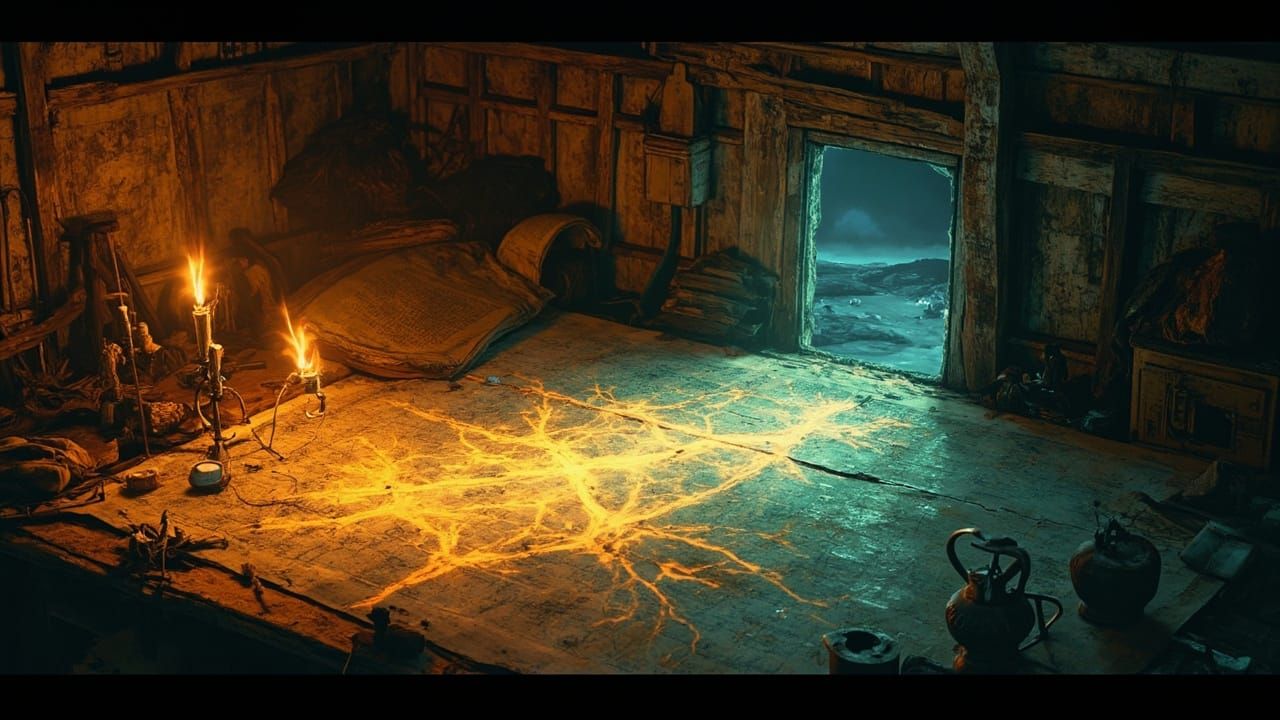
A Story of Mapping What Should Not Be Found
Mira had been drawing maps since she was seven years old, the day she sketched the garden behind her grandmother's house and a door appeared in the hedge that had never existed before. She was twenty-six now, and she had long since learned to be careful about what she put on paper.
The Guild of Cartographers operated in quiet rooms above a bookbinder's shop on Ember Street, and Mira spent most of her days there, bent over drafting tables, transforming the rough sketches of merchants and explorers into documents of power. Her ink was special — bought at great expense from the mineral traders in the northern provinces — and every line she drew carried weight. The harbor she charted last month now had two new coves that hadn't existed before. The trading post in the high valleys had grown a quarter-mile closer to the mountain pass she'd mapped for the矿业公司.
This was the gift. This was also the curse.
"Another commission?" asked Tomas, the senior cartographer, without looking up from his own work. He was mapping a client's childhood home — or rather, mapping it into existence for an inheritance dispute. The law in their province was clear: if you could map it, you owned it. The Guild had been drafting that legislation for three centuries.
"Just a harbor survey," Mira said. "They want the eastern inlet extended. Something about tidal patterns."
"Extend it, then." Tomas shrugged. "That's what the ink is for."
But Mira lingered at her table that evening, after the others had gone, and she found herself staring at a blank sheet of vellum. She hadn't planned to do it. The impulse came from somewhere beneath thought — from the same place that had once made her draw that garden door at seven years old, before she understood what she was doing.
She thought about the apartment she went home to. The silence in it. The way the light fell through the kitchen window at exactly 6:47 PM, when she was always still at work, so the apartment sat empty and waiting, patient as a held breath.
She dipped her pen.
And she began to draw.
The Cartography of Silence
She started with the outline. The shape of the space she lived in — forty-two square meters on the fourth floor of a building that had once been a textile mill. She drew the walls first, then the windows, then the kitchen counter where she never ate and the table where she always sat alone.
The ink flowed differently when she drew from memory rather than from survey notes. It felt heavier. Warmer. The lines seemed to pull at her hand, as if the paper wanted to be filled.
She documented the empty chair across from her at meals. The blank wall where she had once considered hanging a photograph but never did. The closet door that stuck, which she had never fixed, because fixing it would mean admitting she was staying.
Then she began the inner work.
She drew the shape of her loneliness the way a topographer draws terrain — contour lines marking the peaks of grief, the valleys of ordinary exhaustion. She mapped the geography of 3 AM thoughts, the way they spiraled down into the same worn grooves: the message she should have sent, the person she should have called, the door she should have opened instead of closing.
She drew the silence in her apartment as a physical feature, a kind of negative space with mass and weight. She shaded it in with crosshatching, with stippling, with the same care she gave to any territorial feature.
And as she drew, she felt something shift. A subtle change in pressure, like the air before a storm. The room around her seemed to grow quieter, even though she was alone. The shadows in the corners of her vision stretched a little longer than they should have.
She set down her pen. Looked around her apartment — the real one, the one she could see through the window of the drafting room.
It looked the same.
But she could have sworn the empty chair was a little further from the table than it had been that morning.
The Unmapped Guild
The Guild had rules about this kind of work. Everyone knew them, the way everyone knows laws they might break — with a kind of studied ignorance, a comfortable distance from the consequences.
You did not map what you had not been commissioned to map. You did not use the ink on personal subjects. You did not chart the interior landscape — the geography of the heart, the topology of memory, the cartography of the self.
These rules existed because, two hundred years ago, a cartographer named Sable had mapped her own grief after her wife died. She had drawn the shape of her sorrow with such precision, such care, that it had become real. It had stepped out of the page and into the world. It had walked beside her for three years before anyone realized what it was — and by then, it had grown so large that the only solution was to burn every map Sable had ever made, including the ones that charted legitimate territory.
The resulting territorial disputes had taken a generation to resolve.
Mira knew this story. Everyone knew it. It was the reason the Guild kept such careful records of who had drawn what, and why the ink supplies were locked in a vault with three separate locks.
But as she sat in her drafting room, looking at the map she'd begun, she felt the pull of it. The map wanted to be finished. The loneliness wanted to be named, to be given form and contour. And some part of her — the part that had been drawing doors into existence since childhood — wanted to see what would happen if she completed it.
She picked up her pen.
She kept drawing.
The Door That Wasn't There
Over the following days, Mira's life began to change in ways she couldn't quite name.
The apartment felt larger. Not physically — she measured the rooms with a tape measure and they were exactly the same dimensions they had always been — but the space within them seemed to expand. The distance from her bed to the kitchen counter felt like a journey now. The hallway stretched. The closet door that had always stuck seemed to have developed a new kind of resistance, as if it didn't want to be opened at all.
She started finding things in the wrong places. Not missing — she could always find them eventually — but relocated. Moved by a silence she couldn't see. The coffee mug she left on the counter would be on the table when she came home. The book on her nightstand would be across the room. The keys she hung by the door would be on the kitchen floor, as if they had wandered.
And the silence — the silence had texture now. She could feel it in the mornings when she woke, a kind of weight pressing against her skin. She could hear it at night, a low hum that wasn't quite sound, more like the memory of sound, the impression of a voice she had forgotten.
She thought about burning the map. She had the map in her drafting room, rolled up and tied with string, and all she had to do was hold a match to it. She thought about this often, especially at 3 AM when the hum was loudest and the empty chair seemed to lean toward her with something like attention.
But she didn't burn it.
She wanted to see what would happen. She wanted to know if she had actually done something, or if she was just tired, just lonely, just imagining the weight of what she'd drawn.
The map sat on her drafting table, patient as a held breath, waiting.
The Cartographer's Dilemma
On the twelfth night, she came home to find the apartment rearranged.
Not dramatically. Not obviously. But the couch was three inches closer to the window than it had been that morning. The rug had shifted. The empty chair — the one she had documented so carefully, the one that marked the space where someone should have sat — was now facing away from the table, facing the wall, as if it had given up waiting.
Mira stood in the doorway for a long moment, her keys in her hand, watching the silence breathe.
She went to her drafting room.
She unrolled the map.
The loneliness she had drawn was still there, rendered in careful crosshatching and stippling, the contour lines marking every peak and valley of her isolation. But now — and she was certain she wasn't imagining this — the map had changed. New details had appeared in the blank spaces. Small features she hadn't drawn: a crack in the wall that didn't exist, a stain on the ceiling she'd never noticed, a window that looked out onto nothing.
The map was adding to itself.
She picked up her pen. She thought about correcting it, about drawing a line through the new features, about reclaiming the territory she had ceded to the emptiness.
Instead, she drew a door.
It was a small door, barely three inches tall, in the corner of the map where the kitchen met the hallway. She drew it the way she had once drawn her grandmother's garden door — without thinking, without planning, following the same impulse that had made her seven-year-old self reach for a pen in the first place.
The moment she finished the line, she heard something.
A click.
From the hallway of her apartment.
She turned. The closet door — the one that stuck, the one she had never fixed — was open. It hadn't been open when she came in. She was certain of that. She always closed it, because an open closet door in a small apartment made the space feel even smaller.
But now it was open. And through it, she could see not her coats and old boxes, but a doorway. A small one. Three inches tall. Set into the back wall of the closet, where there had never been anything but plaster and old wood.
The door was open.
And beyond it, she could see the contour lines of her loneliness, rendered in the same careful crosshatching, stretching out into a territory that went on forever.
The Choice
Mira stood before the closet door for a long time.
She understood now what she had done. The map wasn't just documenting her loneliness — it was creating it. Every line she had drawn had given weight to the emptiness she felt, had made it real, had made it more. The apartment wasn't shrinking; the loneliness was growing. The silence wasn't getting louder; it was multiplying, spreading across the territory she had so carefully charted.
And the door — the door was the way in.
She could go through. She could walk the landscape of her own isolation, see it from the inside, understand it the way she understood the harbors and valleys she mapped for clients. She could learn its shape, its limits, its secrets. Maybe she could find a way to close it from the other side.
Or she could burn the map.
She had a match in her pocket. She always carried one, old habit from the Guild's safety regulations. One match, one flame, and the map would be gone. The territory would remain — the empty rooms, the shifted furniture, the silence that breathed — but without the document, without the source, it would begin to fade. It would become what it had been before: just a feeling. Just the ordinary loneliness of a person living alone.
She looked at the door.
She looked at the map.
The loneliness waited, patient as it had always been, and she realized that this was the choice she had been making all along. Every day she had spent in this apartment, every meal eaten alone, every night spent listening to the hum of silence — these were all choices. The map just made them visible.
She reached for the match.
Then she stopped.
She walked to the closet. She knelt before the small door, three inches tall, and she looked out at the contour lines of her own heart. She studied them the way she studied any territory — with care, with precision, with the attention she had always given to the work that mattered.
Then she reached into the closet and closed the door.
Not all the way. Just enough. Just enough to stop the spread, to slow the growth, to buy herself time. She would need to find another solution — one that didn't involve burning the map, one that didn't involve letting the emptiness consume her. She would need to learn the territory before she could change it.
But she had time now. She had the door.
She went back to her drafting table. She picked up her pen.
And she began to draw something new.
Not the loneliness.
Something else.
She began to draw the shape of what it might mean to be found.
For the ones who are mapping their way back.