

A Nautical Mystery
The Map in the Bottle
The bottle washed up on the rocks at Pelican Cove just after dawn, and it was old — genuinely, impossibly old. Not in the way that thrift store souvenirs pretend to be old, but genuinely corroded, salt-stained, and worn smooth by decades or perhaps centuries of patient bobbing. The cork was saturated with mineral deposits, and when Mara Voss pried it loose with a oyster knife, it crumbled like old bread.
Inside was a single sheet of vellum, rolled tight and pressed flat by the constraints of its prison. She unrolled it carefully on the kitchen table of her inherited cottage, coffee growing cold in her hands as she studied what lay before her.
It was a map. Hand-drawn, meticulous, beautiful. The coastlines were rendered in precise strokes, with depth soundings marked at regular intervals. A small notation in the lower right corner read: "For the Vera Cruz — Captain Elias Marsh, Master. Anno 1743."
Mara knew that name. Everyone in Pelican Cove knew that name, or at least the legend of it. Captain Elias Marsh had commanded the merchant vessel Vera Cruz, bound for Havana in the winter of 1743, carrying a cargo that was never officially recorded and has never been officially confirmed. What was confirmed: the ship left New Bedford in late November, was caught in a nor'easter, and was never seen again. What was believed: the ship was carrying something other than ordinary trade goods. What was whispered: the captain had made a deal, and the sea had come to collect.
But here was his handwriting, his chart — and it was leading somewhere specific. Somewhere marked with a small X and the words: "Where the current runs wrong."
The Weight of Everything
Mara was thirty-seven years old, a marine cartographer by training and something of a reluctant inheritor by circumstance. Her grandmother's cottage had passed to her with the understanding that she would visit, maintain it, keep it from falling into the sea — both literally and financially. She had spent three summers here as a child, learning to read the water the way some children learn to read faces. Now she was trying to figure out what to do with a lifetime.
The map suggested she had a decision to make.
She spent two days cross-referencing Marsh's chart against modern nautical surveys. The coastline matched reasonably well — Pelican Cove had been a smaller settlement in 1743, but the landforms were recognizable. The harbor entrance, the sandbar at the south channel, the deep-water anchorage near the old fort: all were there. But the coordinates Marsh had marked as "Where the current runs wrong" corresponded to a spot approximately three miles northeast of the cove, in water that modern charts showed as unremarkable.
Except.
Except when she pulled the tidal current data from the NOAA archive, there was something odd. A slight anomaly in the flow patterns, detectable only when you looked at thirty years of aggregate data. A subtle veering, a place where the current didn't behave as the models predicted. It was the kind of thing that could easily be measurement error, the kind of thing that someone not looking for it would never notice.
Mara was looking for it.
She called in a favor with a colleague at the hydrographic office and got access to the full dataset — current meters, drift buoys, everything. The anomaly was real. It was small, subtle, and had been flagged by at least two researchers over the years as "inconclusive" before they moved on to more publishable subjects.
The current ran wrong in one specific spot, and had for as long as the instruments had been measuring.
The Unexpected Guest
The knock on the cottage door came on the third evening, just as Mara was printing the map to take offshore. She opened it to find a man she didn't recognize — late sixties, weathered in the way that suggested he spent a lot of time on water rather than land, wearing a canvas jacket that had seen better decades. He had the kind of eyes that seemed to be taking inventory of everything behind her even as he looked at her face.
"Ms. Voss," he said. Not a question.
"That's me."
"My name is Thomas Alder. I understand you've found something that belonged to Elias Marsh."
She should have asked how he knew. She should have asked who he was. Instead she asked: "What do you know about the Vera Cruz?"
"I know she never sank." He said it simply, the way someone might say the sun rises in the east. "I know she's been waiting."
"Waiting for what?"
"For someone to find the door."
He stepped inside without waiting for an invitation, and Mara realized she hadn't asked the most important question: how did he know the bottle had washed up? She had told no one. She had not posted on social media, had not mentioned it to her colleagues, had not even called her sister. She had been alone with the map, and the decision, and the growing certainty that she was not entirely prepared for what she had stumbled into.
But Thomas Alder was already studying the chart spread across her kitchen table, and he was pointing at a small notation she had nearly missed — a tiny asterisk next to the X, with the word "tide" written beside it.
"He wasn't marking a treasure," Alder said. "He was marking a time. The Vera Cruz is only visible when the current runs wrong — and that only happens at a specific tidal window."
"When?"
"Every thirty-one years. The last window closed in 1995. The next one opens in six days."
The Woman Who Remembered
Mara did not believe him. That was the honest thing. She was a scientist, or had been trained as one, and the notion of a ship hidden inside a current anomaly for nearly three centuries was not the kind of thing that warranted belief.
But she went out on the water anyway.
She took her small sloop, the Cassandra — an appropriate name, she thought, for a vessel carrying a prophecy no one would believe — and motored northeast to the coordinates Marsh had marked. The water was calm that morning, glassy and indifferent, the kind of morning that made the ocean look peaceful even when it wasn't. She dropped anchor at the exact coordinates and waited.
Nothing happened.
She sat there through the morning and into the early afternoon, watching the water, watching the GPS, watching the current indicators she had borrowed from the hydrographic office. At 14:30, the current pattern shifted — and Mara felt it before she saw it, a subtle change in the way the water moved against the hull, a faint vibration that might have been her imagination if she hadn't known exactly what to listen for.
The current ran wrong.
And in the middle of it — impossible, undeniable, appearing like a watercolor bleeding through wet paper — she saw it.
The Vera Cruz.
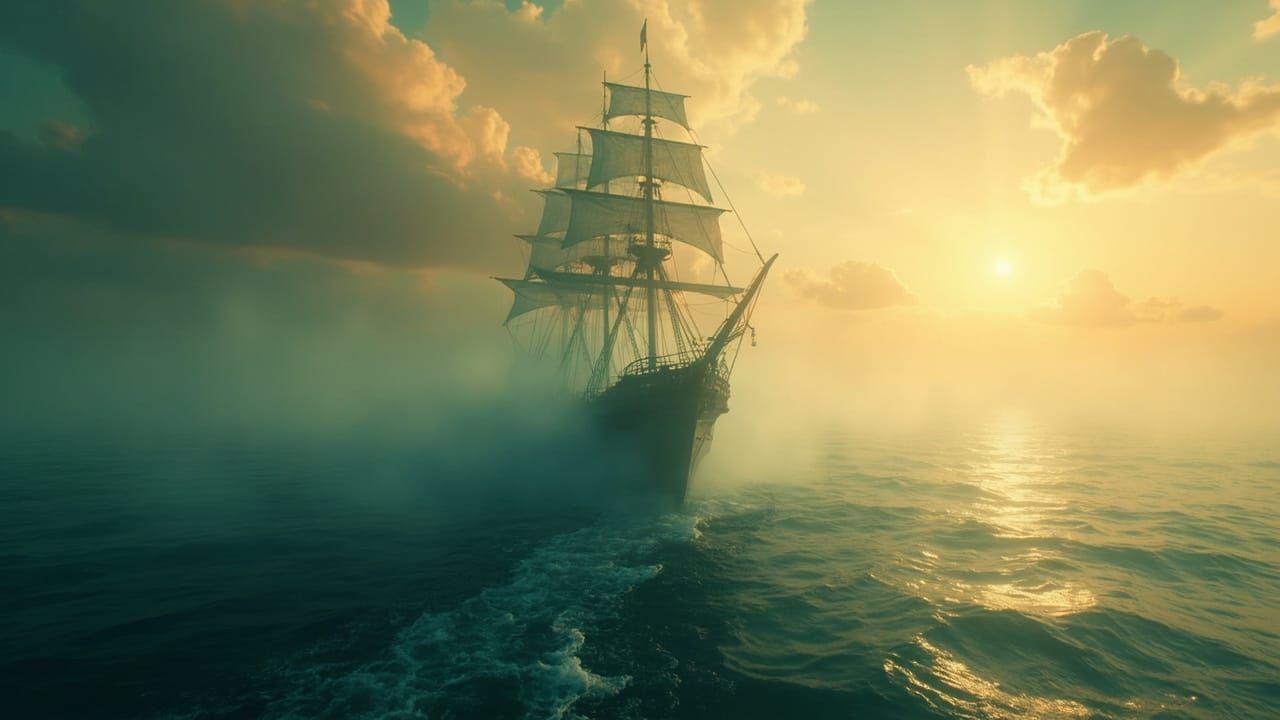
She was intact. Not a wreck, not a ruin, but a fully-rendered ghost ship, her masts and rigging detailed with a clarity that made Mara's breath catch. She sat in the water as if she had never left it, her lanterns lit, her sails furled, her hull riding the current in a way that should have been impossible given that the current itself was bending around her like water around a stone.
Mara raised the sail and motored toward her, and as she approached, the world seemed to compress, to thicken, to acquire a weight and presence that pressed against her skin. The air smelled different — salt and tar and something older, something mineral, something that made her think of deep caves and older oceans.
She tied off at the Vera Cruz and climbed the rope ladder hanging from her rail, and when she stepped onto the deck, she found Thomas Alder waiting for her.
"I was wondering if you'd come alone," he said. "The last ones always brought others."
"The last ones?"
"The last cartographers." He gestured toward the hatch to the captain's quarters. "She's been charting the sea floor for three hundred years, Ms. Voss. The Vera Cruz doesn't hold treasure. She holds the shape of everything that was ever lost in these waters — every wreck, every current, every tide. She is the map of what the ocean remembers."
Mara stepped into the captain's quarters and found it filled with charts. Thousands of them. Every inch of wall was covered with hand-drawn maps, and they were still being drawn — old ink bleeding into new vellum, lines moving and shifting like the current itself, the ship updating its own record of everything the sea had swallowed.
And there, on the central table, she found a chart that looked like her own coastline. Her own harbor. Her own waters.
A chart that was dated tomorrow.
The Calculation
"You don't have to accept," Alder said, when she emerged from the captain's quarters with her hands full of maps she didn't fully understand. "The ship offers. She doesn't compel. You can walk away, and she'll wait for the next one."
"And if I accept?"
"Then you join her. You become part of the charting. The Vera Cruz needs a cartographer who can read what she's drawn — and then draw what comes next."
Mara looked at the charts in her hands. She looked at the ship around her. She looked at the water outside, still running wrong, still bending around the hull like a living thing.
"The current runs wrong because of her," she said.
"Because of what she holds. The weight of all that memory, all that lost geography — it bends the water. That's why the measurements never made sense. They were trying to chart an ocean that was being continuously rewritten by a ghost."
Mara thought about her life. The cottage. The career she'd walked away from. The growing suspicion that she had been waiting for something without knowing what it was.
She thought about her grandmother, who had always said that the sea in these waters was alive, and that you only ever saw what it wanted you to see.
The Open Door
Mara Voss climbed back aboard the Cassandra and motored back to Pelican Cove as the sun began to set. She filed nothing with the hydrographic office. She told no one what she had seen. She spent the night studying the charts she had brought back — maps of shipwrecks and tidal patterns and ocean floors that matched no survey she had ever seen.
At 03:47 in the morning, she sat down at her grandmother's desk and began to draw.
She did not know what she was charting. Not yet. She only knew that the ocean was speaking, and that for the first time in her life, she was listening.
Thomas Alder had told her the truth: the ship offered. She didn't compel. There was still time to put the charts away, to take the Cassandra back to her mooring, to return to the life she had been living.
But the current was already running wrong outside the harbor, and Mara Voss was already beginning to understand that the sea does not ask permission before it changes you.
She drew another line on the chart.
And somewhere in the deep water, three miles northeast of the cove, the Vera Cruz adjusted her sails and waited for the next window to close.
THE END