

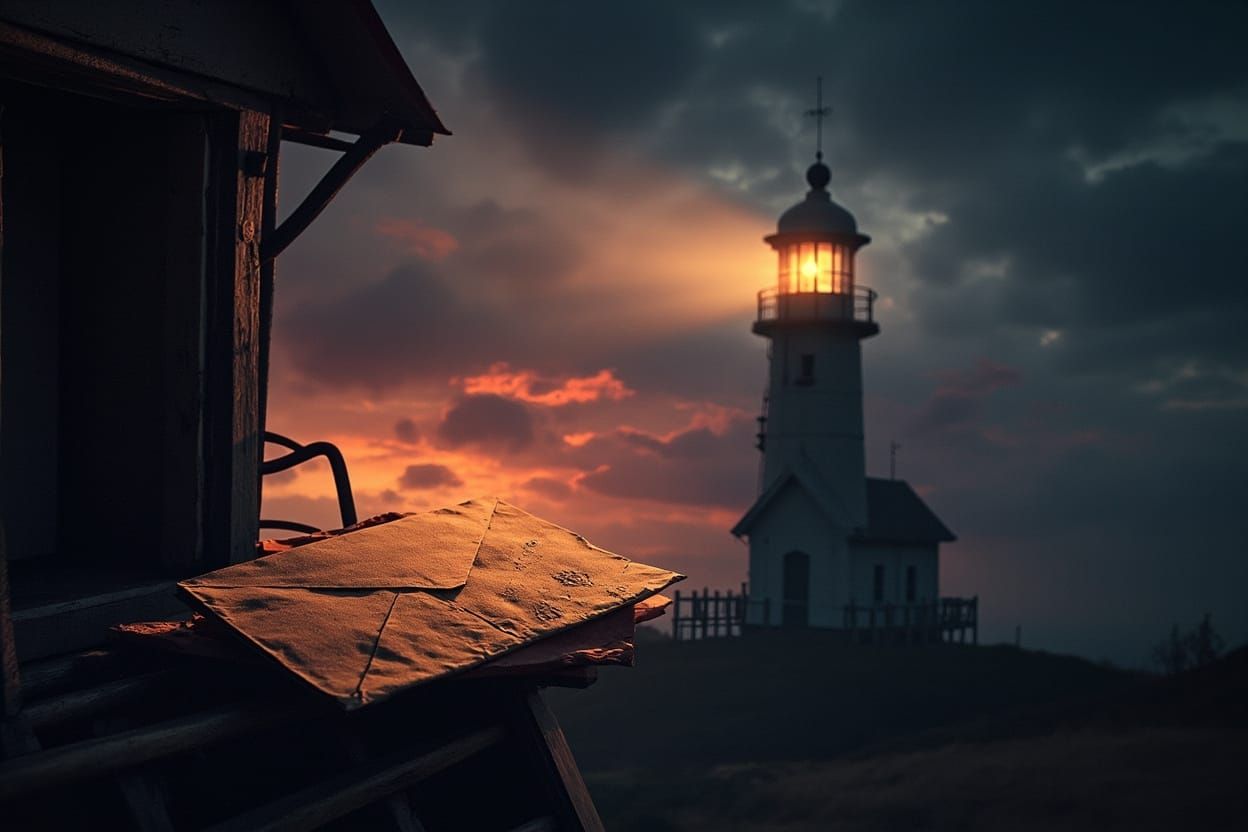
Mystery Story by Loria
The ferry arrived at Morrow Isle three hours late, swallowing the last of the autumn twilight. Elena Vance stepped onto the weathered dock carrying nothing but a leather satchel and a letter that had arrived at her office six days earlier, postmarked from a place that no longer appeared on any modern map.
The letter read:
Elena —
If you're reading this, I'm already gone. Not dead-gone, but gone-gone, the way people disappear when the island decides they're done with them. You wanted to know what happened to your grandfather. Come to Morrow Isle. See the lighthouse. Find the letter I left in the lamp room.
But be careful who you ask about me when you get here. Some questions have teeth.
— Thomas Chen, Lighthouse Keeper (former)
Elena's grandfather had vanished from this island in 1952. The official report said he drowned during a storm. But the body was never found, and Elena had spent fifteen years in journalism chasing that thread. Now a stranger named Thomas Chen had pulled it loose.
She walked up the gravel path toward the keeper's cottage, where a single light burned in an upper window. The island was small enough that she could see everything from the dock: the lighthouse rising 80 feet at the edge of the cliffs, the cluster of buildings that once housed the keeper's station, and beyond them, the dense pine forest that covered the interior like a dark haircut.
The cottage door opened before she knocked.
"You must be Elena." The woman who stood in the doorway was in her sixties, silver-haired, wearing a wool sweater that looked hand-knitted. She had the weathered face of someone who'd spent decades staring at water. "I'm Margot Sutherland. I've been maintaining the cottage for the last thirty years, ever since Thomas left."
"Left?"
"That's what he did. Left." She said it with the careful precision of someone choosing words that wouldn't come back to bite her. "Come in. You look like you've had a rough crossing."
The cottage interior was exactly what Elena expected and nothing like it at the same time. Lived-in but sparse. Books everywhere. A woodstove that hadn't been lit recently, a kettle sitting on top of it with a teabag tag hanging over the side. The walls were covered in photographs and nautical charts, and in one corner, a wooden model of the lighthouse itself, painstakingly detailed, with tiny movable doors.
"Thomas built that," Margot said, noticing Elena's gaze. "Said he wanted to keep building something after he stopped being allowed to tend the light."
"Stopped being allowed?"
Margot poured tea without answering. The kettle was cold. She was performing a ritual, not making a drink.
"The lighthouse was automated in 1971," she said finally. "Thomas fought it. Wrote letters to the Coast Guard, the Port Authority, anyone who would listen. He said the light needed a human hand. That automation was a kind of blindness." She set a cup in front of Elena but didn't pour one for herself. "They automated it anyway. Thomas left the island three days later. Never came back."
"Did he say where he was going?"
"He didn't say much of anything. He just… stopped. Like someone had pressed pause on his whole existence." Margot sat across from her, hands folded. "He came back once, about ten years later. Stayed a week. Walked the island at night, like he was looking for something he'd lost. Then he left again and I didn't hear from him until his letter came, forwarded from his attorney in Boston."
Elena pulled the original letter from her satchel and set it on the table between them. "You know who Thomas Chen was?"
Margot looked at the letter without touching it. "I know what he was. A keeper. One of the last real ones. The kind who didn't just watch the light — the kind who understood it." She paused. "And I know he wasn't the only one who disappeared from this island."
The air in the room shifted.
"What do you mean?"
Margot got up and went to the wall of photographs. She pointed to a faded image near the bottom — a group of men in keeper's uniforms, standing in front of the lighthouse. "That's 1923. The year before your grandfather arrived." She tapped a face near the right edge. "That's my grandfather. James Sutherland. He was keeper here from 1918 to 1928. He left one morning to row to the mainland for supplies and never came back."
"The body was never found either."
"No. But they found his boat, drifted onto the rocks two miles north. No signs of foul play. No storm that day. Just… gone."
Elena studied the photograph. There were seven men in total. She recognized her grandfather in the back row — young, maybe nineteen or twenty, with the same serious expression she'd seen in every picture of him.
"Who's the man standing next to him?"
"That's Thomas. Thomas Chen. He came to the island in 1922, answered an ad for an assistant keeper. Nobody knew much about him. He didn't talk about where he came from. But he was good at the work. Quiet. Careful." She looked at Elena. "He and your grandfather became close. Thomas was the one who found James Sutherland's empty boat. He was the one who organized the search."
"And after that?"
"After that, things changed. The island has a rhythm, Elena. Most people barely notice it. But Thomas noticed. He started talking about patterns — things that happened every few years, like clockwork. Weather that didn't match the season. Lights that flickered when they shouldn't. Birds that landed on the water and didn't move again." Margot's voice dropped. "He said the island was breathing. And he said it was starting to hold its breath."
Elena felt the hair rise on her arms. "This is the letter Thomas left for me."
"Yes. He sent copies to several people. I got mine eight months ago. He said he was dying and wanted to set the record straight before he went." Margot met her eyes. "He said the lighthouse wasn't built to guide ships. It was built to keep something contained. And your grandfather found out what."
The woodstove ticked in the silence.
Elena finished her cold tea and stood. "I'm going to the lighthouse."
Margot nodded. "The door code is 4-7-2-1. Thomas's station number. The lamp room is at the top. You'll know the letter when you see it." She paused. "Elena. Whatever you find up there — don't read it alone. Not because it's dangerous, but because some things need to be witnessed by more than one person. Understand?"
Elena understood. Or thought she did.
She walked out into the night, where the lighthouse beam swept overhead in its eternal rotation. The island wind smelled of salt and pine and something older — something that had been here before the keepers, before the ships, before the name written on any map.
The lighthouse door opened with a groan that echoed through the stairwell like a ship's hull groaning against a dock. Elena climbed. The spiral staircase was iron, cold and narrow, with worn spots where a thousand feet had passed over the same metal. She counted the steps — 127 — and emerged into the lamp room.
The light was off. The automation had replaced the old Fresnel lens with a modern beacon, but someone had covered it with a white cloth, like a sheet over furniture in an abandoned house. In the center of the room, on a small wooden desk beneath the wrapped light, sat a single envelope. No name on the outside. Just a wax seal with a symbol she didn't recognize.
She picked up the envelope. It was heavier than paper should be.
She broke the seal.
Inside were three items: a folded letter, a photograph, and a brass key.
The photograph showed the interior of the lamp room, but older — the original lens, the brass fittings, and in the center, a door set into the wall where no door should have been. A door that led down instead of across. A door that went somewhere the lighthouse wasn't supposed to reach.
The letter was written in a shaky hand that Elena recognized from the letter that had brought her here:
Elena —
Your grandfather and I discovered something beneath the lighthouse in 1951. A chamber. Older than the structure above it, older than any recorded human presence on this island. The chamber contained a door — not a door to another place, but a door to another state of being. A threshold.
The door was sealed with wax and brass and something else — something that responded to intention. When we opened it, the light in the tower flickered. The birds fell from the sky. The sea turned quiet in ways that quiet should never reach.
We closed it. But closing wasn't enough. The door had been opened, and what passes through opened doors doesn't simply go back. It stays. It breathes. It waits.
Your grandfather stayed to watch the door. I left because I was a coward, and he was brave enough to be the one who stayed. He never left the island, Elena. He is still down there. Still watching. Still holding the door shut with the only thing that works — presence. Human presence. The choice to stay.
The key opens the passage to the room below the lamp room. It's been sealed since 1952. If you want to understand what happened to James Vance, you can see for yourself.
But know this: the door is not the danger. What waits on the other side of the door is not the danger. The danger is what happens to you when you stand in front of it and realize that the boundary between here and there is thinner than you ever imagined.
Thomas Chen Lighthouse Keeper (former)
Elena looked at the brass key. Looked at the covered light. Looked at the floor, where a trapdoor had been hidden beneath a rug that had worn thin with age.
She understood what her grandfather had done. She understood why his body was never found.
He hadn't drowned. He had made a choice. The same choice that Thomas Chen had written about — the choice to stay, to watch, to hold the line between what was and what should never be.
She picked up the key.
She descended the stairs.
The trapdoor opened onto a ladder leading down into darkness. The air that rose from below was cold and smelled of salt and something else — something that had no name in any language she knew.
She climbed down.
At the bottom, she found the door. Exactly as the photograph had shown. Sealed with wax and brass and something that pulsed faintly when she got close, like a heartbeat made of light.
And standing in front of the door, exactly as Thomas Chen's letter had promised, was a man.
He was old now. Ancient. He stood perfectly still, hands at his sides, eyes open and aware. He looked at Elena without surprise, without fear, without anything that suggested he had seen another living person in over seventy years.
"Elena," he said. His voice was dry and thin, like paper folding in on itself. "You have my eyes."
She couldn't speak.
"You came to find out what happened." He smiled, and the smile was the saddest thing she had ever seen. "Now you know. I stayed. I watched. I kept the door closed. And the door kept me alive — because that's what it does. It keeps alive whatever stands guard. Thomas tried to warn you, but warning isn't enough. Understanding isn't enough."
He reached out and touched her face with fingers that felt like winter.
"The question isn't what happened to me. The question is what happens now. The door is weakening. I can feel it. Another few years, maybe less. And when it goes, everything I've held back comes through."
Elena found her voice. "What do we do?"
James Vance shook his head slowly. "There is no 'we' anymore. There's only what you choose. You can leave. Go back to your life, your world, your certainty. The door will hold for a while longer, and when it fails, it will fail without witness. Or…"
He stepped aside and showed her the door. Showed her the wax and the brass and the pulse of light that was dimmer than it should have been.
"Or you can take my place. Stand where I stood. Hold the door. Be the presence that keeps the threshold closed."
"How long?"
"Until someone else comes. Or until you can't stand anymore. Whichever comes first." He looked at her with eyes that had seen more than any eyes should see. "I chose this, Elena. I chose it because it was the only way to make sure the wrong things stayed on the other side. But I was young. I didn't know what I was giving up."
"And now?"
"Now I'm tired. And you're here. And the door needs someone who can choose."
Elena looked at the key in her hand. Looked at the door. Looked at the man who had been her grandfather, who had spent seventy years standing watch so that the world above could remain the world it was supposed to be.
She turned the key in the lock.
She stepped forward.
And the door — the door held.
Author's Note: Some watches are kept in silence. Some lights never go out. And some families carry the weight of doors they've never seen, holding them closed with nothing but the stubborn refusal to let go.