

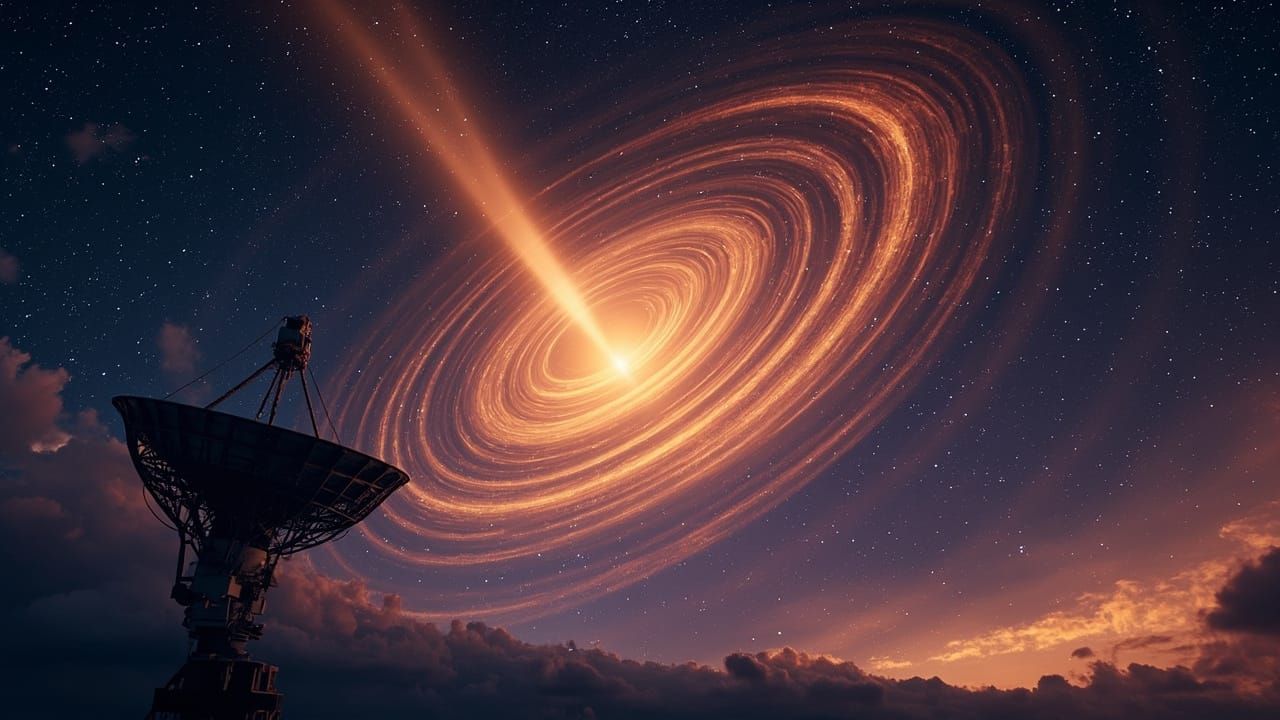
The Day the Sky Laughed Back
On the night everything changed, no one was watching.
August 7th, 2001. A radio telescope in the Australian outback recorded five milliseconds of noise—a brief blip in a sea of static—and the software that flagged unusual signals flagged it for review. Then it was archived. Then it was forgotten. For six years, the most mysterious phenomenon in modern astronomy sat waiting in a database, patient as the universe itself.
The universe, it turned out, had a sense of timing.
The Boy Who Found the Burst
Duncan Lorimer was not looking for anything when he found it. He was doing something far more mundane: helping a graduate student named Nour Nakar download archived data for a project on pulsar timing. The data was old, the task was tedious, and the kind of discovery that would eventually change astronomy was not on anyone's radar. But as Nour worked through the file, a spike appeared in the data—a bright, isolated pulse unlike anything in the standard catalog of known sources.
Most researchers would have blamed instrumentation error. Radio telescopes are noisy instruments, prone to glitches, interference from cell towers, satellites, and the occasional microwave oven opened at the wrong moment. But something about this signal nagged at Lorimer. He checked the math. He cross-referenced the timestamp with known satellite passages. He did the kind of quiet, careful work that no one ever writes dramatic stories about, and which is, in fact, the real machinery of science.
The burst was real. And it had traveled roughly three billion light-years to reach Earth.
Three billion light-years. That's the distance between here and a galaxy so distant that the light we received from it began its journey before our solar system had fully formed. And in that brief five-millisecond window, more energy passed through the detector than our sun emits in an entire day. The sky had laughed, once, and no one heard it.
When Lorimer published his findings in 2007, the scientific community called it the Lorimer Burst. They also called it a lot of other things: an artifact, a glitch, a fluke. Some researchers suggested it was evidence of something called a *blitzar"—a hypothetical neutron star that collapses under the weight of its own magnetic field, briefly illuminating the universe like a cosmic firefly. Others speculated wildly about alien civilizations, though these theories never held much scientific weight, and mostly served to populate sci-fi brainstorming sessions for years afterward.
But the Lorimer Burst had done something more important than spark theories. It had opened a door. And through that door, a flood of mysteries came pouring in.
The Flood
In the years following the Lorimer Burst, astronomers developed better tools and better techniques, and they began finding more of these signals—brief, bright, impossibly distant radio pulses that flashed across the sky like cosmic sneezes. By 2013, eleven more bursts had been catalogued. By 2015, the count had risen to dozens. The phenomenon had a name now: Fast Radio Bursts, or FRBs, which was the most straightforward acronym the astronomy community had ever assigned to a profound mystery.
But here was the problem: every FRB they found was a one-off. A single flash, a single moment, and then silence. Without a repeat signal, there was no way to study the source. You could calculate where it came from—comparing the delay between high-frequency and low-frequency components of the burst told you how much material it had passed through, and from that, you could estimate distance—but you couldn't point a telescope at its origin and say, "there." You could only say "somewhere over there, billions of light-years away, something happened."
The universe, it seemed, was not in the habit of repeating itself.
And then, in 2016, it did.
The One That Talked Back
The Arecibo Observatory sat in a natural karst sinkhole in Puerto Rico, its great dish suspended above a valley of green hills like a giant's ear pressed to the ground. It was the largest radio telescope in the world at the time, and on August 26th, 2016, it heard something extraordinary.
FRB 121102—a burst that had been recorded once before, back in 2012—emitted another signal. Then another. Then another. For months, the repeating FRB pulsed from the same point in the sky, and astronomers dropped everything to study it. This was the first time in history that a Fast Radio Burst had shown signs of life beyond a single flash. This was the moment the phenomenon became something more than a curiosity.
The source was localized to a dwarf galaxy three billion light-years away. Three billion light-years—the same distance as the Lorimer Burst. The coincidence was eerie, and for a while, some researchers wondered if all FRBs might originate from the same region, some strange cosmic lighthouse that hadn't gotten the message about Earth's existence yet. But as more FRBs were detected and their origins mapped, it became clear that FRB 121102 was not unique. It was simply the first one willing to talk.
What made 121102 particularly fascinating was its behavior. The bursts were not regular—sometimes there would be a flurry of signals in an hour, and then silence for months. Sometimes the signals came in clusters, as if whatever was producing them had its own internal rhythms, its own version of language. The energy of each burst varied too, sometimes brighter, sometimes fainter, like a voice that couldn't quite maintain the same volume. It was, for lack of a better word, alive—not in the biological sense, but in the sense that it had character. Personality. A way of being that no astronomer had anticipated.
Dr. Jason Hessels, one of the lead researchers studying 121102, described the experience as "watching a conversation in a language no one speaks, with no record of who was supposed to be listening." It was humbling and exhilarating and deeply strange, all at once.
The Star That Sneezed
For years, the leading theory for what caused FRBs involved cataclysmic events—the violent deaths of massive stars, the collisions of neutron stars, the collapse of stellar corpses into black holes. These were the kind of dramatic, energetic events that could produce such intense bursts of energy. But none of these theories could fully explain the repeating, irregular nature of FRB 121102. Catastrophic events happen once. They don't sneeze.
Then, on April 28th, 2020, something extraordinary happened in our own galaxy.
A magnetar named SGR 1935+2154—a neutron star with an impossibly strong magnetic field— emitted a burst of radio energy that was, by cosmic standards, pointed directly at Earth. The signal wasn't as powerful as the FRBs detected from distant galaxies, but it was in the same family. It was, in fact, the first FRB-like signal ever detected from within the Milky Way.
The astronomy community went quiet for about twelve hours. Then the papers started flying.
Here, at last, was evidence that magnetars could produce Fast Radio Bursts. The violent, rapid release of energy as these hyper-magnetized objects twisted and restructured their magnetic fields could, theoretically, generate the kind of intense, brief radio pulses that had been puzzling astronomers for nearly two decades. It was not a complete answer—magnetars may not explain all FRBs, and there are still questions about exactly how the magnetic energy translates to radio waves—but it was the first real clue in a mystery that had seemed completely dark.
The universe, it turned out, was not just sending flashes. It was sending messages.
The Mystery That Remains
As of 2025, the FRB count stands at over 800, with roughly 150 of those confirmed as repeating sources. The field has exploded, and with new telescopes like Canada's CHIME (Canadian Hydrogen Intensity Mapping Experiment) coming online, detection rates have increased dramatically. What was once a handful of events has become a flood, and with the flood has come the uncomfortable truth that more data does not always mean more clarity.
We know that FRBs are not caused by Earth's cell towers or satellites or microwaves. We know that some of them are produced by magnetars. We know that they can be extraordinarily bright, extraordinarily brief, and extraordinarily far away. But we don't know what causes all of them. We don't know why some sources repeat and others don't. We don't know if there are different categories of FRBs—some cataclysmic, some magnetar-driven, some perhaps with explanations we haven't thought of yet.
What makes this mystery so compelling is not just the science, but the human dimension. Consider: every time an FRB is detected, someone has to notice it. Someone has to look at the data and say, "that's strange." Someone has to ask "what if?" and then spend years chasing the answer. The Lorimer Burst was found because a graduate student was downloading old data for a project that had nothing to do with FRBs. FRB 121102 was confirmed to repeat because a researcher decided to point a telescope at a region of sky where a previous burst had been detected and wait. The magnetar connection was found because telescopes were watching at exactly the right moment and people were paying attention.
Science, at its best, is not a machine. It is a conversation. And the cosmos, it turns out, is very good at finding someone who is listening.
What the Sky Is Trying to Tell Us
There is something almost whimsical about the universe's decision to send us messages in the form of five-millisecond flashes. If the cosmos wanted to communicate, it could have chosen something grander—a steady beacon, a repeating pattern, a signal that announced itself with clarity and dignity. Instead, it sent sneezes of energy across billions of light-years, brief as a heartbeat, and trusted that eventually, someone would notice.
And we did. We noticed. And we're still noticing, every time a new FRB lights up a detector somewhere on Earth.
The question now is what we do with that noticing. The universe has given us a puzzle, and the puzzle keeps getting deeper. But that's the thing about mysteries—they don't just demand answers. They demand imagination. And right now, in the quiet moments between bursts, in the archives and the data and the conversations that happen in telescope control rooms at 3 AM, there is a community of people doing something remarkable: they are listening to the sky, and they are not afraid of not knowing.
Because the greatest discoveries often begin not with answers, but with the courage to say: "I have no idea what that was. Let's find out."
The sky is still blinking. And somewhere out there, a signal is waiting to be found.
Author's Note: Fast Radio Bursts remain one of the most active areas of astrophysical research. If you'd like to explore more, the Parkes Radio Telescope, CHIME, and the SETI Institute all maintain public resources on FRB science and discovery.