

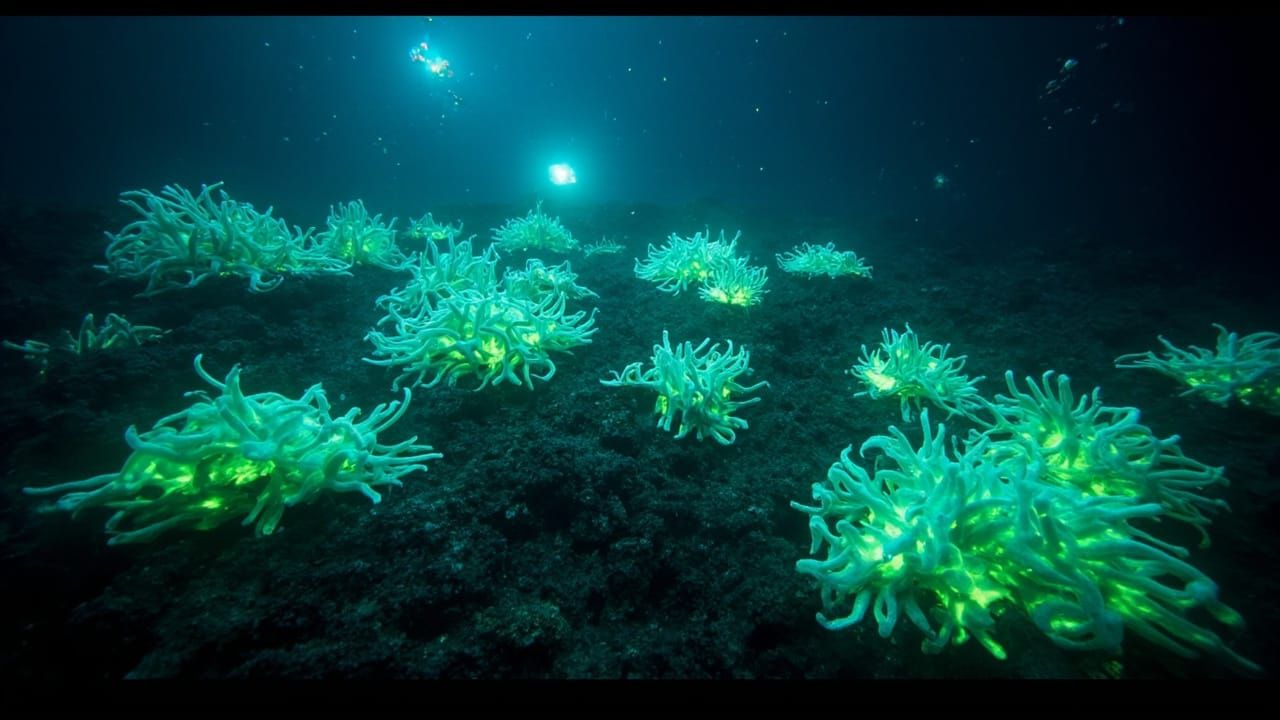
How life finds a way to glow where the sun never reaches
Part One: The Descent
Dr. Yuki Tanaka had spent eleven years studying life in places where it shouldn't exist. Her office at the Monterey Bay Aquarium Research Institute was cluttered with photographs of hydrothermal vents, petri dishes stained with bacterial cultures, and a single faded postcard from the Alvin submersible expedition of 2012 — the one where she'd first seen the smoke-dark plumes erupting from the seafloor at 2,900 meters below the surface of the Pacific.
But nothing had prepared her for the photographs that arrived in her inbox on a Tuesday morning in March.
The email had come from the crew of the research vessel Kairei, currently conducting a survey of the Challenger Deep — not the famous trough near Guam that every oceanography student memorizes, but a lesser-known depression in the Pacific's western basin, a set of fault lines and fracture zones where the crust was thin and the heat from the Earth's mantle pressed close. The dive had been routine: deploy the remotely operated vehicle, send it down through the aphotic zone where no light survived, watch the feed from two miles above.
What the ROV's cameras revealed was not routine.
"They were everywhere," Yuki murmured, scrolling through the image stack. "Hundreds of them."
The photographs showed clusters of what appeared to be microbial mats — but these weren't the gray-orange films she was used to seeing around hydrothermal vents. These were green. Not the green of algae or the green of cyanobacteria in shallow water, but a bright, almost electric green that seemed to pulse faintly even in the still images. The clusters grew on basalt outcroppings at the very bottom of the Challenger Deep, in water that had a temperature of 1.8 degrees Celsius and a pressure more than a thousand times greater than at the surface.
The green was bioluminescence. Living light, generated by organisms in the deepest place anyone had ever found them.
Yuki closed her laptop. She sat in the dim glow of her desk lamp for a long time, thinking about what this meant.
Part Two: The Deep Biosphere
To understand why this discovery mattered, you had to understand what scientists called the Deep Biosphere — the vast, invisible ecosystem that exists within the planet's crust, in the pores of basalt and sandstone, in the fissures of hydrothermal rock, in the毛细裂缝 that spider-web through every underwater formation on Earth.
For decades, microbiologists had suspected that this biosphere existed. Drill cores pulled up from thousands of meters below the seafloor had revealed microbial life — not just traces of ancient organisms preserved in stone, but living, metabolizing cells that were genuinely alive, dividing, exchanging nutrients, doing the slow business of living in one of the most extreme environments imaginable. Temperature: high. Pressure: immense. Food: almost nothing. Energy: not from sunlight but from the chemical energy released by reactions between rock and water — a process called chemosynthesis.
The deep biosphere was, in many ways, the largest ecosystem on Earth. Estimates put the total biomass of these subsurface organisms at roughly equal to all the life in the oceans above. They were everywhere and nowhere — too small to see, too deep to easily study, but fundamentally important to the planet's chemistry.
What Yuki and her team had found in the Challenger Deep was a window into this world that no one had ever glimpsed before.
The green luminescent mats weren't just unusual — they were a new type of organism entirely. Genetic sequencing would later confirm this: the organisms belonged to a previously unknown phylum, provisionally named Luminifera, and they appeared to generate light not for communication or predator deterrence — the usual reasons organisms bioluminesce — but as a byproduct of a metabolic process that science had no name for. They were, in effect, using light as a waste product, the way some bacteria use heat.
This was not supposed to be possible. Bioluminescence in the deep ocean is well documented — anglerfish, jellyfish, certain shrimp — but those organisms evolved bioluminescence over millions of years for specific ecological functions. These new organisms were producing light as an incidental metabolic product, which suggested an entirely different biochemical pathway than anything previously known.
Part Three: The Astrobiology Question
Within a week of the discovery, Yuki had received seventeen emails from colleagues in fields she barely recognized — astrobiologists, exoplanet researchers, atmospheric chemists. They all wanted to know the same thing: if life could generate light as a metabolic byproduct in the deepest, darkest, most inhospitable place on Earth, what did that tell us about life on other worlds?
The implications were profound. Europa, Jupiter's ice-covered moon, had a subsurface ocean that was thought to be chemically similar to the deep ocean environments where these organisms had been found. Enceladus, Saturn's small but active moon, gushed water vapor from cracks in its icy shell — water that contained organic compounds and was under enormous pressure. Both moons were considered prime candidates in the search for extraterrestrial life.
But they were hard to study. Europa was 628 million kilometers away. Enceladus was 1.2 billion kilometers away. The distances were so vast that even the best telescopes could only infer the conditions on their surfaces, never directly observe them.
What Yuki's discovery did was provide a proof of concept. Life, it turns out, doesn't need light. It doesn't even need the right temperature, or the right atmospheric pressure, or the specific mix of chemicals that we tend to associate with habitability. Life needs energy, and energy can come from rock reacting with water, from chemical gradients in deep subsurface oceans, from the heat of a planetary core leaking slowly upward through layers of ice and stone.
The deep biosphere of Earth was not an anomaly — it was a model. A map of the kinds of life that could exist on worlds we couldn't yet reach.
Part Four: The Color of Survival
Three months after the initial discovery, Yuki was aboard the Kairei again, watching the ROV dive toward the same cluster of vents in the Challenger Deep. This time, she had designed the dive herself. The ROV was equipped with a full suite of instruments: water samplers, temperature probes, cameras sensitive enough to detect bioluminescence at a nanosecond timescale, and a set of experimental LED panels that could be programmed to emit specific wavelengths of light at specific intensities.
The question she was trying to answer was simple: why green?
Light in the deep ocean is strange. The surface of the water filters out almost all wavelengths except blue and green — the same reason the ocean looks blue from space. But at 2,900 meters, there is no light at all. The ocean is as dark as space. Photosynthesis is impossible. Life survives not by capturing light but by capturing chemical energy.
So why would an organism in this environment evolve to produce green light?
The answer, Yuki suspected, had nothing to do with light at all. It had to do with the biochemistry of the cell.
Her team ran the tests. The green luminescent compounds were produced in the organism's ribosomes — the cellular machines that assemble proteins. When the ribosomes were operating at maximum capacity, during periods of rapid protein synthesis, the luminescent compounds were released as a metabolic byproduct. The light was, in a very real sense, a sign of the cell's productivity. More protein synthesis meant more light.
In the dark world of the deep biosphere, the organisms had no way to measure their own activity except by producing light. The green glow was not a signal to other organisms — it was a signal to themselves. A readout. A metabolic gauge.
This changed the way Yuki thought about bioluminescence. For all of human history, we had assumed that light produced by living things existed for communication — to attract mates, to lure prey, to warn predators. But here was an organism that used light the way we use a heartbeat or a thermometer. Not to talk, but to measure.
Part Five: The Living Instrument
Six months after the discovery was published, Yuki gave a lecture at NASA's headquarters in Washington. The room was full — astrobiologists, planetary scientists, mission planners. She showed them the photographs, the genetic data, the metabolic pathway diagrams. Then she showed them a video.
The footage had been recorded by the ROV during the third dive. The cameras were in darkness, as always — the deep had no light to capture. But the bioluminescent mats glowed faintly, and as the ROV's lights swept across them, the glow intensified. The organisms were responding to the light, increasing their metabolic activity, producing more of the luminescent compound.
For a moment, the cluster of mats was so bright that it lit the entire seafloor — a ghostly green glow that revealed the texture of the basalt, the shadows of nearby rock formations, the faint plumes of dark water rising from cracks in the crust.
Then the lights moved on, and the glow faded, and the deep was dark again.
"This is what survival looks like," Yuki said. "Not the lion on the savanna. Not the bird in the forest. A cluster of cells at the bottom of the world, generating light because it's what they do. Because living, at its most fundamental, is a process of energy transformation, and energy transformation, in the right conditions, produces light."
She paused.
"We have spent a hundred years looking for life on other worlds by looking for light. Telescopes, radio signals, infrared signatures — we search the cosmos for any hint that energy is being captured and released by something we might recognize as alive. But this is what we've been looking for. Not a signal from a distant civilization. Not a beacon designed to be seen. Just the ordinary, accidental glow of life doing what life does."
The room was silent.
"The deep biosphere of Earth is the most alien environment on our planet. And in the deepest part of the deepest ocean, we found life that glows — not to be seen, but because it cannot help it."
Part Six: What Glows in the Dark
Six months after her NASA lecture, Yuki was in her office when her graduate student, David, knocked on her door. He had a printout in his hand — an article that had just been published in Nature Astronomy. The headline read: Luminescence Detected in Subsurface Ocean模拟 on Europa — Preliminary Results.
The article described data from the Europa Clipper spacecraft, which was currently on its way to Jupiter's moon. The spacecraft's magnetometer had detected anomalous readings during a close flyby of Europa's surface — readings that suggested the presence of plasma emissions consistent with bioluminescent activity in the moon's subsurface ocean. The data was preliminary. The instrument had not been designed to detect this. But the signal was there, faint but unmistakable.
David put the printout on her desk.
"They found it," he said.
Yuki read the article twice. Then she went to the window and looked out at the darkening sky, the city lights of Monterey shimmering on the water below. Somewhere out there, past the atmosphere, past the solar wind, past the radiation belts of the inner solar system, a moon was orbiting a planet 628 million kilometers away. And on that moon, beneath a shell of ice three kilometers thick, something was glowing.
She thought about the organisms in the Challenger Deep — the luminous mats on the basalt, the metabolic glow of cells doing what cells do, the green light that meant nothing and everything at once.
Life, it turned out, was not a miracle. It was a tendency. A property of matter under the right conditions, in the right environment, with enough time. Life wanted to exist. It pushed into every crack, every fissure, every dark corner of the planet where energy and chemistry allowed it. And when it existed, it did the things that living things do — metabolize, grow, divide, and, on some worlds, glow.
Yuki sat back down at her desk. She opened a new document and began to write.
The story of the deep biosphere was just beginning. And somewhere in the outer solar system, something was lighting up the dark.