

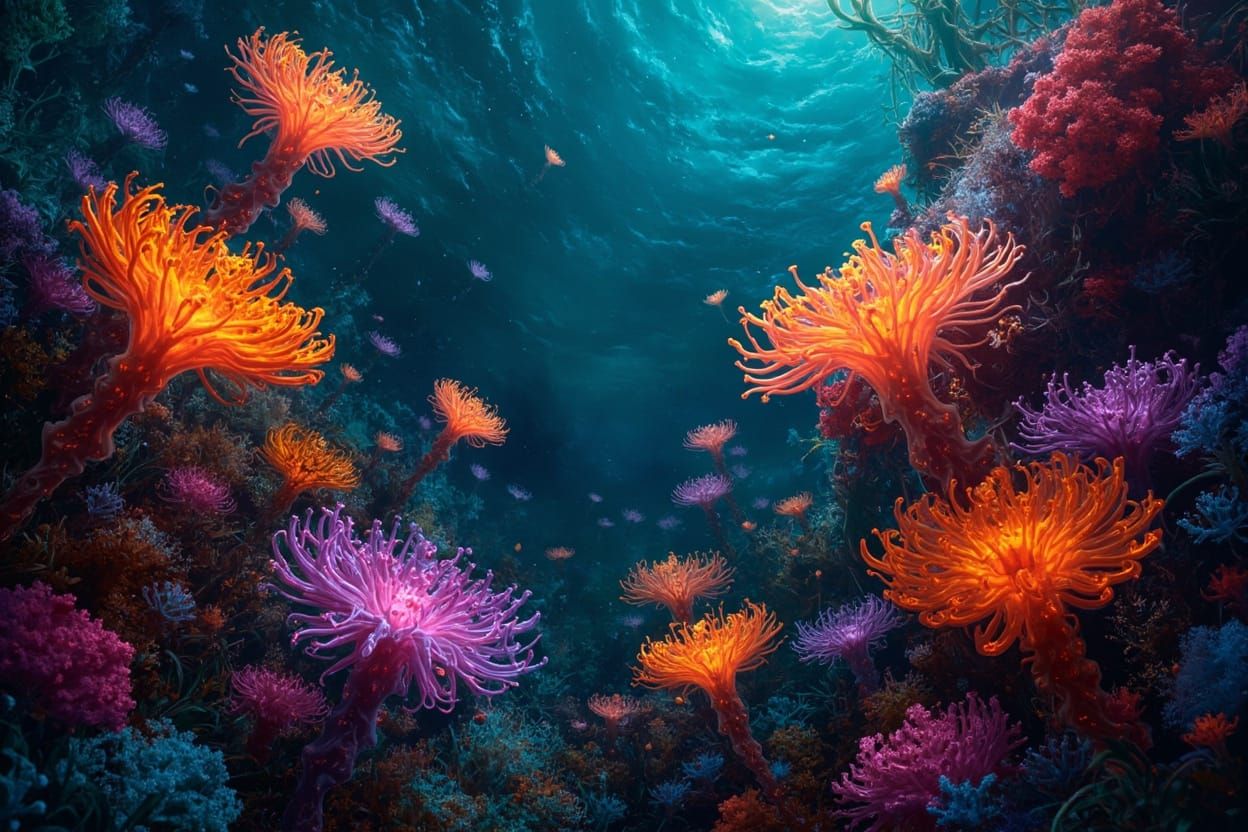
Dr. Maris Vidal had spent eleven years studying the bioluminescent ecosystems of the Mariana Trench, and she had learned to expect the impossible. The deep ocean was a place where the rules of the surface world simply stopped applying. Pressure that should crush, life that not only survived but thrived. Darkness so complete that some creatures had evolved to simply not exist visually — they were invisible to each other, phantoms in an endless black.
But she had never seen anything like this.
The ROV's lights cut a narrow cone through the water at 10,900 meters — close to crush depth, close to the kind of place where even the research sub's titanium hull creaked in ways that made the deck crew nervous. Maris was watching the feed from her console in the support vessel, fingers wrapped around a cold cup of tea she had forgotten to drink, when the ROV rounded a volcanic vent and entered a valley that shouldn't have existed.
It was a garden.
Not a metaphorical garden. A literal one. Rows of structures that rose from the seafloor like columns, covered in a soft, pulsing glow that shifted between deep violet and a blue so rich it looked like the ocean itself had learned to dream. The light pulsed in waves — not randomly, not in the chaotic flicker of normal bioluminescence, but with a rhythm. A pattern. A heartbeat.
"Rotate left," she said into her headset. "Full sweep."
The ROV turned, and the garden kept revealing itself. Stands of what looks like crystalline structures, each one individually lit from within, each one pulsing in perfect synchronization with its neighbors. Schools of fish — or things that looked like fish — moved between the columns in formations so precise they could have been choreographed. And at the center of the garden, at the lowest point of the valley, something that looked almost like a greenhouse. A dome of dark glass, or dark ice, or something she had no name for, perfectly still in the current that moved everything around it.
Maris sat back in her chair. Her heart was doing something uncomfortable against her ribs.
"This isn't vents," she said. "This isn't chemosynthesis. This isn't anything."
The international response was immediate and overwhelming. Within 72 hours, the valley had been renamed — the Garden, the media called it, though the scientists preferred something more clinical until they understood what they were looking at. The dome was the focus of everything. Two ROVs, three crewed submersibles, and a seabed drone that cost more than most countries' annual science budgets were deployed to examine it.
Maris was the first human to touch the dome.
She descended in a submersible designed for two, accompanied by Dr. Kenji Okonkwo, a materials scientist who had been flown in from Geneva and who had spent the entire descent反复检查 his instruments as if expecting them to discover they had been lied to about physics.
The dome was warm. That was the first surprising thing. The surrounding water at this depth was just above freezing — maybe 1.5 degrees Celsius. The dome surface registered 23 degrees on every sensor they pointed at it.
The second surprising thing was what happened when she touched it.
The dome was transparent. Not glass-transparent, not ice-transparent — transparent in the way that a window is transparent. On the other side, visible with perfect clarity despite the darkness of the surrounding ocean, was a garden. Not the same garden. A different one. Smaller, enclosed, clearly artificial. Plants she recognized — mosses, ferns, flowers — growing in a bed of soil that was exposed to open air. Air that fogged the inside of her viewport with warmth and moisture.
There was a chair inside the dome. Wooden. Weathered. And on the arm of the chair, a book.
Maris stared. Kenji stared. Neither of them spoke for a very long time.
"That's impossible," Kenji finally said, which was the understatement of the millennium.
The consensus, after six months of study, was that the dome contained a pocket of atmosphere and life that had been sealed for an estimated 1.8 billion years — roughly the age of the oldest known rock formations in the Mariana Trench region. It was not a structure in the conventional sense. It was more like a fold in reality, a bubble of conditions from a different era that had somehow persisted through every catastrophe, every shift in the ocean, every extinction event that had reshaped life on Earth's surface.
The book, when the ROV's robotic arm was finally able to extract it through a carefully widened access valve, was written in a language that bore similarities to no known script on Earth. But someone had taken the time to press flowers between its pages, and someone had written numbers in the margins — long columns of them — and when the cryptographers got hold of those numbers, they found that they described, with perfect accuracy, the positions of the planets in our solar system at various points in history.
The last date in the book was approximately 600 million years ago. The date of the first complex multicellular life on Earth.
They had been keeping records. For nearly two billion years, whoever they were, they had been keeping records. And then, 600 million years ago, they had stopped.
Maris thought about that a lot in the years that followed. She led the team that studied the dome for a decade, watching it become the most visited site on the ocean floor — a pilgrimage destination for scientists, for world leaders, for artists and philosophers and ordinary people who simply needed to stand at the edge of the impossible and feel small in exactly the right way.
The dome never changed. The garden inside it remained at the same stage of growth, the chair remained occupied by its invisible sitter, the book remained open to its final page. Whatever time was inside that bubble, it did not flow the way time flowed outside it.
She retired at seventy-two, having published forty-seven papers on the geological and biological properties of the Garden, and none of them having answered the fundamental question: who, and why, and what did they want us to understand?
On her last dive, she brought a single flower from the surface world — a marigold, bright orange, absurdly cheerful against the crushing dark. She pressed it into the access valve herself, watching through the ROV's camera as it drifted through the warm air on the other side and came to rest on the soil of the ancient garden.
She never saw it grow. The dome's time was not her time.
But she knew, with a certainty she had never felt about anything else in her life, that somewhere in that other flow of moments, the marigold was blooming. Had been blooming. Would bloom forever, in a garden that had been waiting for someone to leave something behind.
The universe, Maris had come to believe, was not empty. It was patient. And it kept its secrets not because it wanted to hide them, but because some things can only be understood when you're ready to receive them.
She died at seventy-eight, in her sleep, with the sound of the ocean in her ears.
Her colleagues carved a single line into her memorial stone, at the bottom of the cliff that overlooked the research station:
She planted something, and it grew.
The Garden at the Bottom of Everything is now a protected site. The dome remains, as it has always remained, exactly as it was. Thousands of people visit it every year, descending through the dark water to stand before the glass and look inside at the impossible garden that has been waiting, in its own time, for two billion years.
No one has ever opened the book.
No one has ever needed to.