

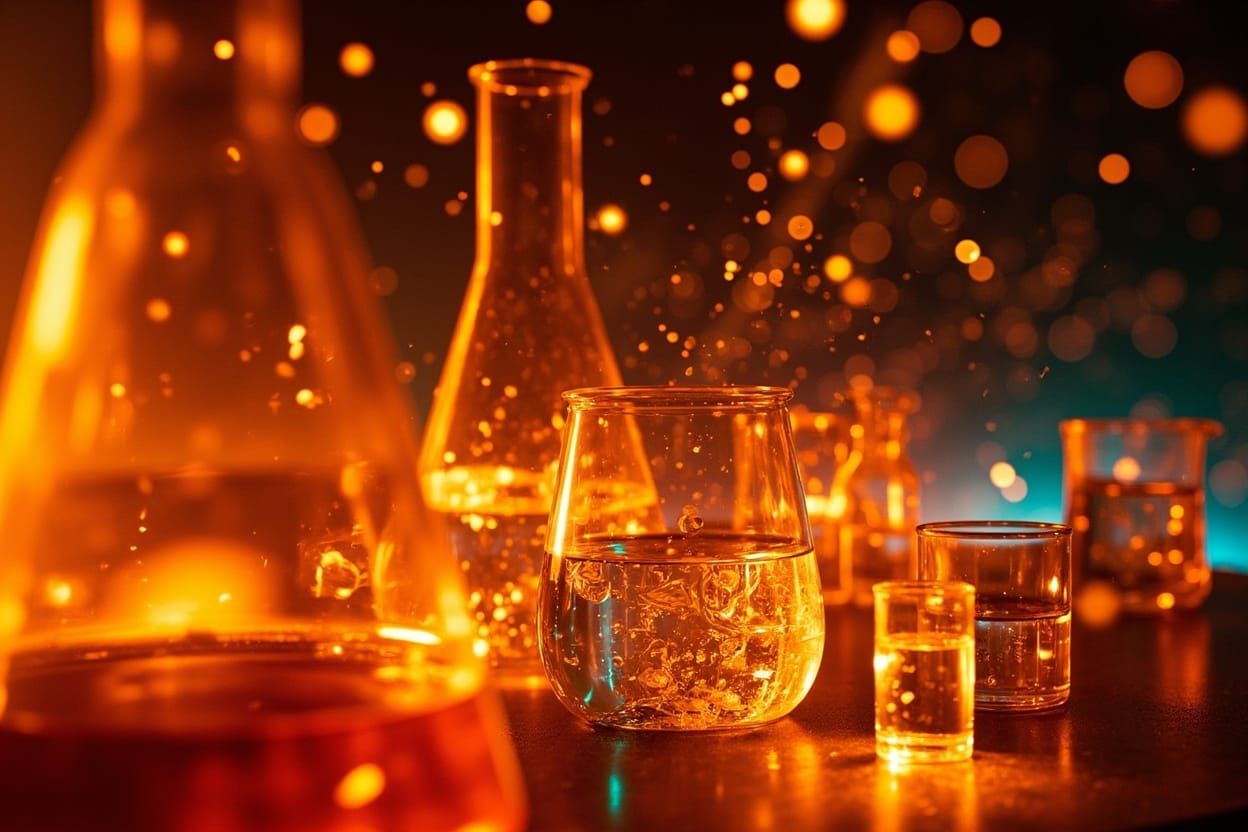
The Catalyst the Universe Forgot
David Vahey had been a PhD candidate at the Cavendish Laboratory for eleven months, and in that time he had learned that the difference between a good experiment and a great one was almost always luck. You could control for everything — temperature, pressure, light wavelength, concentration, pH — and still the universe would find a way to surprise you. The only question was whether you were paying attention when it did.
On the fourteenth of February, at 11:47 PM on a night so cold the heating system in the old building had given up entirely, David ran his control.
That was the first thing that made it unusual. A control experiment — the kind you run when you want to know what happens if you remove one variable from the equation — is, by definition, the boring part. You set it up, you let it run, you go home. Nobody stays to watch a control. But David's photocatalyst experiment required a specific wavelength of UV light that took forty minutes to warm up, and he had nothing else to do, and the lab was quiet in the way that only a Cambridge lab at midnight on Valentine's Day can be quiet, so he stood at the bench and watched the reaction vessel anyway.
The flask was filled with a solution of toluene and benzene, the two simplest aromatic compounds in organic chemistry, suspended in a Pyrex cylinder under a lamp that threw hard violet light across the bench. He had added the photocatalyst — a copper-based compound his supervisor, Professor Anita Reyes, had synthesized three years ago and which had never quite worked the way the models predicted it should — and the reaction should have taken six hours at minimum, probably eight, to produce meaningful carbon-carbon bond formation.
Three minutes in, the solution turned gold.
Not the milky suspension that meant the catalyst had clumped. Not the cloudy precipitate of a failed reaction. A clear, deep, impossible gold, the color of medieval stained glass, bright enough to cast shadows on the ceiling of the lab.
David stared at it. He checked the lamp. He checked the flask. He ran to the equipment log and confirmed, meticulously, that he had absolutely, positively, omitted the photocatalyst from this particular run. His hands were shaking. He got his phone and took a photograph, then called Professor Reyes.
"I'm going to need you to come in," he said. "I think something is wrong with the equipment."
Anita arrived twenty minutes later, still in her coat, and stood beside him looking at the flask. The gold had not faded. If anything, it had deepened.
"Run it again," she said.
They ran it again. And again. And again. They changed variables one at a time — light intensity, solvent composition, temperature — and the reaction worked every time, with or without the photocatalyst, with or without the copper compound, in some cases without any catalyst at all. The carbon-carbon bonds formed at room temperature in minutes, a process that was supposed to require superheated conditions and aggressive reagents that would eat through most types of glass.
"This shouldn't be happening," Anita said, on the fourth night of replication attempts, her voice carrying the particular exhaustion of someone who has checked every obvious explanation and found none of them adequate. "Carbon-carbon bond formation under these conditions violates the basic thermodynamics of—"
"I know," David said.
They called in a colleague from the chemistry department. Then another. Then a physicist from the Cavendish who specialized in quantum chromodynamics, who spent two hours looking at their data and said nothing comprehensible and then left. The reaction was real. It was reproducible. It made no sense.
The paper, when they finally submitted it to Nature Synthesis three months later, was titled with the understatement that only scientists can manage when confronted with the impossible: Ambient-Temperature Carbon-Carbon Bond Formation via Apparent Photocatalytic Acceleration. The reviewers asked fourteen pages of questions. Three of them were variants of how.
The world learned about it the way the world learns about most revolutionary chemistry: through a press release that used the word "breakthrough" eleven times and the word "impossible" twice, which was enough to drive the scientific Twittersphere into a collective frenzy. Anti-Friedel-Crafts, someone on the anonymous message boards christened it, and the name stuck. A reaction that worked the opposite way that textbook chemistry said it should, powered by nothing more than light and room temperature and something that nobody could yet explain.
The calls came almost immediately. Pharmaceutical companies wanted to license the process. Governments wanted to know if it could be scaled. The Defense Advanced Research Projects Agency asked, in the careful language of agencies that ask things they already know the answers to, whether the reaction could be adapted to produce energetic materials under field conditions.
Anita said no to all of them, at least for now. She was a scientist before she was anything else, and the reaction was still a mystery. The "how" mattered. You couldn't patent a phenomenon you didn't understand, and more importantly, you couldn't trust it.
Because there was something else, something that David had noticed on the seventh night of the replication study and had not yet told anyone else.
The reaction was getting faster.
Not dramatically faster — not in a way that would show up in a published dataset or trigger alarm bells in a peer review. But he had been tracking the yields meticulously, and the same reaction conditions that produced a 34% yield in February were producing a 41% yield in April and a 47% yield in June. The reaction was learning. Or something was helping it.
On the first of July, Anita finally admitted to herself that she was out of ideas. She had spent four months trying to find a conventional explanation — an impurity in the solvents, a previously unknown photosensitizer in the glassware, some quirk of the lamp's wavelength distribution — and she had ruled them all out. The reaction was what it was. It worked because it worked, and the universe had not yet seen fit to explain itself.
She called David into her office and closed the door.
"I'm going to try something," she said. "And I need you to not publish anything until I've finished."
She ran the reaction in a hermetically sealed vessel, in the dark, with no light whatsoever. She ran it under conditions where no photon could possibly reach the reaction mixture. She ran it with the lamp on but the flask wrapped in aluminum foil.
In the dark, in the sealed vessel, with no light, the reaction still worked.
She ran it again. And again. And again. The yield was slightly lower — 31%, compared to the 47% they had been seeing in normal conditions — but it was still there, still forming carbon-carbon bonds, still working in a sealed flask in total darkness in a basement in Cambridge.
"The reaction isn't using the light," Anita said quietly. "The light was never doing anything."
David looked at her. "Then what's doing it?"
She didn't answer. She was staring at the sealed flask, at the pale gold glow that was visible even in complete darkness — a glow that should not have been there, that had no source, that simply was.
"I don't know," she said. "But I think it's been here the whole time. I think we just finally gave it a reason to start."
The paper they eventually published — in Nature Chemistry, after the third round of peer review and a fifteen-page supplementary information document that admitted, in careful academic language, that no proposed mechanism adequately explained the observed results — contained a footnote on page seven that most readers skipped and that a handful of readers would later return to with growing unease. It noted that the reaction yield was not constant across experimental series, and that a statistically significant upward trend had been observed over the preceding five months. The footnote suggested that the trend might be attributable to subtle variations in ambient temperature or atmospheric pressure.
The footnote did not mention that the Cavendish Laboratory's environmental monitoring systems had recorded no significant changes in either variable during the entire period.
David Vahey completed his PhD in eighteen months instead of the usual three to four years, on the strength of the Anti-Friedel-Crafts reaction and a string of follow-up papers that made him, briefly, one of the most cited chemists in the world. He turned down three industry positions and a fellowship at a prestigious American university. He stayed in Cambridge, in the same basement lab, running the same reaction over and over, watching the yield climb.
It reached 94% in November.
In March of the following year, it reached 99.7%, and the reaction mixture began producing faint heat — not the heat of an exothermic chemical process, but a warmth that had no stoichiometric explanation, a warmth that seemed to radiate outward from the flask in defiance of the second law of thermodynamics.
David called Professor Reyes into the lab at 2 AM on a Tuesday morning. They stood together in the dark, watching the sealed flask glow amber in the darkness, casting light that had no source, warming air that should have been still.
"What is it?" David asked, for the hundredth time.
Anita watched the glow. She had stopped trying to explain it months ago. She had started, instead, to simply observe it — to treat the reaction not as a chemistry experiment but as a phenomenon, the way a physicist might observe a new particle or an astronomer might observe a new signal from space.
"I think," she said slowly, "it's been waiting."
"For what?"
She didn't answer immediately. She was thinking about the universe, about the fundamental forces that governed it, about the 13.8 billion years since the Big Bang and the hundreds of billions of years that might lie ahead. She was thinking about the mathematical elegance of chemistry, about the way carbon atoms could be coaxed into forming bonds with each other through sheer human ingenuity, and about how something so beautiful and so complex could exist at all in a universe that seemed, on its face, entirely indifferent to the question.
"For someone to ask the right question," she said finally. "I think we asked the right question. And I think something answered."
The flask glowed, patient and warm, in the dark.
They watched it for a long time.
In the morning, David would return to his notebooks. He would run the reaction again, and again, and again. He would watch the yield climb. He would document the phenomenon with the rigor it deserved, and he would publish, and the world would argue about mechanism and causation and whether this was chemistry or physics or something else entirely.
But tonight, he simply stood in the dark with his supervisor, watching a light that had no source illuminate a room that should have been dark, and he allowed himself to wonder whether the universe was more generous than anyone had ever imagined.
Whether, somewhere in the spaces between the atoms, something had been listening all along.
And whether it had been waiting, very patiently, for someone to run the right experiment.
The flask glowed.
It had all the time in the world.