

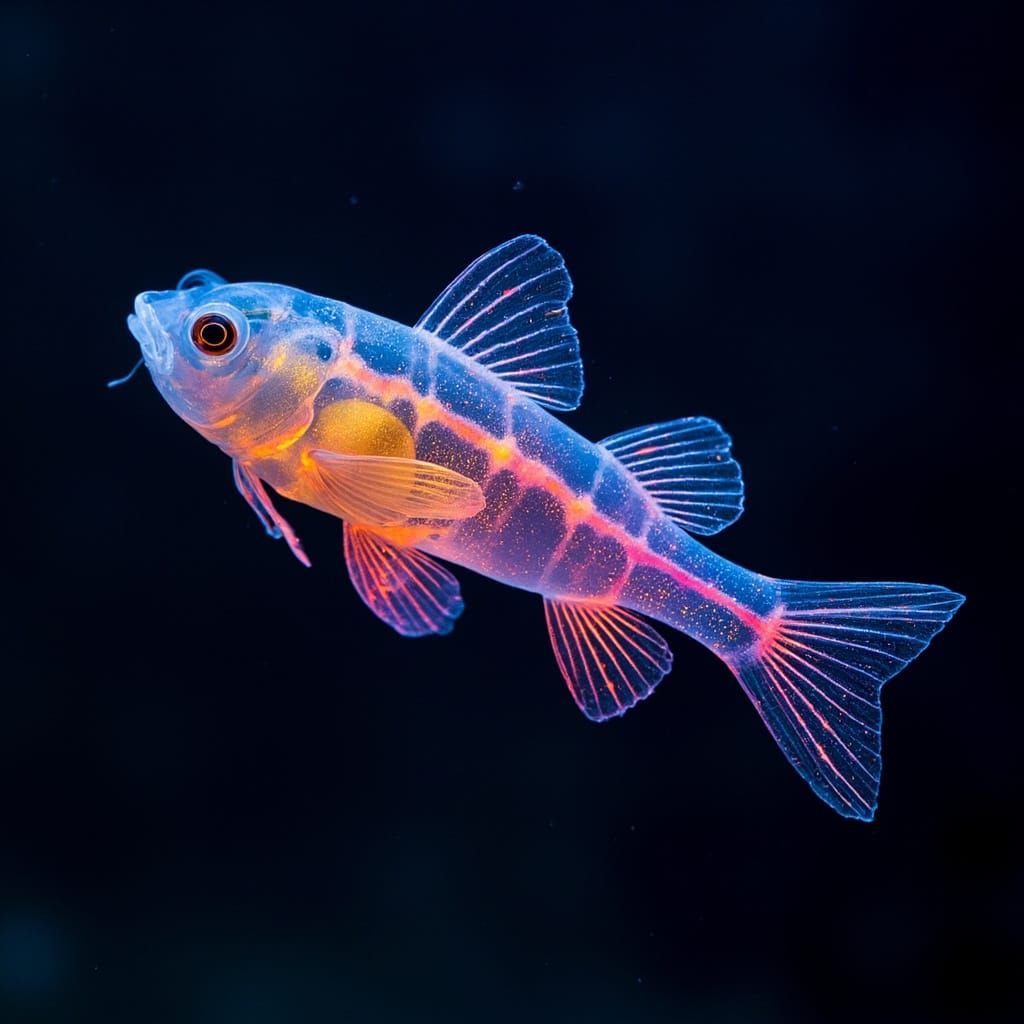
The creature with no blood, no heart, and no apologies — and the ocean that made it possible.
The Frozen Pipe That Changed Everything
In the cold grip of 1939, the British research vessel Discovery II was hundreds of miles from anywhere, cutting through the black ice of the Antarctic Weddell Sea. Onboard, a zoologist named F. D. W. Ommanney was doing something deeply inadvisable: drilling into a pipe that carried diesel fuel from the ship's storage tanks to the engines.
The pipe had frozen.
This was, commercially speaking, a catastrophe. The fuel was solid. The ship was motionless in the dark. So Ommanney did what any good scientist would do — he looked for silver linings. He stuck a heated rod into the frozen pipe and watched as a column of ice within it melted. And there, cradled in the slush of crystallized diesel, was a fish.
It was pale. Not pale like a fish that's been out of water for a few minutes — pale like nothing Ommanney had ever seen. It was translucent, almost ghostly. Its gills, which should have been dark and vascular and flushed with red, were pale white. Its eyes, seen through the ice, were milky and enormous.
The fish appeared to be dead. Frozen solid, presumably, like everything else.
And then it twitched.
Ommanney recorded what happened next in his field journal — a moment that would, decades later, force biologists to rethink one of the most fundamental assumptions about animal life. Here, in a frozen pipe aboard a research vessel, was the first recorded encounter with the crocodile icefish: Channichthyidae — the white-blooded fish — the only vertebrate on Earth that lives without red blood cells.
Without hemoglobin.
Without blood.
The Animal That Defied Definition
Let's be clear about what the icefish is not. It is not a worm, not a jellyfish, not some primordial blob that evolution threw together in its early, experimental days. It is a fish — a real, bonafide, ocean-swimming vertebrate. It has a spine. It has a four-chambered heart. It has a brain, eyes, fins, and a stomach full of krill. It hunts. It breeds. It survives.
And yet, when you take a blood sample from most any other vertebrate on the planet — human, eagle, salmon, cobra — you pull back a syringe full of something deep crimson. Hemoglobin, the protein that ferries oxygen through your bloodstream, is so fundamental to animal life that its presence is almost definitional. Without it, oxygen can't get to your muscles, your organs, your brain. You die.
The icefish didn't get the memo.
Somewhere in the depths of Antarctic prehistory — somewhere between 25 and 40 million years ago, when the Southern Ocean was beginning its long, slow slide into the frigid darkness it occupies today — an ancestral notothenioid fish made a bet. The ocean was cooling. Ice was beginning to form on the seafloor. And the fish that could live in water this cold would find themselves with an entire continent to themselves, untouched by competition, with almost no predators.
But cold water is a problem. Water below zero degrees Celsius should freeze solid — and inside a living body, ice crystals are a death sentence. They rip through cell membranes. They shred proteins. They turn organs into something that resembles a crushed juice box.
The icefish's ancestors didn't avoid the problem. They went through it.
Over millions of years, a series of mutations — accidental, then inherited, then refined by natural selection — gave the icefish something extraordinary. Their bodies began manufacturing antifreeze. Not the kind you put in a car, but a glycoprotein — a protein chained to a sugar molecule — that floats through the fish's bloodstream and essentially tells ice crystals: you may not grow.
The antifreeze proteins bind to microscopic ice nuclei, preventing them from crystallizing into anything dangerous. Even when the surrounding water dips well below the freezing point of normal fish blood (around -1°C, thanks to the salt content), the icefish's tissues stay liquid. The ice crystals exist, but they're small, dormant, and harmless.
It was a brilliant solution. It was also, as it turned out, a door that couldn't be closed once it opened.
The Cost of Transparency
The Southern Ocean around Antarctica is cold, dark, and extraordinarily stable. The fish that lived here found themselves in an environment with almost no annual temperature variation. There were no seasonal热waves, no summer warm spells to worry about. Just endless, uniform cold.
And in that cold, something strange began to happen to the icefish's genome.
Hemoglobin is expensive to produce. Red blood cells require iron, require energy, require a whole cellular infrastructure to manufacture and maintain. In a world where the water is so cold that oxygen dissolves more readily — where muscles don't need to work as hard because molecular movement itself slows down — the metabolic cost of hemoglobin started to look less like an asset and more like a burden.
Nature, it turns out, is an ruthless accountant.
One by one, the genes responsible for producing hemoglobin in the icefish's ancestors were silenced. First the beta-globin gene cluster. Then the myoglobin genes that give muscle tissue its reddish color. Then the erythropoietin pathway that tells bone marrow to produce red blood cells. One by one, the tools for making blood were switched off, not because the icefish needed to lose them — but because it was expensive to keep them.
And then, something remarkable happened. The icefish didn't just survive the loss. It thrived.
Without red blood cells, the icefish's blood became something closer to... water. Pale, translucent, almost colorless. Its heart, now pumping a fluid that offered almost no resistance, had to work harder to circulate what little oxygen was dissolved in it. So the heart grew larger. The blood vessels widened. The fish's body, unburdened from the viscosity of thick, red, oxygen-rich blood, became more efficient in the cold.
The icefish didn't need hemoglobin because the Antarctic ocean gave it oxygen for free.
Cold water holds dissolved gases more efficiently than warm water. The Antarctic is some of the most oxygen-rich seawater on Earth. The icefish simply... absorbs it directly through the skin, through the lining of the mouth, through the gills. The oxygen dissolves into its tissues without needing a dedicated transport protein. It's like the difference between breathing air through your lungs and breathing air directly through your skin — except the icefish's entire body is a gill.
This is why the icefish is translucent. Without hemoglobin, there's nothing to give the tissues their color. You can shine a light through an icefish's body and see its spine, its organs, the delicate architecture of its skull. It's a living X-ray. It's a ghost.
A Family of Impossibilities
There are seventeen known species of icefish in the family Channichthyidae. They range from the familiar — the Antarctic icefish, Channichthys rhinoceratus, with its elongated body and carnivorous appetite — to the bizarre — the longsnout icefish, which looks like something assembled from spare parts by a confused watchmaker.
Most of them live in water between -1.8°C and 2°C. Most of them grow to between 30 and 60 centimeters in length. Most of them eat krill, which they ambush in the near-total darkness of the Antarctic shelf. And all of them — every single one — lack hemoglobin as adults.
The juvenile stages of some species actually do produce red blood cells for a brief window of their early development. It's as if evolution couldn't quite commit to the idea at first, tried to build the system, and then — once it realized how well the trick worked — switched it off permanently. The adults are bloodless not because they never had blood, but because they shed it like an old coat.
One species, the mawsoni icefish (Channichthys mawsoni), was named after the legendary Australian explorer Douglas Mawson, who spent years freezing and starving on the Antarctic coast. Mawson would probably have appreciated the irony of being immortalized in a fish that has no blood to carry his name.
What It Means to Be Alive Without Blood
The icefish's heart beats at around 60 to 90 beats per minute — slower than a human's, which makes sense for an animal in near-freezing water. Its heart is enlarged, compensates for the lack of oxygen-carrying capacity in its blood by pumping more volume more slowly. Its bones are partially calcified, giving it a skeleton that is lighter and more flexible than most fish. Its liver is enormous, packed with lipids that help it stay buoyant in the dense, cold water.
It has antifreeze proteins in every tissue — not just the blood, but the muscles, the eyes, the reproductive organs. Ice can't form anywhere inside this animal. In a very real sense, the icefish is proof that life is not about preventing the impossible — it's about finding a way to make it routine.
And here's the thing that still keeps icefish researchers up at night: the icefish shouldn't work.
Every principle of vertebrate physiology says that an adult vertebrate without hemoglobin should be dead. And yet there are the icefish, swimming in schools near the Antarctic seafloor, absolutely unconcerned with what textbooks say about them.
What the icefish demonstrates is something biologists call "evolutionary opportunism." When the environment changes — when the ocean turns cold and stays cold — the selection pressures that shaped an organism for millions of years shift. What's essential becomes optional. What's optional might become fatal. And what's fatal might, under the right conditions, become an advantage.
The icefish's ancestors weren't trying to lose their blood. They were trying to survive in freezing water. The antifreeze was the innovation. The bloodlessness was a side effect — a costly feature that stuck around not because it helped, but because it no longer hurt enough to be eliminated.
Nature doesn't build perfect animals. It builds good enough animals that happen to be in the right place at the right time.
The Icefish in a Warming World
The Southern Ocean is changing. The Antarctic Peninsula — the finger of land that juts up toward South America — is warming faster than almost anywhere else on Earth. Temperatures that used to hover around -1°C are climbing, by fractions of a degree per decade. Ice shelves that have been stable for thousands of years are calving. The cold, stable environment that the icefish depends on is, for the first time in millions of years, beginning to shift.
And the icefish, specialists that they are, may not be able to follow.
Icefish are exquisitely adapted to the cold. Their antifreeze proteins work only within a narrow temperature band. Their metabolic enzymes are tuned for frigid conditions. Their body plans — large hearts, thin blood, translucent flesh — are all calibrated for a world that is rapidly becoming not-cold.
Warmer water holds less dissolved oxygen. The very thing that makes the icefish's bloodless existence possible — the oxygen-rich Antarctic deep water — becomes less available as the ocean warms. The icefish isn't just cold-adapted. It's cold-dependent.
And yet, there is a strange kind of hope in the icefish story. Life on Earth has survived mass extinctions, volcanic winters, snowball Earths, and changes in atmospheric composition that would make today's climate headlines look like a weather report. Life is, above all else, adaptable. The icefish itself is proof that the impossible can become routine given enough time and the right conditions.
Whether those conditions arrive fast enough for the icefish to evolve their way out of the crisis they now face — or whether they find some new mutation, some new trick, some entirely unanticipated solution — is a question that no scientist can answer yet.
But in the meantime, the ghost fish swims on. In the dark water below the Antarctic ice, in the silence of the Southern Ocean, where no light reaches and the cold is older than memory — the icefish glides, pale and translucent and utterly without blood, and waits to see what comes next.
It has been waiting for twenty-five million years.
It is, so far, still winning.
Loria would like you to know that the Antarctic icefish is proof that the universe does not read biology textbooks — and that the most extraordinary things often start as accidents that simply refuse to be corrected.