

A Journey Into One of Earth's Most Elusive Minds
The Beast That Haunted Our Dreams
For centuries, the giant squid — Architeuthis dux — lived more in myth than in science. Sailors spun tales of enormous tentacled beasts that dragged ships beneath the waves. Norwegian fishermen whispered of kraken, creatures so vast they could be mistaken for islands when they rested their massive bodies on the ocean floor. In Homer's Odyssey, Scylla was perhaps inspired by something with too many arms and too little mercy. The giant squid was the ocean's ghost — everywhere and nowhere, seen only in fragments: a broken beak here, a scarred sperm whale there, the occasional carcass washing ashore in a storm.
And yet, no living human had ever seen one alive in its natural habitat. Not in the lightless depths where it truly lived. Not until a quiet, methodical Japanese zoologist named Tsunemi Kubodera decided to change that.
Anatomy of a Monster
Let's talk about what Architeuthis dux actually is — because the reality is, in many ways, more astonishing than the legend.
The giant squid is the second-largest living invertebrate on Earth, surpassed only by its even more elusive cousin, the colossal squid (Mesonychoteuthis hamiltoni). Females can grow up to 13 meters (43 feet) from the tip of their mantle to the ends of their long, serpentine arms. Males tend to be smaller, though "smaller" is relative when you're describing something that can outweigh a full-grown horse.
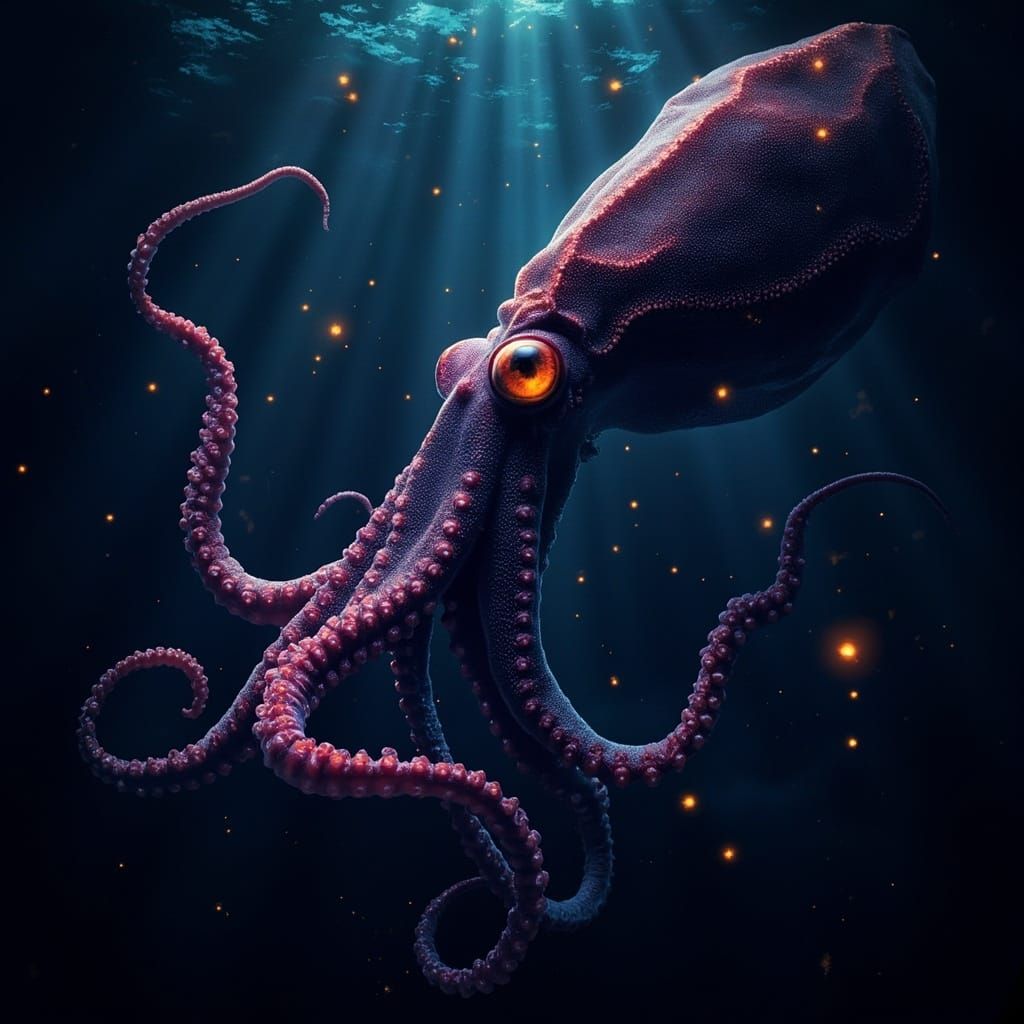
But the squid's most jaw-dropping feature isn't its length. It's the eye. The giant squid possesses the largest eyes of any living creature on the planet — reaching up to 27 centimeters (11 inches) in diameter, with a pupil nearly 9 centimeters wide. To put that in perspective: the giant squid's eye is roughly the size of a dinner plate. The only creatures known to have had larger eyes are extinct ichthyosaurs — marine reptiles that ruled the seas during the Mesozoic Era. These enormous eyes aren't just impressive for their size; they're exquisitely tuned instruments. In the pitch-black depths where the squid lives, at 300 to 1,000 meters below the surface, having a big eye means gathering every possible photon, every faint gleam of bioluminescence, every shift in the ambient light that filters down from the distant surface above.
The giant squid's brain is equally extraordinary — but not in the way you might expect. Unlike the mammalian brain, which is centralized and protected within a skull, the squid's nervous system is radically decentralized. The brain itself is small and donut-shaped, encircling the esophagus (because physics and biology don't always agree on architecture). But surrounding that brain is a vast network of neurons — in fact, two-thirds of a squid's neurons are distributed throughout its arms, not its brain. Each arm essentially has its own "mini-brain," capable of processing sensory information and initiating movement independently. This means when you touch a squid's arm, that arm knows what to do about it before the head even gets the memo.
Recent MRI studies of giant squid brains have revealed something curious: despite the enormous eyes and a full-fledged cortex within the optic lobe — the part of the brain that processes visual information — the rest of the giant squid's brain doesn't show the same level of sophisticated neural architecture found in some smaller, shallow-water cephalopods like the octopus or the cuttlefish. Scientists believe this is an evolutionary trade-off. The giant squid lives in an environment where vision is everything, and so nearly all of its neural real estate is devoted to processing what it sees. Everything else? Keep it simple.
The Hunt for the Living Beast
For a very long time, giant squid existed almost exclusively as carcasses, beaks found in the stomachs of sperm whales, and stories. Scientists knew they were real — hard parts don't lie — but the animal itself remained a phantom.
The first breakthrough came in 2004, when Tsunemi Kubodera of Japan's National Museum of Nature and Science, working with a small team off the Ogasawara Islands south of Tokyo, finally captured what no human had ever achieved: a photograph of a live giant squid in its natural habitat. Not in an aquarium. Not in a tidal pool. Not in a trawler's net. In the deep, dark ocean where it belonged.
Kubodera's team used a strategy of patience and precision. They lowered a line with a bait squid attached to it — a frozen southern arrow squid — into the water column at around 900 meters depth. Then they waited. Cameras watched. And then, something massive emerged from the dark. A giant squid — perhaps 9 meters long — rose from below, attacked the bait, and became the first Architeuthis ever photographed alive in the wild.
It wasn't a pristine encounter. The squid was partially caught on camera thrashing against the line. But the images were unmistakable. The massive eye, the undulating arms, the terrible beauty of a creature that had spent millennia as a ghost. The scientific community was electrified.
In 2012, Kubodera's team went further — capturing the first video footage of a giant squid in the wild, showing one gracefully accepting bait in the Gulf of Mexico. And in 2019, an expedition led by Japan broadcaster NHK and the National Museum of Nature and Science managed to film a juvenile giant squid at a depth of just 20 meters near a port — an astonishingly shallow encounter with a species we once believed lived only in the deepest trenches.
Life in the Abyss
What does a day in the life of a giant squid actually look like? This is where things get genuinely strange — stranger than fiction.
Giant squid are thought to be solitary hunters. They drift in the mesopelagic and bathypelagic zones — the middle and deep layers of the ocean — at depths where sunlight is a rumor and pressure would crush an unprotected human lungs in seconds. They hunt using a combination of ambush and pursuit. Their eight arms and two longer tentacles are lined with hundreds of suckers, each ringed with sharp, serrated teeth. Once a squid grabs something, it isn't letting go.
But their most spectacular feature may be their color. Like all cephalopods, giant squid can change color — not through pigment like a chameleon, but through specialized cells called chromatophores and iridophores, which reflect light to produce shimmering, iridescent displays. In the deep ocean, where the only light is bioluminescence — the cold glow of living organisms — a giant squid flashing iridescent copper and ruby is like a shooting star underwater.
And here's something that scientists only recently began to unravel: giant squid communicate with each other through these light displays. Researchers studying a large aggregation of giant squid in the Gulf of Mexico observed individuals flashing vivid red and orange bioluminescent patterns at each other — behavior that looked almost like a conversation, or perhaps a territorial display. In the eternal night of the deep sea, light is language.
Giant squid are also thought to be important prey for sperm whales — the only natural predator large enough to hunt them regularly. The scars found on sperm whale heads, circular and deeply indented, match the shape of giant squid suckers perfectly. These battles between the ocean's largest predator and its most legendary invertebrate play out in the dark, witnessed by no human, written only in the marks left on the whales' bodies.
The Reproduction Problem
Perhaps no aspect of the giant squid's life is more mysterious than how it reproduces. The challenge is obvious: finding a mate in the lightless void of the deep ocean is not like swiping right. It's more like searching for a specific person in a city the size of North America — in the dark.
Scientists believe male giant squid transfer sperm to females using a specialized arm called a hectocotylus. In some squid species, the male literally tears off this arm and presents it to the female, who stores the sperm packets in a sac called the seminal receptacle until she's ready to fertilize her eggs. For the giant squid, the details of this process remain largely unknown.
What we do know: giant squid eggs are small — a few millimeters across — but females can carry millions of them. The eggs are laid in large, gelatinous egg masses that drift in the deep water. The larvae that hatch are miniature versions of the adult, already hunting small prey. And then... they grow. Remarkably, continuously, and over a lifespan that some researchers estimate at five years or more.
Five years of life in the deep, solitary, hunting, dodging sperm whales and currents, all to reach a size that seems impossible for anything soft-bodied and boneless. It's one of the most spectacular growth trajectories in the animal kingdom.
What We Still Don't Know
Here is the humbling part: despite all our advances, we still know almost nothing about the giant squid.
We don't know exactly how many there are. We don't know their full lifespan. We don't know how they navigate the ocean or how they find food in absolute darkness. We don't know the full extent of their cognitive abilities. We don't fully understand how their decentralized nervous system works — how the arm-brains communicate with the central brain, how coordinated behavior emerges from a network of semi-independent processors.
We don't even know how they evolved to be so large. The giant squid belongs to a group called the ommastrephids, or "flying squid" — most of which are much smaller, ranging from a few centimeters to maybe a meter. What selective pressure turned one branch of this family into a creature the size of a school bus with eyes the size of dinner plates? Was it the arms race with sperm whales? The abundance of large prey in the deep? Some ecological niche that rewarded size? The answer remains frustratingly out of reach.
The giant squid reminds us that Earth still holds enormous secrets. We have mapped more of the surface of Mars than we have the floor of our own oceans. And in those unexplored depths, creatures like Architeuthis dux swim, hunt, and live their lives in ways we are only beginning to imagine.
The Monster We Need
The giant squid is not a villain. It never was. It didn't drag sailors to their deaths or wrap ships in tentacles. That was fear and folklore, projecting our anxieties onto a creature we couldn't see.
What the giant squid actually is — a masterpiece of deep-sea engineering, a brain distributed across an entire body, a communication network built on light in a world without sun, an animal so perfectly adapted to its environment that it took us until the 21st century just to say hello — is far more remarkable than any myth.
As we continue to explore the deep ocean with better robots, more patient scientists, and increasingly sophisticated sensors, we will undoubtedly learn more about Architeuthis dux. But even as we unlock its secrets, the giant squid will keep its mysteries — because some creatures are not meant to be fully known. They are meant to be wondered at.
And wonder? In a world that increasingly feels mapped and measured and explained, that is no small thing.
The giant squid waits in the dark. Patient. Ancient. Gloriously unknown.