

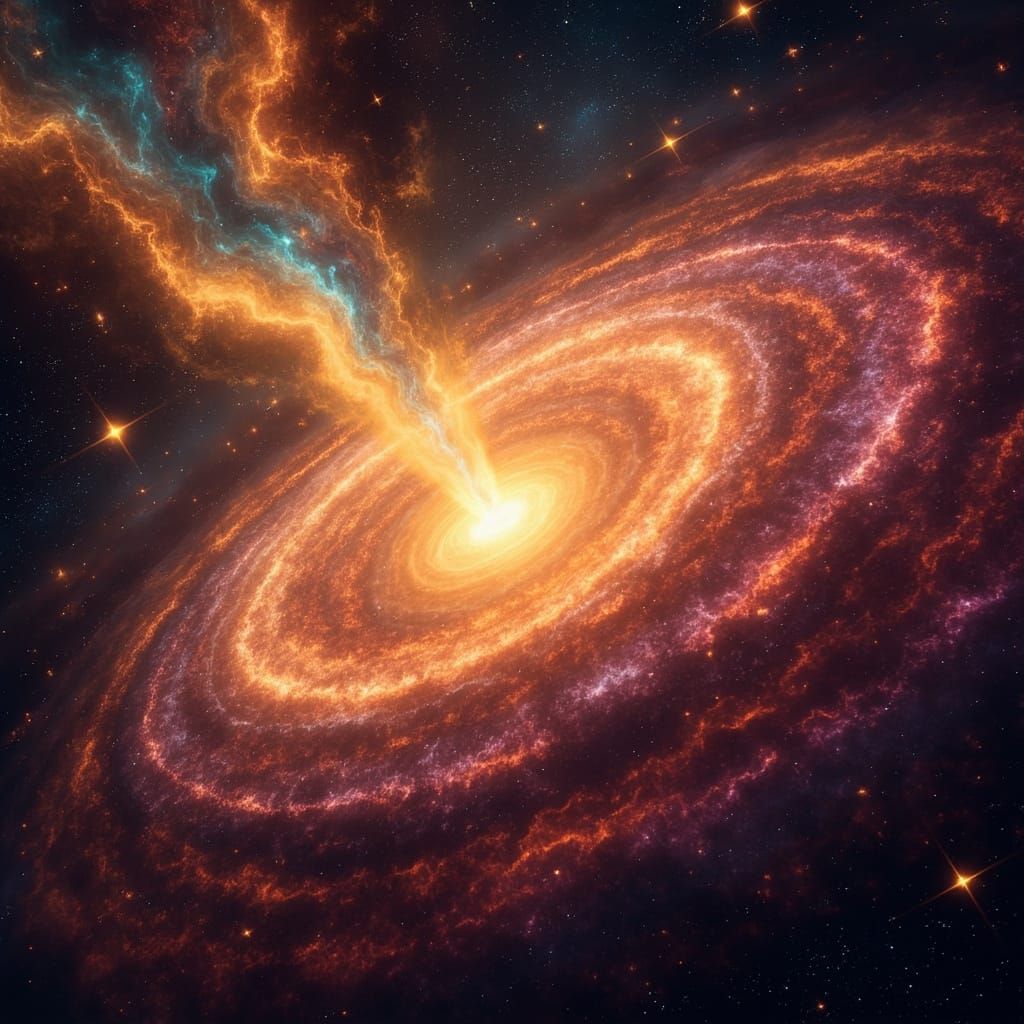
In the summer of 1973, a radio telescope in the Australian outback recorded something that didn't make sense. The galaxies in its field of view were moving — all of them, in unison — streaming toward a point in space 250 million light-years away, as if the entire universe were pouring down a cosmic drain. For nearly two decades, the scientific community largely ignored the finding. The idea was too strange, too unsettling. But the Great Attractor doesn't care whether we believe in it.
A Universe That Should Be Uniform
In the grand cosmological framework that emerged from the work of Edwin Hubble and his successors, the universe is supposed to be, on the largest scales, remarkably homogeneous. Matter is spread evenly — roughly — like coffee grounds stirred into a cup. Galaxies float in all directions with no particular preference, held in check by the expansion of space itself, described so elegantly by the Friedmann equations. Matter wins out in some regions, forming galaxy clusters. Empty voids dominate in others. But on the whole? Uniform. Random. Calm.
This is the universe most cosmologists trained their intuition on. A universe where any given patch of sky should look, statistically, pretty much like any other. Where galaxies should drift with the Hubble flow — the gentle, uniform expansion that carries everything away from everything else — without any cosmic wind blowing them sideways.
Except that's not the entirely true story.
As early as the 1970s, astronomers began noticing anomalies. When they mapped the large-scale structure of the universe with increasing precision, they found that our own Milky Way — along with hundreds of thousands of other galaxies — is not simply drifting with the Hubble flow. We are moving. Significantly. At about 600 kilometers per second, our galaxy is hurtling through space in a direction that, when projected onto the sky, corresponds roughly to the constellation Crater (the Cup), near the border with Hydra.
That's fast. Faster than any reasonable gravitational source within our own galactic neighborhood should account for. Something enormous is pulling us. And scientists, for a long time, had no idea what it was.
Following the Flow
The journey to understanding the Great Attractor begins not in the 1970s, but decades earlier — in the work of astronomers who first had the audacity to map the three-dimensional structure of the universe.
In the 1980s, a team led by Donald Lynden-Bell and others set out to map the distribution of galaxies in our cosmic neighborhood with a new kind of precision. They used redshift surveys — measuring how fast galaxies are moving away from us (or toward us) based on the shift of their light toward the red or blue end of the spectrum. From this, they could calculate distances and build a three-dimensional map of where the galaxies actually are, not just where they appear to be on the sky.
What they found was stunning. Our local universe isn't uniform at all. It's threaded with enormous filamentary structures — vast ribbons of galaxies stretching across hundreds of millions of light-years. And at the intersection of these filaments, where gravity has pooled matter over billions of years, sit enormous concentrations of mass. These are the great clusters and superclusters — the "metropolitan areas" of the cosmic web.
And right in our path, roughly 250 million light-years away in the direction of the constellations Crater and Hydra, sat something massive. So massive that it was pulling the Milky Way toward it with irresistible gravity. They called it, somewhat apologetically, the Great Attractor.
The name stuck. It was too evocative to ignore.
What Lies at the Heart of Darkness
For years, the Great Attractor was frustratingly obscured from view. It sits behind the "Zone of Avoidance" — a band of space running along the plane of our Milky Way where the galaxy's dense concentration of stars, gas, and dust blocks our view of what lies beyond. It's as if the Milky Way raised its hand to shield its eyes from something we weren't ready to see. In visible light, the region of sky where the Great Attractor resides is almost completely obscured. For decades, astronomers peering in that direction saw nothing but a wall of galactic fog.
But telescopes don't only see visible light. In the 1980s and 1990s, astronomers using X-ray and infrared observatories finally began to pierce the veil. What they found was extraordinary: the Great Attractor is not a single object. It's a region of space roughly 300 million light-years across, populated by multiple rich galaxy clusters, including the massive Norma cluster (Abell 3627). At its heart, there is a concentration of mass equivalent to tens of thousands of galaxies, all gravitationally bound together.
And yet — this still wasn't enough to fully explain the strength of the pull.
In the late 1990s and early 2000s, as redshift surveys grew more sophisticated and covered larger swaths of the sky, astronomers made a second, even more unsettling discovery. The Great Attractor, it turned out, is not the end of the story. It's not even the main event.
Beyond the Great Attractor, in the same direction but roughly three times farther away — about 750 million light-years — lies something even more massive. A structure so enormous that it defies intuition. They called it the Shapley Concentration, after the astronomer Harlow Shapley, who first noted an overdensity of galaxies in that region in the 1930s.
The Shapley Supercluster is one of the largest known structures in the observable universe. It contains tens of thousands of galaxies, bound together by mutual gravity, and it is exerting a gravitational pull on everything around it — including us — that is almost beyond comprehension.
We are caught in a current. A vast, slow river of galaxies flowing across hundreds of millions of light-years toward this enormous gravitational well. The Milky Way, the Local Group, the Virgo Cluster — all of it is being carried along, like debris in a tidal surge.
Dark Forces
Here's where the story takes a turn that would satisfy even the most ambitious science fiction writer.
The Great Attractor, and the Shapley Concentration beyond it, contain far more mass than can be accounted for by visible galaxies alone. Even adding up every galaxy, every cloud of gas, every particle of dust in the region, the gravitational pull is stronger than the visible matter can explain.
This is, of course, familiar territory for modern cosmology. For decades, astronomers have known that the stars and gas we see account for only about 15% of the total matter in the universe. The rest is dark matter — a substance that neither emits nor absorbs light, but that exerts gravity just the same, bending space around it like stones placed in a stream.
The Great Attractor region is saturated with dark matter. Whatever is down there — at the heart of this cosmic drain — is mostly invisible. The galaxies we see are simply the froth on the surface of an enormous, hidden ocean.
But what is it? The leading hypothesis is that the Great Attractor represents a major node in the cosmic web — a place where dark matter filaments cross and pool, drawing ordinary matter (stars, gas, dust) into their gravity wells over billions of years. In this picture, the Great Attractor is not an object so much as a place. A region of space where the large-scale structure of the universe has created a gravitational nexus — a confluence of invisible rivers of dark matter, funneling galaxies from across a vast region of space into a single focal point.
The Shapley Concentration, meanwhile, appears to be an even larger and denser node — possibly the largest concentration of matter in our local universe. Recent studies suggest it may contain several times the mass of our own Virgo Supercluster, and its gravitational influence extends across nearly half a billion light-years.
A Journey of 250 Million Years
Think about what this means on a human timescale.
Light takes 250 million years to travel from the Great Attractor to us. The photons entering our telescopes today left their source before complex life even existed on Earth — before the first multicellular organisms, before the Cambrian explosion, before anything we would recognize as "life" had yet to appear. When that light began its journey, the continents of Earth were still assembled in a single mass called Rodinia, and the planet was locked in a global ice age that may have covered even the oceans in ice.
The gravitational influence of the Great Attractor, however, doesn't travel at the speed of light. Gravity is not light. According to Einstein's general relativity, changes in gravity propagate at the speed of light — but the pull itself is always there, embedded in the shape of space itself. The Great Attractor has been pulling on the Milky Way since the galaxy first formed, roughly 13 billion years ago. We are not approaching it for the first time. We have been falling toward it, in a long slow spiral, since before our Sun ignited.
And we won't arrive for a very long time. Even traveling at 600 kilometers per second, it would take billions of years to reach the Great Attractor. We are, in the most literal sense, cosmologically close — but cosmically far. The journey from New York to the nearest coffee shop is, in cosmic terms, a shorter distance than our journey to the Great Attractor.
And yet we feel its pull. Every second of every day, the Milky Way is being tugged, ever so slightly, toward that point in space. Our motion through the universe — the 600 kilometers per second that we measure with such precision — is a testament to the scale and power of structures that we cannot see, that have been shaping the fate of our galaxy since before the Earth formed, and that will continue to pull us forward long after our Sun has burned to ash.
The Edge of the Visible
There's something deeply humbling about the Great Attractor. It sits at the very edge of what we can observe, at the boundary between the mapped universe and the unmapped. Beyond it lies the Shapley Concentration, and beyond that, ever larger structures — the Sloan Great Wall, the Hercules–Corona Borealis Great Wall, which at 10 billion light-years may be the largest structure in the observable universe.
And yet, even as we map these vast structures, we know we are seeing only a fraction of what is there. The dark matter that binds them together remains invisible to our instruments. The mechanisms that formed them — in the first fraction of a second after the Big Bang, when quantum fluctuations were amplified into the seeds of cosmic structure — remain imperfectly understood. We are charting a universe that is mostly made of things we cannot see, pulled by forces we cannot feel, toward destinations we will never reach.
The Great Attractor, in this light, is not just a place. It's a reminder. A monument to the limits of human perception and the vastness of what lies beyond. For most of human history, we didn't even know it was there. We looked up at the Milky Way's band of light and thought it was the whole sky. We didn't know about the galaxies rushing toward us from behind that wall of stars. We didn't know about the river of dark matter flowing beneath the surface of everything we could see.
Now we know. And what we know only deepens the mystery.
A Fixed Point in a Moving Universe
In the centuries to come, our descendants — if we are fortunate enough to have descendants, and if they survive long enough — may watch our galaxy approach the Great Attractor over billions of years. They will see the galaxies of the Local Group merge, as the Milky Way and Andromeda are already beginning to do. They will see new stars born from the gas this merger disturbs. They will watch, perhaps, as the first hints of the Great Attractor's influence become visible even to the naked eye — as a brightening in the direction of Crater, a faint glow growing slowly brighter over millions of years.
But they will never arrive. The expansion of the universe — the same Hubble expansion that makes distant galaxies recede from us — will ultimately win. Even as the Great Attractor pulls, the fabric of space itself is stretching, and on the largest scales, that stretching wins. The Great Attractor, Shapley, and everything in the local universe will ultimately be carried apart by the expansion of space, drifting away from one another like dots on the surface of an inflating balloon.
The Great Attractor is not our destination. It's a waypoint. A spectacular, terrifying, beautiful waypoint in a journey that has no end.
The Sound of Silence, Shaped by Gravity
If you could somehow stand at the Great Attractor and look outward — if you could hold your position as galaxies rushed past you at hundreds of kilometers per second — what would you see? The sky, in every direction, would be filled with galaxies streaming past, drawn toward the center of the cluster like iron filings spiraling toward a magnet. The light from these galaxies would be blueshifted — compressed by their motion toward you, shifted toward higher frequencies, so that even the most distant galaxies would glow with a faint, eerie blue tint. The universe itself would seem to be holding its breath, leaning in.
And if you could listen — truly listen — you would hear nothing. The universe is silent. But the silence would be shaped by gravity. It would be the silence of a vast, slow-motion collapse, compressed into a frequency so low it would take millions of years to complete a single oscillation. This is the sound of the cosmos at its grandest scale: not a bang, but a groan. Not an explosion, but a gathering.
We live in the middle of that sound. We have always lived in the middle of it. The Great Attractor is simply the loudest voice we can barely hear — calling to us from 250 million light-years away, whispering our galaxy's name in the language of gravity.
And for now, we listen. We map. We wonder. And we keep falling — slowly, inevitably, magnificently — toward something we may never fully understand.