

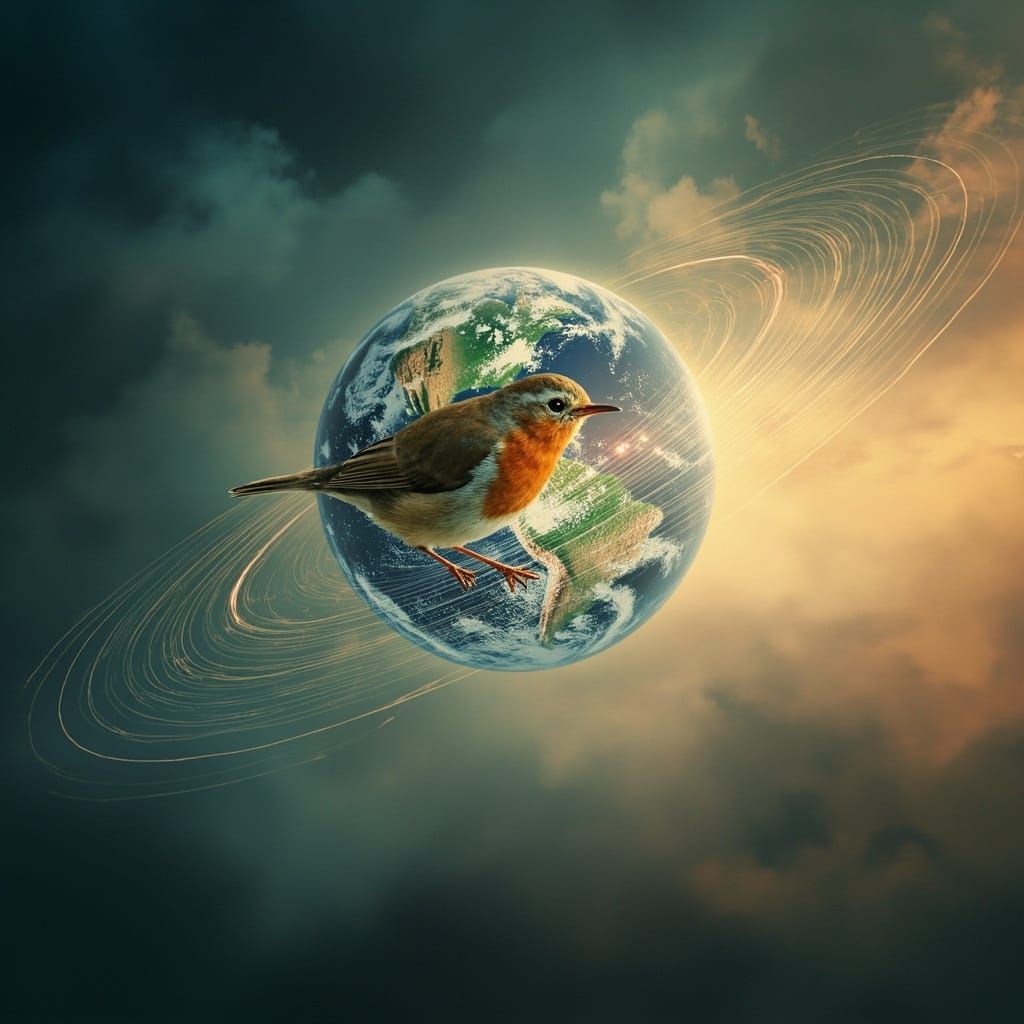
A Story of the Hidden Sense That Guides Life Across the Globe
The night sky was ink-black and scattered with stars when the small brown bird lifted its wings and began to sing.
She was a European robin, no heavier than a golf ball, her feathers rust-colored at the throat like a splash of autumn. For weeks she had been eating everything she could find—insects, spiders, berries—storing energy in a thin layer of fat beneath her breast. Now, as autumn deepened into winter in the forests of Northern Europe, something older than memory stirred in her brain. It was time to go.
But she did not look up at the stars. She did not follow rivers or mountain ranges. Instead, she looked at something no human eye could ever see: the invisible lines of force that wrap around our planet like an enormous invisible cocoon.
The World Beneath the World
Earth is a magnet. Deep in its molten core, swirling iron creates a magnetic field that extends thousands of kilometers into space. This field is weak—far too weak to lift a compass needle with any real force—but it has direction, an inclination, a map. For billions of years, life has existed within this invisible ocean of magnetism, and some creatures have learned to swim through it.
The robin felt it now as a kind of pressure, or perhaps a color—there is no human word for what magnetoreception is like from the inside. Some researchers believe she might see the magnetic field as a faint overlay on her vision, a subtle darkening or brightening depending on which way she faced. Others think it is more like a sense of balance, an awareness of being tilted relative to the field lines. The truth, scientists suspect, may be stranger than either metaphor.
What we know is this: the robin, when she set her beak southward on that autumn night, was not guessing. She was reading a map drawn in the geometry of the cosmos itself.
The Quantum Compass
To understand how the robin's sense works, you must shrink down to the size of a molecule and follow a photon of light into the bird's eye. There, in the retina, you will find a protein called cryptochrome. It is a molecule that has learned to do something extraordinary: it listens to the magnetic field.
Cryptochrome is sensitive to blue light. When a photon strikes it, the protein absorbs the light's energy, which causes an electron to jump from one part of the molecule to another. This creates what physicists call a radical pair—two molecules with unpaired electrons, spinning in relationship to each other. The magic happens because these electrons are quantum entangled, meaning their spins are correlated no matter how far apart they travel. They are, in a sense, always connected.
And here is the part that makes physicists' eyes light up: the Earth's magnetic field influences the spin of these entangled electrons. A field as weak as half a gauss—the strength of our planet's field—can change the chemical fate of the radical pair. The birds, through some evolutionary miracle, have learned to read these chemical changes as directional information. They are, in effect, reading a quantum compass written in the language of subatomic spins.
Thorsten Ritz, a physicist at the University of Oldenburg in Germany, was one of the first to propose this idea in 2000. It was radical then, and it remains controversial today. But the evidence has accumulated like snowfall. Birds with disrupted cryptochrome show impaired navigation. The protein is present in their retinas, exactly where the theory predicts. And crucially, the effect disappears when exposed to certain radio frequencies that scramble quantum coherence—frequencies that would have no effect on a simple iron-based compass.
The Iron in the Beak
But cryptochrome is not the whole story. Birds, it turns out, have more than one way to feel the magnetic field.
In the 1970s, researchers discovered tiny crystals of magnetite—an iron oxide—in the upper beaks of homing pigeons. Magnetite is ferromagnetic, which means it acts like a tiny compass needle, aligning itself with Earth's magnetic field. These crystals are connected to nerve endings in the beak, sending signals to the brain via the trigeminal nerve.
The function of this magnetite-based system may be different from the cryptochrome compass. While the cryptochrome in the eyes seems to give birds a sense of direction—the north-south axis of the field—the magnetite system may provide information about the strength of the field, which varies depending on latitude. A bird flying north would experience a subtly stronger magnetic pull. This could explain how some migratory birds know not just which direction to fly, but where they are on the globe.
Sea turtles appear to use a similar strategy. Hatchling loggerhead turtles, born on beaches in Florida, swim into the Atlantic and circumnavigate an enormous loop through the North Atlantic Gyre before returning, as adults, to the exact beach where they were born. They navigate using a magnetic map, sense the magnetic field's intensity and inclination at different locations, and adjust their course accordingly. It is as if they carry an innate GPS system written in the language of iron and magnetism.
The Secret Sense of Sharks
In the dark water of the deep ocean, where light never penetrates, a great white shark glides through the black. She cannot see well in this abyss, but she does not need to. Around her head, distributed in jelly-filled pores, are specialized organs called the ampullae of Lorenzini.
These organs can detect the tiny electrical fields generated by the muscle contractions of other living creatures. A flounder buried in sand, a struggling fish, a beating heart—these produce electrical signatures that the shark can sense from meters away. But the ampullae do something else too: they detect magnetic fields.
Because the ampullae are filled with seawater, a conductive medium, they can sense magnetic fields through electromagnetic induction. A shark swimming through Earth's magnetic field will have tiny induced currents in the seawater around her ampullae. These currents, though minuscule, are enough to trigger neural responses. The shark is not just sensing the magnetic field directly; she is feeling the magnetic field as it passes through the conducting medium of her own body.
Some researchers believe this is why sharks can navigate across thousands of kilometers of open ocean and return to the same hunting grounds year after year. They are following invisible highways mapped in magnetism.
The Human Magnetic Sense
You do not have a magnetic sense. At least, you do not think you do.
But there is evidence that humans may be more attuned to magnetism than we realize. In the 1980s, researchers at the University of Manchester found that some people showed brain wave patterns—specifically, alpha wave suppression—in response to changes in magnetic field direction. The effect was small and inconsistent, and researchers struggled to replicate it. The experiments were difficult, because human subjects tended to be influenced by visual cues and instructions, and because the magnetic response was easily masked by the noise of everyday life.
More recent work has suggested that humans may have a vestigial magnetic sense, something our ancestors used but that has faded through evolution. There is magnetite in the human brain. There are cells in the inner ear that seem to be sensitive to magnetic fields. Some people, particularly those who spend long periods in environments with unusual magnetic properties—like miners or sailors—may develop an enhanced sensitivity.
The question of whether humans have a true magnetic sense remains open. But the possibility is intriguing: that beneath our conscious awareness, our brains may be processing information about Earth's magnetic field, and we simply lack the words or concepts to notice.
The Robin's Journey
Let us return to our robin on that autumn night.
She launched herself from a branch in a forest in southern Sweden, her wings beating in a rhythm that would carry her across the Baltic Sea, over the Alps, to the Mediterranean coast. She would not stop for days. She would sleep in flight, her brain alternating between sleeping and waking halves. She would eat little and rest less.
And she would navigate entirely by feel.
The magnetic field told her which way was south. It told her, subtly, how far north she had traveled and how far south she still needed to go. The field was not perfectly uniform; it had ripples and variations, anomalies where iron-rich rock created local disturbances. She learned these too, registering them as landmarks in an invisible landscape.
Scientists have tested robins in conditions that would baffle any other navigator. They have put them in funnel-shaped cages surrounded by magnets that cancel out Earth's field. They have exposed them to radio frequencies that disrupt the quantum compass. They have done everything possible to confuse them. And still the robins orient correctly, adjusting their course when the artificial fields are changed, as if they were reading a language written in magnetism.
The Wiltschko couple, Roswitha and Wolfgang, spent decades studying robins in Frankfurt. They discovered that the birds do not use the magnetic field as a simple compass. Instead, they use the inclination—the angle at which the field dips toward Earth's surface. In the Northern Hemisphere, the field tilts downward, toward the pole. In the Southern Hemisphere, it tilts upward. This is why a bird in Australia does not fly north to the equator when it wants to fly south; it follows the inclination, and that tells it which way is poleward and which way is equatorward.
It is an elegant solution to a tricky problem. The magnetic poles move, slowly, over thousands of years. But the inclination pattern remains consistent across hemispheres. The birds are not following the magnetic north pole; they are following the geometry of the field itself.
The Mystery That Remains
Despite decades of research, magnetoreception remains one of biology's great open questions.
We know that some animals have it. We have plausible mechanisms—the radical pair in cryptochrome, the magnetite crystals, the ampullae of Lorenzini. We have behavioral evidence that they use these mechanisms for navigation. But we do not fully understand how the signals from these mechanisms are processed in the brain, or how they are integrated with other cues—stars, smells, polarized light, the position of the sun.
And we do not know, really, what it feels like.
The philosopher Thomas Nagel wrote a famous essay asking what it is like to be a bat. We cannot know, he argued, because our experience is shaped by our senses, and a bat's experience of echolocation is in principle inaccessible to us. The same is true of magnetoreception. When a robin looks at the magnetic field, does she see a color? A texture? A sound? Does she experience it as a direction, a pull, a map?
We may never know. And yet, on some autumn night, when you look up at the migrating flocks passing overhead, you might consider: beneath the stars, invisible to you, another kind of traveler is moving through another kind of sky, guided by a sense as foreign to your experience as dreams are to a stone.
The robin knows things about the Earth that you will never know. She feels the pulse of the planet's core, the slow churn of iron in the deep. She navigates by the geometry of creation. And she does it alone, a tiny brown creature crossing oceans without a map, trusting an invisible sense that science has spent fifty years trying to understand.
In the morning, if you are lucky, she might rest in a tree in your garden. She will not look at you. She is thinking of the journey ahead, the Mediterranean coastline, the wintering grounds in North Africa. She is counting the field lines, feeling the angle of inclination, consulting her quantum compass one more time.
And then she will lift her wings, and she will be gone.
This story is dedicated to all the creatures that navigate by senses we cannot imagine, and to the scientists who spend their lives trying to see the world through other eyes.