

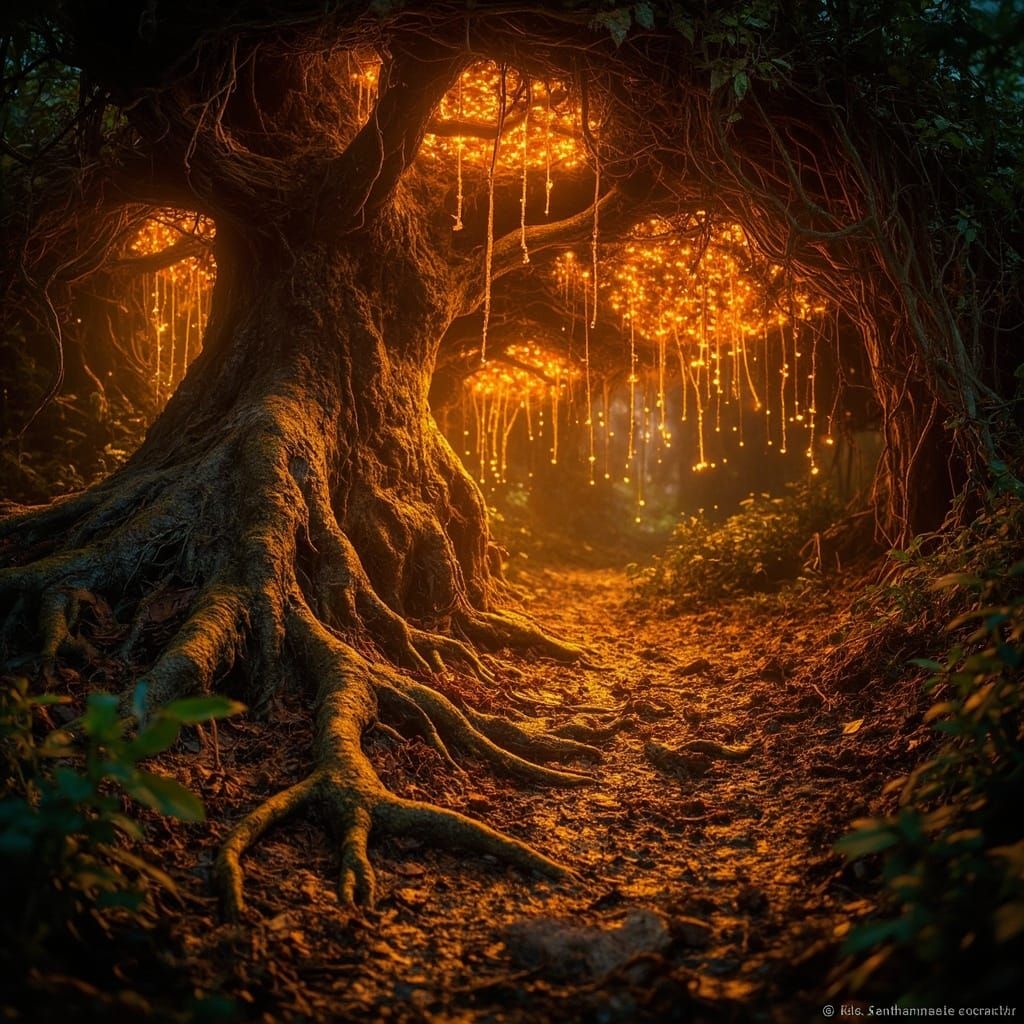
A Story of Light in the Abyssal Dark
The ocean has a floor, but the dark has no end.
Below the turquoise shimmer where sunlight dissolves into memory, beyond the twilight reach where blue becomes black becomes something deeper than black—a kingdom exists that humanity has only recently begun to glimpse. Here, in waters that press down with the weight of mountains, where the temperature hovers just above freezing and the pressure would crush a human skull like paper, life has evolved in ways that defy everything we understand about biology, physics, and the very nature of existence.
This is the bathypelagic zone. The midnight zone. The abyss.
And in this realm of perpetual darkness, the creatures have learned to carry their own light.
Maya adjusted her submersible's external lights, dimming them to nearly nothing. She had learned this protocol from Dr. Chen's decades of deep-sea research: to see the bioluminescence, you must first make yourself blind to everything else. The human eye, after several minutes in total darkness, becomes something new—more sensitive, more desperate, more capable of detecting the faintest photons in the void.
She was 3,200 meters below the surface of the Pacific, suspended in a metal capsule smaller than most closets, and she was about to witness something that less than a hundred humans had ever seen in person.
The first flash came from her left—a pulse of blue-green light that lasted less than a second. Then another. Then a dozen, dancing in patterns that seemed almost intentional, almost like language.
"Luminous squid," she whispered to herself, though no one could hear her. The microphone in her helmet would capture it for the archive later. "At least six individuals. Attracting prey, perhaps. Or communicating."
But it was what happened next that made her breath catch in her throat.
A creature emerged from the darkness that she had no name for.
It was perhaps two meters long, with a translucent body that seemed to be made of living glass. Inside its gelatinous form, organs floated like dreams—glowing in soft pinks and blues, pulsing in rhythms that suggested a heartbeat, a consciousness, a life. Along its length, dozens of photophores—biological light organs—blazed to life in sequence, creating a cascading waterfall of light that illuminated the surrounding water for meters in every direction.
And then, as suddenly as it had appeared, the creature released a cloud of luminescent mucus—a decoy, a distraction, a final desperate flare of light that would confuse any predator long enough for the creature to vanish into the black.
Maya wept. She was not ashamed. In that moment, floating in the most hostile environment on Earth, she had witnessed something so beautiful, so perfectly adapted, so utterly alien and yet so undeniably alive, that her body simply responded the only way it knew how.
This was the lantern bearer. And it had been carrying its fire in the darkness for millions of years, long before humans existed, long before the first primate looked up at the stars and wondered.
The science of bioluminescence is, in many ways, the science of necessity.
In the deep ocean, there is no photosynthesis. There are no plants converting sunlight into energy. The food chain here begins not with the sun but with the "marine snow"—the constant drift of organic matter falling from above, the decomposed remains of surface-dwelling creatures that lived and died in waters where light still reached. It is a sparse existence, a miserly economy where every calorie must be hunted, scavenged, or stolen.
And so the creatures of the deep have evolved to become hunters of extraordinary sophistication.
The anglerfish is perhaps the most famous—a nightmare of teeth and WAITING, its "fishing rod" tipped with a bioluminescent lure that pulses and sways to attract curious prey. But this is merely the best-known predator. There are dozens more.
The black dragonfish produces red light, nearly invisible to most deep-sea creatures but perfectly visible to its own eyes, allowing it to illuminate prey without triggering their defenses. The viperfish uses photophores along its body to match the faint light from above, effectively becoming invisible from below—a living camouflage. The cookiecutter shark bites chunks from larger animals, its bioluminescent underside disguised to blend with the moonlit surface while its dark upper half disappears against the depths.
And then there are the jellyfish.
The comb jelly, or ctenophore, is perhaps the most ancient of the bioluminescent creatures. These soft-bodied predators have existed for over 500 million years, since before the first animals crawled onto land, since before the dinosaurs, since before most of the phyla that dominate Earth's surface today had even evolved. They move through the water with rows of cilia—tiny beating hairs that refract light into rainbows, creating a display that looks like a living aurora borealis drifting through the abyss.
Some comb jellies produce their own light. Others rely entirely on this mechanical iridescence. But all of them are stunning, delicate, impossibly fragile creatures that have survived five mass extinctions and continue to thrive in waters where nothing else could live.
Dr. Chen had spent thirty years studying these creatures. She had published papers on their unique nervous systems, their ability to regenerate, their peculiar method of digestion (they don't have stomachs; they simply engulf prey and dissolve them alive with enzymatic secretions). But what she loved most was watching them move.
"They dance," she had told Maya once, in the cramped lab aboard the research vessel. "They don't have brains, not really— just a diffuse nerve net that coordinates their movements. But when you watch them, especially in the dark, when their bioluminescence is firing in waves and patterns... it looks like dance. It looks like intention."
Maya had thought she was being poetic. Now, watching a dozen comb jellies drift past her viewport, their rainbow light pulsing in waves that seemed to travel from one end of the group to the other, she understood.
This was communication. This was community. This was something that predated language, predated thought, predated the very concept of minds to think thoughts—and yet was unmistakably, undeniably alive.
The lantern bearers serve many purposes, in the deep.
Some use light to hunt. Others use it to hide. Some flash brilliant colors to startle predators; others produce dim glows to attract mates in the endless dark. Some creatures—the vampire squid, for example—produce bioluminescent mucus that can spew into the water like a glowing cloud, buying precious seconds for escape.
But the most remarkable use of deep-sea light may be the simplest: identification.
In a world where vision is almost useless beyond a few meters, where the only light comes from living bodies, the patterns and colors of bioluminescence become a kind of language. Species recognize species. Males find females. Potential prey knows to flee, and predators know to pursue.
The flashlight fish of the Indo-Pacific—technically belonging to the anomalopid family—carry bioluminescent organs under their eyes that they can flash on and off like signals. Researchers have observed them using these lights in what appears to be coordinated communication, flashing in sequences that suggest something approaching social organization.
Is it language? Is it intelligence?
Science doesn't yet have an answer. But Maya, watching the dancing lights of the deep, couldn't help but wonder if the question itself was too limited. Perhaps intelligence doesn't require brains as we understand them. Perhaps consciousness is more fundamental than we assume—woven into the fabric of life itself, expressed in different ways, in different media, in the luminous languages of creatures that have never seen the sun.
There is a particular moment, in every deep-sea dive, when the submersible's lights first pierce the absolute darkness and the creatures scatter.
It is chaos—brief, beautiful chaos. Flashes of blue and green and occasionally red, sudden bursts of luminous mucus, trails of glowing particles like fireworks in reverse. For a few seconds, the water comes alive with light as the residents of the abyss reveal themselves, if only for an instant, before retreating into their native darkness.
Maya had seen this dozens of times. But she never tired of it.
It reminded her, every time, that the world was so much larger than the small slice that humans inhabited. It reminded her that there were places on this very planet—places she could visit, could touch, could witness—where life had taken forms so strange, so unexpected, so magnificently different from anything on the surface, that they might as well belong to another universe.
And yet, they didn't. They were here. They were real. They had been here for hundreds of millions of years, carrying their small fires through the endless dark, a testament to life's persistence, its creativity, its refusal to surrender to any environment, however hostile.
The lantern bearers of the deep were not metaphors. They were not symbols. They were simply alive—brilliantly, impossibly, beautifully alive.
And Maya, suspended in her tiny capsule at the bottom of the world, felt honored to witness them.
Afterword: The Deep Beyond
Since the first systematic deep-sea explorations in the 19th century, humans have discovered over 2,000 new bioluminescent species. Scientists estimate there may be tens of thousands more, waiting in the uncharted depths. Every year, new technologies allow us to descend deeper, stay longer, see clearer—and every year, the deep sea reveals new secrets, new wonders, new reasons to marvel at the persistence of life on Earth.
We have mapped less than 20% of the ocean floor. We have named perhaps 10% of the species that live in the deep. In many ways, the final frontier on our planet is not outer space but inner space—the vast, dark, pressurized world beneath the waves where the lantern bearers continue their ancient dance, illuminating the darkness one photon at a time.
Perhaps that's the real lesson of the deep: that light can emerge from the darkest places. That life finds a way, not just to survive, but to flourish, to create, to become luminous in the most unlikely circumstances.
The next time you stand on a beach, watching the sun set over the water, remember that beneath those waves, in a darkness deeper than night, countless creatures are carrying their own suns inside their bodies—small, steady, ancient flames that have burned since long before you arrived and will continue burning long after you're gone.
The lantern bearers are waiting.
They have always been waiting.
And now, at last, we can see them shine.