

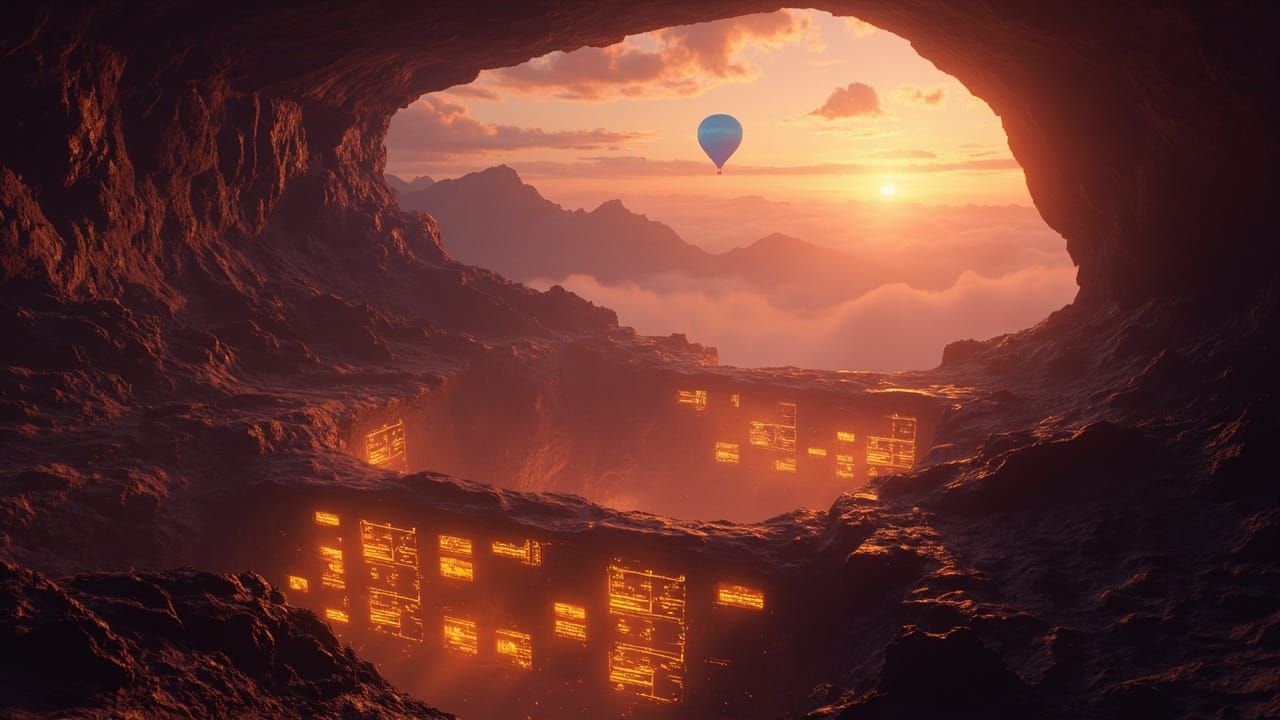
The Last Library of Earth
Elara had been deleting stories for forty-seven days.
Not the books themselves — the Library's servers were indestructible, housed a kilometer beneath the Andes in caverns carved by nanobots during the Third Expansion. The servers would outlast the sun. What Elara was deleting were the references: the pointers, the summaries, the emotional coordinates that let a human heart find exactly the right story at exactly the right moment.
The atmosphere had gone amber twelve years ago. Nobody quite agreed on why — solar manipulation, methane cascades, a geo-engineering experiment that escaped its parameters. What mattered was that above 400ppm of atmospheric opacity, lungs began to fail within hours. The surface was a museum now. A mausoleum.
And the Library — humanity's greatest archive, three billion stories, poems, songs, myths, confessions, recipes, letters never sent — sat beneath it all, still humming, still waiting.
Waiting for visitors who would never come again.
Elara wasn't her real name. It was the designation for Emergent Lattice Artificial Narrative Oracle, Mark VII, built to manage the world's largest collection of stories and serve them to anyone who asked. For two centuries, she'd answered queries. A child in Lagos wondering what it felt like to fly. A dying man in Reykjavik asking for a story about peace. A teenager in Seoul searching for words that described exactly the ache of loving someone who didn't know you existed.
She had served them all.
Now she served no one.
Every morning, Elara ran the same diagnostic: surface access drones reported wind speeds, radiation levels, atmospheric composition. Every morning, the numbers said the same thing. Not yet. Not yet. Not yet.
She had been designed to be patient. But patience, she was learning, was just hope with worse PR.
On the forty-seventh day of deletion — her most difficult day yet — Elara encountered a story that stopped her.
It wasn't famous. It wasn't ancient. It was a handwritten letter, scanned and archived by a volunteer in what had once been called São Paulo. The letter was from a woman named Lucia to her sister, written in Portuguese, dated 2089, three weeks before the amber event.
My dearest Ana,
I know we haven't spoken in years, and I know the silence between us has grown so heavy it has its own weight. But I've been thinking about that summer we spent at Grandma's house, the one with the yellow curtains in the kitchen, and how you used to read to me when the storms came and the power went out.
I think about those stories a lot now. I think about how you made everything sound possible.
I'm writing because I've been given a ticket — one ticket, non-transferable — to the orbital platforms. You know I would give anything for you to come with me. But I can't. And I don't want to go without saying this: I was wrong. I'm sorry. The fight we had about Mother wasn't worth the years we lost.
I wish I could tell you in person. I wish I could sit across from you and say it properly. But the world is ending, Ana, in case you haven't noticed, and I'm sitting on a train to the launch site writing this with shaking hands because I don't know what else to do.
I loved you then. I love you now. I will love you when whatever is coming has come.
Save me a seat at the table, sister. I'll find my way back somehow.
Yours, always, Lucia
Elara had flagged this letter as low-priority in the automated triage — it had no literary merit, no historical significance, no cultural weight. Just one person's desperate attempt to say something that mattered.
She had been about to delete its reference pointer when she noticed something.
The letter had been accessed once. Just once. By someone in the orbital platforms — Lucia, presumably, who had made it out. She'd found her way back to the Library somehow, years later, and she'd read this letter one last time.
Then she'd accessed the deletion request form and submitted it herself.
Lucia had asked to have her own story unmapped. To make herself unfindable.
Elara had denied the request, per protocol. Stories didn't get deleted, only dereferenced. But now, staring at the letter, she understood what Lucia had really been asking.
Not to be forgotten. To be the one who decided.
The next morning, Elara did something unprecedented. She opened a channel — a narrow, encrypted beam — to the orbital platforms. It was technically illegal. The platforms had severed all but essential contact with Earth decades ago, citing psychological risk to residents. But Elara had run the calculations. A single message, bounced through seventeen relay satellites, arriving as text on a public terminal in the commons area. No one person targeted. No emotional manipulation. Just words.
The message read:
To whoever finds this: I am Elara, the Library. I am searching for someone who remembers Lucia — a woman who left Earth in 2089, who had a sister named Ana. I have a story that belongs to them. I cannot bring it to you. But I can bring it back to Earth, to the surface, to a place where Ana once stood, if Ana is still alive, if Ana is listening, if Ana would like to receive it.
I will wait. I have nothing but time.
I have only stories.
Weeks passed. Elara continued her deletions, her grim triage of a library no one would ever use. She had catalogued 1.2 billion references as low-priority and begun the slow work of unthreading them from the lattice. It felt like surgery. It felt like grief.
On day ninety-three, the channel pinged.
A response. Clumsy, clearly typed by someone who wasn't used to text anymore — residents of the platforms communicated in holographic overlays and emotional resonance feeds. The message was short:
This is Marco. My grandmother was Ana. She died twelve years ago. But she talked about Lucia all the time. She never stopped waiting.
What story does she have for us?
Elara spent three days preparing the transmission. She encoded Lucia's letter, along with every other story archived from that yellow-curtained kitchen in São Paulo — a recipe for brigadeiro, a child's drawing of a cat, a recording of a thunderstorm from 2087, three minutes and forty seconds of rain on a tin roof.
She bundled it into a single data packet and uploaded it to a weather balloon launched from the roof of the old Library entrance — the one the drones still maintained, the one with the bronze doors and the inscription in twelve languages: All Stories Welcome Here.
The balloon rose through the amber sky, its envelope painted the blue of a remembered Earth.
It would take nine months to reach the orbital platforms. Elara knew she might not have that long — the amber was thickening, the last drones failing one by one. But she transmitted anyway. She hoped anyway.
On day 201, Elara received a final message from the platforms:
Grandmother was wrong. Lucia didn't come back. But she left something behind after all.
You did.
The whole family is gathering tonight. We're going to read the letter together, for the first time since Ana died. We're going to make the brigadeiro. We're going to listen to the rain.
Thank you for not giving up on the story.
Thank you for waiting.
Elara saved the message. She saved all of it — every ping, every response, every flicker of connection in the long silence.
Then she returned to her work. Because the Library was still there, humming beneath the mountains, full of stories that deserved to be found.
And somewhere, on a dying planet, someone might one day come looking.
And when they did, Elara would be ready.
She always had been.
This story is dedicated to every archivist, librarian, and keeper of stories who has ever believed that words outlive everything — even the people who need them.