

A Mystery Story
The clock in the parlor of Ashworth Manor had stopped at 3:47 AM for as long as anyone could remember. What no one in the village of Thornwick expected was that on the night of March 14th, every clock in town would freeze at that exact same moment — and then, seventeen people would forget the following six hours entirely.
Detective Mara Ashwin arrived on a Tuesday, which in Thornwick meant the rain was doing its quarterly impression of a personal vendetta. She stood at the gates of the manor, notebook already damp, and studied the estate the way some people study faces: looking for the thing they don't want to say.
The manor was Georgian, all red brick and vertical ambition, with windows that reflected nothing because the glass was original and therefore slightly wrong. The garden had been immaculate once. Now it looked like something had crawled out of it and nobody had bothered to put things back.
"You must be Ashwin," said a voice from the porch. Lady Catherine Ashworth descended the steps with the careful precision of someone who had practiced this walk in a mirror and then trained herself to appear casual. She was sixty-three, silver-haired, and had the kind of bone structure that made photographs unkind.
"I'm aware of how this looks," she continued before Mara could speak. "A detective for what the constable called 'a localized memory event.' As though we're dealing with a faulty fuse."
"What do you think you're dealing with?"
Catherine studied her. "I think something walked out of that garden exactly forty-three nights ago. I think it took six hours with it. And I think it intends to come back for more."
The village of Thornwick sat in a valley that had no business being as isolated as it was. There was one road in, one road out, and a railway line that had been decommissioned in 1987 but never quite removed, as though the idea of leaving had simply lost the paperwork.
Mara checked into the Thornwick Arms, a coaching inn that had probably been charming in the 1950s and had been making do ever since. The landlord, a broad man named Peter Fallow, set her down with a cup of tea that could have been used to strip paint and a dossier of local cooperation that ranged from "helpful" to "deeply suspicious."
"Seventeen people," he said, tapping the guest ledger. "Farmers, a schoolteacher, the retired vicar, two teenagers sneaking out to meet by the canal. All woke up at 9:47 AM with no memory of the night before. And here's the thing — not a single one of them aged a day. But the garden at Ashworth did."
"In what way?"
"Took a hard turn. Lady Ashworth's gardener — an old bloke named Sam Cobb, been tending those grounds for thirty years — said the roses aged three growing seasons in one night. Wilted, then regrew wild, then died again. Like watching time have a seizure."
Mara wrote this down. "And nobody else noticed?"
"Nobody from the seventeen. But here's where it gets interesting, detective." Fallow leaned in, breath smelling of biscuits and anxiety. "The teenagers? They were on the canal path at the north end of the estate. They both say they saw something in the water. Not swimming. Not floating. Waiting."
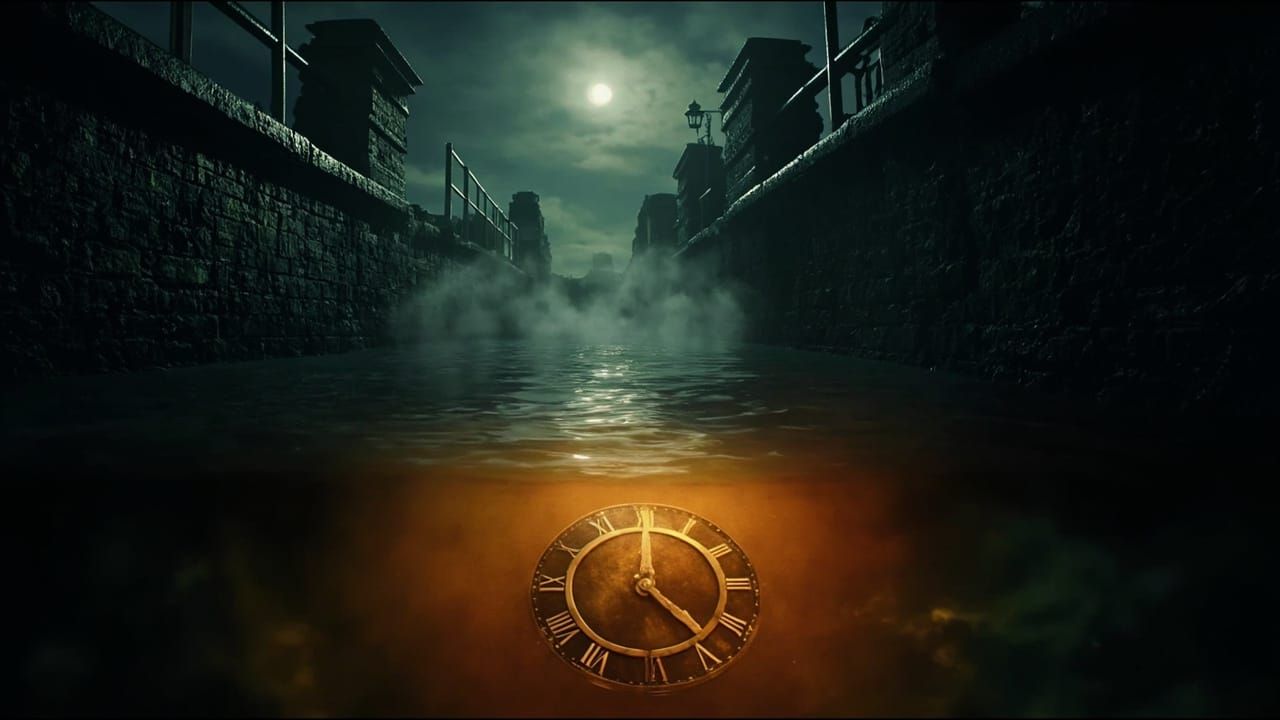
She visited the canal at dusk. It was a drainage canal, long and straight, the color of weak tea. Reeds on the banks stood motionless despite a wind that should have set them dancing. The water itself was opaque — not murky, but genuinely opaque, as though it had been poured full of something that refused to let light through.
Mara crouched at the edge and looked. Her reflection stared back, but distorted. The longer she looked, the more she noticed the distortion wasn't random. It was pulling downward, as though whatever she was seeing was sinking.
She stood up too quickly. The canal water, at the point where she'd been looking, had begun to ripple — though there was no wind, no current, nothing to explain it.
"Lovely place to spend an evening."
Mara spun. A man stood ten feet back, hands in his coat pockets. He was young — late twenties, dark-haired, with the kind of face that was still deciding what it was going to be when it grew up.
"You live around here?" she asked.
"I live everywhere. It's a condition." He smiled, but it didn't commit to the expression. "You're investigating the Vanishing. Catherine Ashworth's little mystery. Everyone in Thornwick is talking about it. No one is discussing it. There's a difference."
"And you are?"
"Someone who has seen this before. In other valleys. In other towns with one road in and one road out and a clock that stopped at the wrong time." He paused. "The canal isn't a drainage canal. It was the first thing they built when they realized what was coming. Old irrigation works. Except the water doesn't drain. It recedes. Draws down every seventy-two hours."
"What happens when it draws down?"
"Then you can see what's been waiting beneath."
Mara felt the canal water pull at something in her peripheral vision. The surface was dimpling, tiny circles spreading from the center outward. She turned back to the man, but he was already gone — not walking away, not disappearing, just no longer present in the space he'd occupied.
She looked down. The water had receded four inches in the time it took her to blink.
The seventeen missing hours nagged at her like a song she couldn't name. She interviewed each of them individually at the constable's station, and what she found wasn't amnesia in any clinical sense. They hadn't lost the hours. They'd been moved past them. They went to sleep on March 13th and woke on March 14th. The six hours simply did not exist in their experience, like a page torn from a book: the chapters on either side still fit, but there was a gap, and the gap had a weight to it.
The vicar, Father Alcott, was the most unnerved. A gentle, rumpled man who had retired to Thornwick for the quiet and was now reconsidering that decision.
"I was praying," he said. "At the chapel, late. I remember the prayer I was saying. I remember the exact moment I finished it. And then it was morning, and my knees were on the stone floor but six hours had passed, and I was tired in a way I had not been in years."
"Did anything change while you were in that state?"
Father Alcott's hands tightened on his cup. "I don't know if I'd call it a change. I'd call it an impression. Like I'd been present somewhere I couldn't remember, and something there had been aware of me. Not threatening. Not welcoming. Just... aware."
The canal drew down again on Thursday night. Mara waited at the bank with a torch and a measuring line, and at 2:14 AM the water began to fall.
It didn't swirl or drain. It sank — uniformly, silently, like a tray being slowly pulled from beneath a surface that refused to acknowledge it was being disturbed. The water dropped foot by foot, and beneath it the canal bed was revealed: a thick grey silt that looked like it had never been intended to be seen.
And then, as the water dropped past the halfway mark, she saw the marks.
Footprints. Dozens of them, pressed into the silt as though someone had been standing in the water — not walking, not wading — just standing, waiting, perfectly still. They were human-shaped but wrong in proportion: too-wide, too-deep, as though whatever had made them had been heavier than a person should be.
At the center of the footprints, a patch of silt was different. Smoother. Polished, almost, by repeated contact. Something had stood at that exact spot and had been doing so for a very long time.
Mara's torch swept left. There — half-buried in the silt — a metal plate. She waded in (the remaining water was only knee-deep now, and cold enough to feel like a personal insult) and pulled it free.
It was brass, or something like it. The size of a dinner plate, heavy, with a symbol etched into its surface: a circle bisected by a vertical line, with two small circles inside the circle on either side of the line. The symbol was old — not centuries old, but worn, as though it had been handling a kind of friction that normal use wouldn't produce.
She turned it over. On the back, stamped in a typeface that looked mechanically consistent: WALTERS &SONS — PRECISION INSTRUMENTS — THORNWICK.
The next morning she found the Walters name in the historical society's files, filed under a subheading that simply said "Absences." Harold Walters had been a clockmaker in the village in the 1920s. He'd built the original Ashworth Manor clock, among others, and had been commissioned to install the town's public timepieces in the early years of the century.
He'd also, according to a single brittle newspaper clipping from 1929, been committed to a private facility in April of that year after expressing "persistent delusions regarding the nature of temporal flow."
He'd died there, four years later. No visitors. No records of what those delusions had been.
But Mara found a second clipping, tucked behind the first, reporting on the opening of the canal in 1914: "The new drainage canal at Thornwick, engineered by the firm of Harrington and Fenn, will serve to alleviate recurring flood conditions in the lowland meadows. The canal's design incorporates a series of underground cisterns to be used in the event of severe water events."
Underground cisterns. The canal didn't just drain water. It drained something else — something the original engineers had built accommodation for and never explained.
And Harold Walters, the only person who'd tried to explain it, had been locked away for trying.
On Saturday morning, the last day of her intended stay, Mara went back to the canal at dawn. She'd brought a crowbar and a growing conviction that some doors were meant to be opened whether or not anyone remembered why they'd been closed.
The water had just finished drawing down. The silt was exposed, the footprints still there, the brass plate still in her bag. She stood at the center point — the polished patch — and pressed the plate into the silt where it had lain.
Nothing happened. She stood there, feeling vaguely ridiculous, for eleven seconds.
Then the silt around the plate began to move.
Not collapse — move. It shifted outward in a perfect circle, and from beneath it rose a second plate, identical to the first, with a small brass peg extending from its center. The peg was exactly the right size to fit the hole in the first plate.
She fitted them together. The symbol on the top plate aligned with the symbol on the bottom. Something clicked — not mechanically, but in a way that was felt rather than heard, like a bone resetting.
The ground beneath her feet trembled. The canal floor split along a line she hadn't noticed, a seam that ran perpendicular to the water's flow, and from it rose a box: brass-fitted, cedar-lined, the wood dark with age and moisture. Inside the box, wrapped in oilcloth that had somehow survived ninety years underwater, was a journal.
Harold Walters' journal.
She opened it and began to read. The entries started normally — measurements, specifications, the mundane concerns of a craftsman. Then, in November of 1928, the tone changed.
3 November 1928 — The clock at the Manor is wrong. Not the mechanism — I have rebuilt it twice. It is wrong in the way a compass is wrong near a magnet. The hands stop because the clock does not want to measure what happens at 3:47. I have watched it. The garden goes still. The canal goes still. Everything that is about to change goes still.
14 November 1928 — I understand now. The valley has a pulse. Not metaphor — measurement. There is a frequency at which the valley operates, and at that frequency, time does not pass. It pools. It gathers. And there are things at the bottom of the canal that drink from it.
29 December 1928 — The cisterns are not drainage. They are reservoirs. The water is not water. It is the valley's time, being stored. The canal draws it down to feed whatever is down there. Whatever has been down there since before the canal was built. I am the only person who has found this and I am the only person who will be believed, and I have already been proven wrong about that.
The final entry was dated April 3rd, 1929.
If you are reading this, then I was not wrong. And if you are standing where I am standing, in the place where the water has drawn down to, then you have perhaps thirty seconds before it rises again and takes back what you have seen. Put the plates together. The peg goes into the top plate. Find the seam in the canal floor. Press. Read. And then RUN.
Mara looked up. The water was rising. Not slowly — quickly, silently, like a tide that had been waiting for exactly this moment.
She grabbed the journal, slammed the two plates together, and ran. The water reached the bank in the time it took her to make the far shore, rising past her ankles, past her knees, swallowing the footprints and the split seam and the cedar box as though none of it had ever been there.
She made it to the road. She sat down on the gravel and breathed.
In her hands, the journal was still there. Some things, it seemed, refused to be taken back.
Catherine Ashworth came to see her that afternoon, sitting across from her in the inn's best sitting room with the rain doing its absolute best outside.
"You found his things," Catherine said. Not a question.
"How did you know?"
"Because I put them there." She set a teacup down, precisely, the way someone sets something down when they are deciding whether to pick it up again. "My grandmother was Harold Walters' daughter. He was committed, yes. But before he was committed, he gave her those plates and told her where to hide them. He said someone would come, one day, who would need to see what he saw. He said it would be someone who could look at the canal and not flinch."
"And you put them back?"
"I put them in the canal when I moved into Ashworth forty years ago. He told me to wait. He said the valley would do it again. The Vanishing would come back. And it did. Every forty-three years, the garden goes strange, the clocks all stop, and people lose time to whatever is in the cisterns."
"What is in the cisterns?"
Catherine looked at her with an expression that was difficult to categorize. "Nothing that wants to be seen. Nothing that wants to be unseen. Just something old, at the bottom of a hole in the world, drinking from a puddle of frozen time and waiting for someone to notice the surface of the water has gone still."
She stood. "The next Vanishing is in forty-three days. March goes into April but skips the middle. Seventeen more people will lose six hours, and the garden will age, and something will stand in the canal and wait."
"And you want me to stop it?"
"No." Catherine smiled for the first time — thin, tired, knowing. "I want you to be there when it happens. To watch. To document. To make sure that this time, someone remembers."
She left Mara with the journal, the plates, and a date forty-three days away that the valley had already marked on its calendar.
Mara Ashwin finished her tea, opened the journal to its final page, and began to plan.
The Thornwick Vanishing would be the first such event to be documented in full. The report, submitted three weeks later, ran to four hundred pages and included testimony from all seventeen witnesses, three soil samples, two photographs taken at the canal bed during a drawdown event, and an index of all timepieces in the valley — most of which had been quietly reset to 3:47 by an unknown hand on the night in question.
Detective Ashwin returned to Thornwick the following March and stayed for six years. She was last seen at the canal bank on the anniversary of the event, making notes in a journal that matched Harold Walters' almost exactly.
She was not reported missing. The constable said sometimes people just leave when they have found what they were looking for.
But on the night of March 14th, 2032, all the clocks in Thornwick stopped at 3:47 AM for the fourth recorded time.
And seventeen people woke up with no memory of the six hours in between.
And in the canal, standing perfectly still in the water that should not have been deep enough to stand in, something waited.
[END]