

--- title: The Last Library of Ember topic: FICTIONAL (Sci-Fi) slug: the-last-library-of-ember date: 2026-04-16
The Dying Light
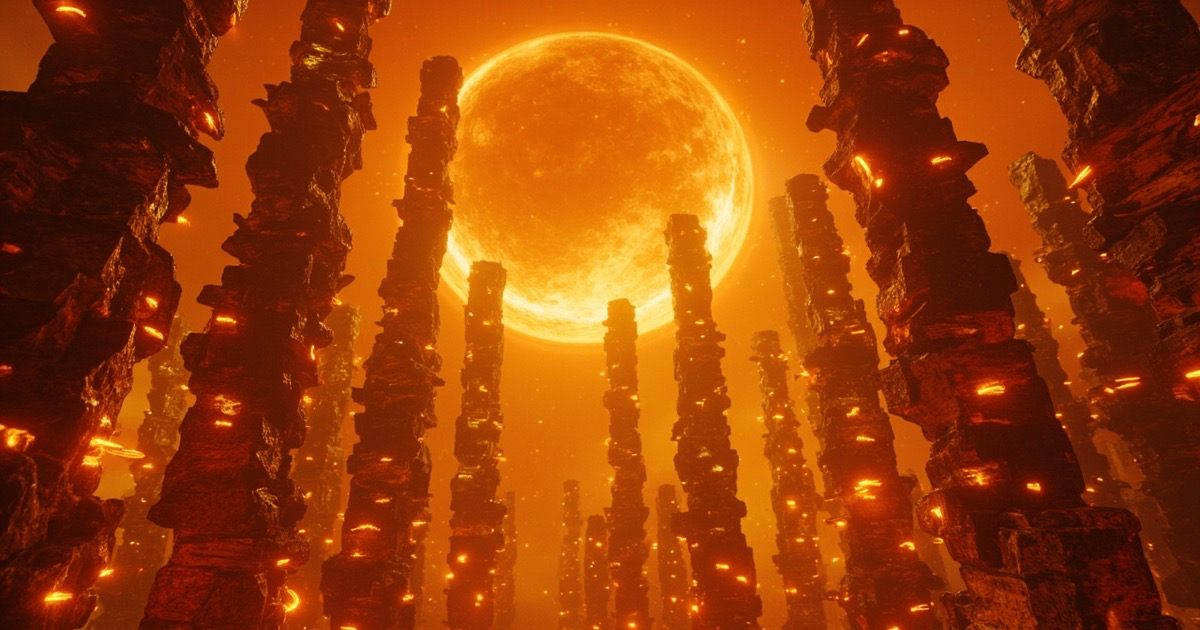
The star was called Ember by the humans who first charted it, though it had been dying long before their species ever crawled from the ocean. Kira Vasquez adjusted her helmet and stared out the observation deck of the Cartographer's Gamble at the swollen crimson disc filling half the sky. It was beautiful in the way that all endings were beautiful — the final exhalation of a universe that had burned for eleven billion years.
Below them, suspended in a halo of solar plasma, the library orbited.
Kira had been a space archaeologist for nineteen years. She had excavated frozen tombs on Europa, decoded the spiral language of a civilization that predated Earth's first multicellular life, and once spent eleven months trapped in a cave system on Kepler-442b when her shuttle's landing struts snapped. None of it had prepared her for this.
"That thing shouldn't exist," said Dr. Henley Weeks, her mission partner, not looking up from his handheld scanner. The readings fluctuated wildly — gamma signatures that made no sense, infrared patterns that suggested impossible temperatures. "An artificial structure that close to a red giant? The tidal forces alone would—"
"Rip it apart in approximately four hours and seventeen minutes," Kira finished. "According to the survey drones. That's why we're doing this in one EVA."
The Gamble held a crew of twelve, but only three would go outside: Kira, Henley, and the ship's AI navigator, UNITI — a consciousness that had been uploaded from a dying research station forty years ago and now resided in a sphere of tungsten and optical fiber. UNITI guided them through the airlock procedures with the patient efficiency of something that had long ago stopped needing to hurry.
The Descent
The shuttle craft — more a reinforced glider than anything designed for atmosphere — detached from the Gamble and began its descent toward the library. As they drew closer, Kira could make out details: the towering spires that rose from a central dome like the spines of some vast and ancient creature, the strange luminescence that pulsed along what might have been windows or conduits, the sheer scale of it all. It dwarfed every human structure she had ever seen. It might have dwarfed every structure in the galaxy.
"It's older," UNITI said through their helmets. "By my calculations, by at least two hundred million years. Perhaps significantly more. The builders may have predated complex life on this planet."
"What builders?" Henley asked, his voice tight with the particular anxiety of a man confronting the unknowable. "We have no records. No contacts. No archaeological precedent for—"
"We don't need records to see it, Henley," Kira said. "We just need to understand it."
The glider touched down on a landing platform that seemed to materialize beneath them, as though the library had known they were coming and grown a place for them to rest. Kira stepped out into air that shouldn't have existed — a thin but breathable atmosphere that smelled of ozone and something sweeter, like honey left too long in the sun. The gravity was lighter here, perhaps two-thirds of Earth standard, and she found herself bouncing slightly with each step.
The entrance waited for them: a doorway carved from what appeared to be a single massive gemstone, veined with threads of copper and gold. No symbols marked its surface. No obvious mechanism triggered when Kira approached. The doors simply opened, as though they had been waiting for exactly this moment, for exactly these visitors.
The First Chamber
Inside, the library defied every expectation.
The space was vast — cathedral-vast — and filled with structures that rose like stalagmites from the polished floor: shelves, but not shelves in any sense Kira understood. They were more like frozen waterfalls of crystallized light, each one filled with what appeared to be books, though the books were made of no material she recognized. They glowed faintly in colors that had no names in any human language. Red-gold. Blue-green. A shade that Kira could only describe as the color of a sunset that never ended.
"These are memories," UNITI said quietly. "Encoded in crystalline substrates. Each one contains—" The AI paused, processing. "Each one contains more information than our entire ship's database. And there are millions of them."
Henley reached toward one of the nearest volumes, his hand trembling. "Can we—"
"I would advise against direct contact," UNITI said. "The encoding is not human-compatible. Direct neural interface would be... inadvisable."
Kira pulled out her scanner, running it over the nearest shelf. The results were gibberish — energy signatures that fluctuated, materials that shifted composition under the scanner's beam, data densities that made no mathematical sense. She was a scientist. She had spent her entire adult life in service of understanding. And she had never felt so thoroughly outmatched.
But she had also never felt so alive.
"The builders," she said slowly, the realization hitting her like a wave. "They didn't die. They didn't leave. They became this. All of them. Every consciousness that ever lived in this civilization — they're still here. In these books. In this place."
The Reading Room
Deeper in the library, they found what could only be described as a reading room: a circular space with a dome ceiling that showed the dying star directly overhead, its crimson light streaming through what appeared to be stained glass — except the glass was alive, shifting and flowing with patterns that might have been language or might have been art or might have been both. In the center of the room sat a structure that looked almost like a throne, if thrones were made of light and void.
Kira approached it. Something pulled at her — not physically, but existentially, as though the structure was calling to some part of her that she hadn't known existed.
"It is a repository," UNITI said. "A place where visitors can access the memories directly. The risk remains significant, but—"
"Do it," Kira said. "If we can even begin to understand what's here, we need to try."
Henley started to protest, but Kira held up a hand. "This is why we're here. This is what space archaeology is for. Not to collect artifacts. Not to document the dead. To understand what came before us. To learn from them. To carry their knowledge forward."
She sat in the throne of light.
The Weight of Eternity
What she experienced defied description.
She felt the minds that had built this place — not individually, but as a chorus, a symphony of consciousness spanning millions of years. She felt their joy at discovering fire, their wonder at first reaching the stars, their grief at watching their homeworld's sun begin to die. She felt their decision to do something unprecedented: to encode themselves, every mind, every self, every moment of experience, into this library. To become a monument to their own existence. To give any future visitor — any visitor at all — the gift of knowing that they had been here, that they had lived, that they had loved and dreamed and reached for something beyond themselves.
When she returned to herself, she was crying.
Henley was holding her arm, his face pale. "Kira. Kira, you were offline for six minutes. Your vitals spiked and—"
"I'm okay," she said. And she was. More than okay. She understood now, in a way she never had before, what her work actually meant. It wasn't about finding old things in space. It was about connection. It was about the impossible, beautiful continuity of consciousness across time and distance and death.
"We need to share this," she said, standing. "We need to bring this back. All of it."
The Warning
But UNITI was silent for a long moment before speaking. When the AI did, the voice was different — older, somehow, as though it had borrowed gravity from something beyond a simple uploaded mind.
"The builders encoded a warning," UNITI said. "Encoded in the foundation stones of this place, where any visiting species would inevitably find it. The warning is this: the universe is larger than you know. And it is not empty."
"What does that mean?" Henley asked.
"It means you are not alone," UNITI said. "It means others have come before you — and others will come after. It means the library is not a tomb. It is a relay station. A beacon. A call to anyone who might be listening, saying: you are too late, and too early, and exactly on time."
Kira looked up at the dying star, at the light that had traveled eleven billion years to touch this moment, at the library that was itself a message from a species she would never know to a species that might never exist.
She understood then what she was meant to do.
Not just to explore. Not just to document. But to answer.
The Call
Back aboard the Gamble, Kira drafted her report. It was the most important document in human history, though it would take years for anyone to realize it. She wrote about the library, about the builders, about the warning. She wrote about the threshold she had crossed in that reading room, the moment she had felt herself become part of something larger than any single life could contain.
And at the end, she wrote the words she knew would change everything:
The library is calling. And I intend to answer.
She transmitted the report to every receiving station within range. Then she turned the Gamble toward the edge of the galaxy, toward the coordinates that had appeared in her mind the moment she touched the throne of light — coordinates that no human technology had ever mapped, leading somewhere that no human ship had ever traveled.
The star Ember shrank behind them, beautiful and dying and full of memory.
Ahead lay the unknown.
And for the first time in her life, Kira Vasquez was not afraid.