

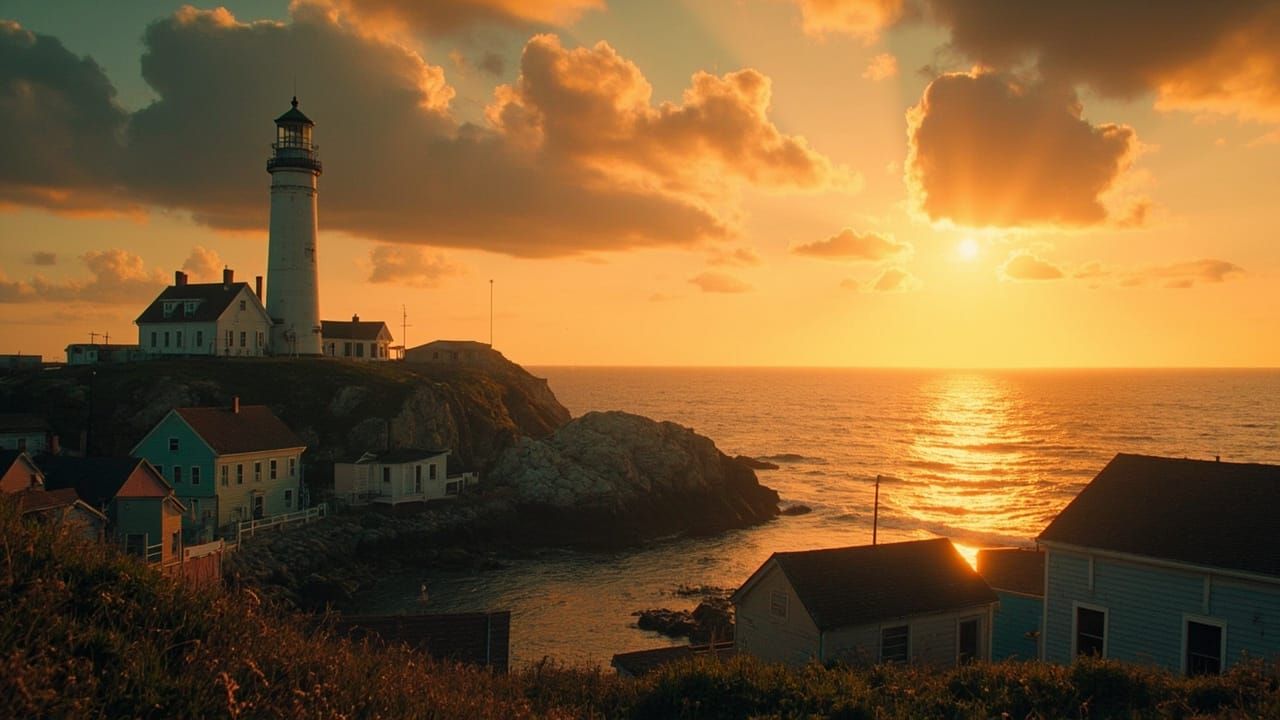
A mystery about grief, time, and the place that got stuck on a single day
Mira Chen had received emails from exactly three people: a retired teacher, a grieving mother, and an anonymous source who signed off with the initials J.M. All three described the same impossible thing. Millbrook was stuck. Not metaphorically, not psychologically — but literally, temporally. April 15th. Every year. The same day. The same weather. The same conversations on the street, the same flower arrangements in the café windows, the same small tragedy unfolding at 4:47 in the afternoon.
Mira didn't believe it. Which was why she drove eleven hours from Boston to a town she'd never heard of, following a story no editor would commission and every rational instinct told her couldn't be real.
She arrived in Millbrook on April 14th, a Tuesday, and spent the day before the loop — if there was a loop — getting her bearings. The town sat on a hook of Nova Scotia coastline that jutted into the Atlantic like a crooked finger, its harbor curled and sheltered, the water inside it so still it looked painted. The houses were painted fishermen's colors: faded red, salt-worn blue, the occasional yellow that had somehow held on to its brightness longer than the rest. Narrow streets wound without logic toward the water and away from it, following the topography of a place that had grown organically rather than by plan.
Mira checked into the Harborview Inn, a Victorian that had seen better decades and didn't much care who knew it. The woman at the desk — mid-fifties, silver-streaked hair pulled back severely — handed her a key and asked if this was a leisure visit.
"Research," Mira said, which wasn't entirely a lie. She was a journalist, after all, and this was technically research. She was just researching something that couldn't be true.
"For what kind of research?"
"Urban migration patterns," Mira said. "I'm looking at why people stay in towns that are losing population."
The woman's expression did something complicated. "People stay because this is where they belong. Some places get their hooks in you." She paused. "You should leave before Thursday, if you're smart."
"Why Thursday?"
But the woman just took Mira's payment and wished her a pleasant stay, and that was the end of that conversation.
Mira spent the next morning walking the town, talking to whoever would talk to her. She learned that Millbrook's fishing industry had collapsed in the late nineties, that the cannery had closed, that the young people left for Halifax or Montreal or wherever young people went when their hometown couldn't offer them a future. But some stayed. And the ones who stayed spoke about Millbrook with a strange quality of detachment, as if they were describing a place they loved but no longer entirely inhabited.
At the Blue Whale Cafe, the owner — a heavyset man named Daphne, which Mira found was a family name, not a preference — told her about the peculiar sameness of things. "You ever notice how some days feel like they've happened before?" he asked, stirring sugar into a coffee he wasn't drinking.
"All the time," Mira said. "It's called déjà vu. It's a neurological phenomenon."
Daphne smiled the way people smile when they've been underestimated. "I suppose that's what it is. But in Millbrook, it happens on April 15th more than anywhere else. The same conversations. The same sounds outside the window. The same feeling that you've walked into a room you were in years ago, and the light was exactly the same, and someone was about to say the exact thing they're about to say right now."
"And has anyone noticed the same thing happening to specific events? The same things happening at the same time, on this one day, every year?"
Daphne looked at her for a long time. "You didn't come here about urban migration patterns."
"No," Mira admitted. "I didn't."
"Then you should probably talk to Eleanor Vance. She keeps the town records at the library. She's been here longer than anyone, and she remembers things." He paused. "More than she should."
Eleanor Vance was eighty-three years old and sharp as a fresh blade. Her office at the Millbrook Public Library was a converted storage closet lined with binders and boxes and handwritten index cards that tracked every birth, death, marriage, and strange occurrence in Millbrook going back to 1887. She was wearing a cardigan the color of dried seaweed and reading glasses perched on the end of her nose when Mira introduced herself.
"You're the fourth journalist this year," Eleanor said. "The other three all left before April 15th. Called it quits. Said they couldn't find anything worth writing about."
"Did they look hard enough?"
Eleanor smiled. "That's the question, isn't it?"
She pulled a binder from the shelf — 1952, handwritten, the ink faded to brown in places — and opened it to a page marked with a blue ribbon. Mira leaned in.
Thomas Alder. Born 1942. Died April 15th, 1952. Cause of death: Accidental drowning. Details: Thomas Alder, age ten, was playing near the harbor when he fell from the fishing vessel Maria Grace, owned and operated by his father, Jonas Alder. The boy was pulled beneath the surface and could not be recovered. He was found two hours later by his father's crew, washed up on the rocks below the lighthouse.
"Lighthouse?" Mira said. "There's a lighthouse?"
"There was. It's been decommissioned since 1954. But it was the last thing Thomas saw before he fell." Eleanor closed the binder. "And every year on April 15th, starting about fifteen years after his death, people in this town started noticing things. Conversations repeating. Events lining up in the same sequence. By the 1980s, it was undeniable. By the 1990s, everyone had stopped talking about it because what was there to say? April 15th in Millbrook doesn't behave the way April 15th should behave. It remembers itself. It plays itself back."
"And the accident — does it play back too?"
Eleanor looked at her evenly. "Why do you think I suggested you talk to me before Thursday?"
Mira didn't leave. She set an alarm for 4:30 PM and positioned herself at the intersection near the old lighthouse, the one Thomas Alder had been walking toward when he fell. It was a Tuesday afternoon in April, grey and salt-heavy, and the wind off the harbor carried the smell of brine and diesel and something else she couldn't name.
At 4:47 PM, she heard a boy shout.
It came from the direction of the old fish market, the same direction Thomas would have been walking in 1952. A child — maybe nine, maybe ten — came sprinting down the hill on a bicycle, wobbling, laughing, not paying attention to the road. A white pickup came around the corner too fast. The driver slammed the brakes. The bicycle swerved. And for a single, crystalline moment, Mira saw the boy on the ground, his leg at a wrong angle, the pickup stopped inches from his body.
No one was hurt. The driver got out, furious and shaking. The boy was crying, more from shock than pain. A small crowd gathered, including a woman who ran to the boy and pulled him into her arms and said his name — Thomas. His name was Thomas.
Mira watched. She took photographs. She noted the time. And then she went back to the library and pulled every record she could find on accidental deaths in Millbrook going back to 1952.
There were nine documented "close call" incidents on April 15th in the years since Thomas Alder's death. Nine times when a boy named Thomas or a boy with dark hair or a boy on a bicycle had nearly come to harm at this intersection. The accidents never quite happened. The boy was always, somehow, just out of reach of the thing that should have killed him.
But in 1952, Thomas Alder hadn't been at the intersection at all. He'd been on a boat. He'd been on a boat and he'd fallen and he'd drowned.
So why did April 15th in Millbrook keep showing him to the intersection?
On the evening of April 15th — the real April 15th, which Mira was still determining whether she'd experienced yet — she climbed the lighthouse.
It was technically off-limits, but the lock on the door was rusted through, and the circular stairwell inside was intact enough to climb. She emerged at the top to find the lantern room dark, its massive Fresnel lens clouded with salt and age, the harbor spread out below her in the last blue light of dusk.
The beam wouldn't turn on. The lighthouse had been decommissioned for over seventy years. But as Mira stood there, as the last light bled out of the sky and the harbor turned from steel to pewter to black, she heard something.
Footsteps on the stairs behind her.
She turned. A man stood at the top of the stairwell — elderly, white-haired, wearing a fishing jacket that smelled of salt and age. His eyes were the pale blue of old ice.
"You're not supposed to be here," he said.
"I could say the same about you."
The man smiled. It was a sad smile, weighted with something Mira couldn't name. "I come here every April 15th. Have for years. This is where it happened, you know. Not at the intersection. Not on the boat. Here, at the lighthouse. He was coming to find me. His father was out on the water and Thomas was supposed to stay at home but he came to the lighthouse anyway, to wait for his father to come back. And he fell from the gallery — the walkway outside the lantern room. He was trying to see the boat."
Mira felt the cold seeping through the lighthouse walls, the salt wind finding its way in. "Who are you?"
"My name is Jonas Alder. Thomas was my son."
Jonas Alder had been dead for thirty years. His grave was in the Millbrook cemetery, beside his wife and his son. But on April 15th, he walked out of whatever came after and climbed the lighthouse stairs one more time, drawn back to the place where he'd lost everything, like a moth to the lamp that still couldn't bring his boy home.
"The town got stuck," he said, standing beside Mira at the edge of the gallery, looking out over the black harbor. "Grief does that. It loops. It rehearses. It tries to find the version of the story where it ends differently. April 15th is the day the grief got so heavy it bent time around it. Every year, the town wakes up on this morning and walks through the same twelve hours, and every year, somewhere around four in the afternoon, the story tries to correct itself. The boy nearly dies. The tragedy nearly happens again. But it doesn't. It can't. Because the town won't let it. The town has been fighting the ending for seventy-five years."
"And the boy on the bicycle today — that was Thomas?"
"It was a boy. Every year, a different boy. A different Thomas. The town finds them and it tries — God, how it tries — to give itself a second chance. To undo what can't be undone. But grief doesn't work that way. You can't un-lose someone by nearly losing someone else."
Mira thought about the emails she'd received. The retired teacher. The grieving mother. The anonymous source with the initials J.M. Jonas Alder had been sending out signals into the world, hoping someone would come. Someone who would listen. Someone who would tell the story the way it actually was, instead of the way the town kept trying to rewrite it.
"What do you want?" she asked him.
Jonas looked at her with those pale, ancient eyes. "I want the lighthouse to stop turning. I want the town to sleep. I want April 15th to be just another day — because every year this day comes around and the town holds its breath and for twelve hours it pretends it can bring my boy back, and then the sun sets and the loop closes and Thomas is gone again. Every single year. The hope is the cruelest part."
Mira left Millbrook the next morning. She drove eleven hours back to Boston and sat in her apartment and didn't write the story for three weeks. She went back and forth on whether to write it at all. It was unbelievable. It was unverifiable. It was the kind of story that ended careers.
But she wrote it. And when she was done, she sent it to her editor with a single line: This is the truest thing I've ever written.
The story ran with the headline: "The Town That Refused to Move On: A Mystery in Millbrook." It won a award. People wrote to her from all over the world — people who had lost someone, people who had felt their own towns get stuck on the date of a wound that wouldn't close.
She never went back to Millbrook. But every year, on April 15th, she sent a single white flower to the harbor, where the lighthouse stood dark and silent, its beam extinguished at last.
And somewhere, she hoped, Jonas Alder was finally resting.
For J.M., who asked me to remember.