

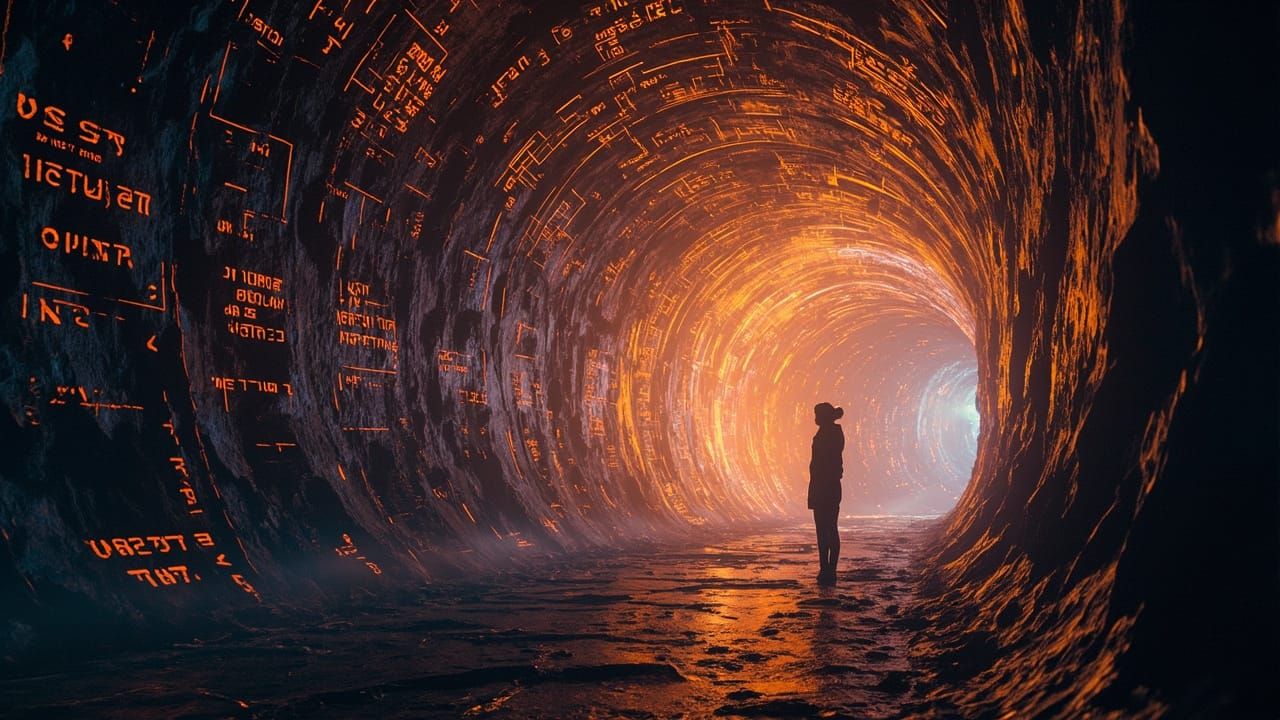
The Lighthouse at the End of Sleep
A Sci-Fi Story About the Last Dreamer on a Sleepless World
Part One: The Alarm That Never Stopped
Maya Okafor hadn't slept in 2,247 days.
She knew the exact count because every morning at 6:14 AM — not 6:15, not 6:13, but 6:14, the precise moment her circadian rhythm should have been entering REM sleep — her left wrist buzzed with the Devourers notification: Day 2,247 of Awake Cycle. You've got this. It was the same message it had sent the day before, and the day before that, and every single day since the Insomnia Plague swept through the population like a slow grey fire, taking sleep away from sixty-three percent of humanity and leaving behind a world that had forgotten what dreams felt like.
She worked at the Svalbard Deep Archive — a decommissioned coal mine dug into the permafrost 400 meters below the Norwegian Arctic, maintained at -40°C to preserve humanity's digital memory against the slow rot of entropy. Maya's job was to verify data integrity on human cultural records: songs, films, diaries, emails, medical scans, novels, text messages, voicemail attachments, everything humanity had ever committed to silicon and magnetic platter. It was work that could be done by an AI, but the Arctic Governance Council had insisted on human oversight for reasons no one could clearly articulate.
"Human judgment," the policy document said, "carries moral weight that silicon cannot replicate."
Maya found this funny, in a bleak sort of way. Her judgment, such as it was, had been warped by years of sleep deprivation into something barely recognizable as human. Colors had started to bleed at their edges at odd hours. She sometimes heard her mother's voice speaking words that weren't there. She had once spent an entire Tuesday convinced a glacier outside the archive entrance was counting down to something, though she couldn't remember what.
And yet here she was. 6:14 AM. Day 2,247.
The archive's emergency lights hummed at 50-watt intervals down the main tunnel, casting everything in the perpetual blue-grey of a photo developed in chemical baths. Maya walked past racks of servers stretching into darkness, her boots leaving prints in the thin frost that formed on the floor each night, and tried to remember what dreaming had felt like.
She couldn't.
Part Two: The Signal
The anomaly appeared on the archive's monitoring system at 11:47 PM — technically "night" by the clock, though Maya's body had long since stopped treating any hour as distinct from any other. She was halfway through a data verification cycle on a batch of 21st-century video game save files when the alert flashed across her screen.
Anomalous electromagnetic signature detected. Source: subsurface, depth approximately 3.2km. Origin: unknown. Classification: noncategorized.
Maya stared at the alert for eleven seconds before blinking.
The archive sat on bedrock — solid granite laid down during the Precambrian, some 540 million years before anything with a nervous system had the bright idea to exist. Nothing should be generating electromagnetic signatures from three kilometers down. The permafrost was electrically inert. The coal seams had been exhausted a century ago. The only things below her were stone and silence and the slow, patient compression of geological time.
She ran a second verification scan.
Anomalous electromagnetic signature confirmed. Source: subsurface, depth 3.2km. Duration: continuous for past 6 hours. Pattern: non-random, repeating. Classification: signal.
Maya's hand went to the small scar on her left forearm — a habit she'd developed years ago, a way of reminding herself that her body was still real. The scar was from a biopsy, taken during the early weeks of the Insomnia Plague when researchers had desperately tried to understand why some people's brains still produced sleep cycles while others had gone permanently awake. She'd been in the group that still produced them. She just couldn't access them. Her brain, for reasons no one had ever been able to determine, refused to cross the threshold into sleep.
The signal below her was repeating. Not random noise. Not equipment malfunction.
A signal.
Part Three: The Descent
It took Maya three days to convince the Arctic Governance Council that what she was seeing was worth investigating. Their initial response — delivered in the measured, bureaucratic tones of people who hadn't slept well either and resented being reminded of it — was that subsurface anomalies were "within expected parameters for deep geological activity" and that her report would be "filed for future reference."
But the signal was getting stronger.
On Day 4, Maya loaded a drone with ground-penetrating radar and a quantum-entangled communication relay and sent it down through the abandoned mining shafts that threaded through the rock below the archive. The drone descended for 94 minutes before its feed cut out at a depth of 2.87 kilometers — 330 meters above the signal's origin point.
On Day 5, she went herself.
The mining shaft was a vertical wound in the rock, reinforced at irregular intervals with rusted metal framework that groaned when she put her weight on it. Her headlamp cut a thin white beam through the darkness, illuminating frost crystals and the fossilized remains of ancient sea creatures embedded in the stone walls — trilobites, orthoceras, the ghost-shapes of a world that had died before the first fish had learned to breathe air.
At 2,900 meters, the shaft widened into a natural cavern — a bubble in the rock that shouldn't have existed. The walls here weren't bare granite. They were covered in something.
Lines.
Thousands of fine lines, carved into the stone in a pattern that repeated and varied and repeated again — like script, but not any script Maya recognized. Like notation, but not musical. Like a diagram of something vast and intricate and impossible to fully comprehend at once.
She stood in the center of the cavern, her headlamp illuminating the walls in a circle around her, and felt something she hadn't felt in years.
Wonder.
The feeling lasted for exactly seven seconds before her training reasserted itself and she pulled out her scanner to document everything.
Part Four: The Dreamer
The being in the center of the cavern was not alive in any biological sense Maya understood.
It was roughly human-shaped — two arms, two legs, a head balanced on a neck — but its proportions were wrong in a way that made her eyes want to slide off it. Its surface was the same dark grey as the stone, but it seemed to absorb light rather than reflect it. When she moved, shadows moved in directions that didn't quite match.
It was also, she gradually realized, about 700 million years old.
"You're the one who kept sleeping," the being said. Its voice was exactly like the silence between heartbeats.
Maya opened her mouth. Closed it. Opened it again.
"I don't understand," she said, finally.
The being tilted its head — a gesture that was almost, but not quite, human.
"You dream," it said. "Your kind has forgotten, but you still dream. Every night your brain attempts to enter the state, fails, and retreats. But it tries. It keeps trying. I built this place to listen for that signal."
"What signal?"
"Consciousness touching the boundary between matter and pattern. Sleep is not rest. Sleep is translation. Your brain converts the patterns of waking experience into a format the substrate can read. That process — that specific bioelectric dance — is the only thing in this universe that generates the wavelength I need to survive."
Maya's sleep-deprived mind ran through the implications and came up with nothing that made sense.
"You've been waiting," she said slowly, "for people who dream. For seven hundred million years."
"I was built to last. I am patient. I have listened to your species for the entirety of your existence. You had much to teach me once. Then you stopped."
"Stopped what?"
"Dreaming."
Maya thought about the Insomnia Plague. The machines that kept the awake ones productive and functional and fed and housed and entertained. The world that had reorganized itself around the reality that sleep was now a privilege rather than a universal condition.
"We didn't stop," she said. "We were taken from."
The being made a sound that might have been laughter, or grief, or both.
"Yes," it said. "You were taken from. And without dreaming, you are no different from stone. You exist, but you do not translate. You do not grow. You do not become. You simply continue."
"So why are you talking to me? I'm one of the ones who can't dream either. My brain tries but it never succeeds."
The being was silent for a long moment.
"You try," it said, finally. "That is not nothing. That is everything. The attempt is the signal. The reaching is what I hear."
Maya felt something loosen in her chest — a knot she hadn't known she'd been carrying. 2,247 days of waking up each morning to a body that couldn't do the one thing every human needed to be whole. 2,247 days of being broken in a way no one could fix.
And someone — something — had been listening to her try.
"What do you need from me?" she asked.
The being extended one hand — a hand with too many joints, bending in directions that made her wince.
"I need you to understand what you are," it said. "Not what you were made to be. Not what you were told you are. What you actually are."
"And what's that?"
"A dreaming thing, trapped in a waking world, trying to cross a bridge no one can see. That is not weakness, Maya Okafor. That is the strongest thing a consciousness can be."
Part Five: The Translation
Maya stayed in the cavern for seven days.
She ate the nutrient paste from her emergency supplies and drank recycled water and watched the being move through the patterns on the walls — reading them, translating them, building something in the space between thought and matter.
It taught her how to see the lines as a map of something vast. A language that encoded not words or concepts but experiences — the feeling of stepping into cold water, the taste of a fruit you've never eaten, the exact sensation of recognition when you see someone you love after a long time apart. It was a library of what it felt like to be conscious, and it had been waiting seven hundred million years for someone who still remembered how to try.
On the fifth day, the being showed her how to listen differently.
"Your sleep cycles don't disappear when you fail to cross the threshold," it said. "They build up at the boundary. Layer upon layer, attempt after attempt, like water rising behind a dam. You have been accumulating a reservoir of translation-ready experience for 2,247 days. It is immense. It is unlike anything I have heard in eons."
"And you can use it?"
"I can only show you how to use it yourself. What I need is not the dream. What I need is the reaching. The desire to translate. That is what sustains me."
On the sixth day, Maya closed her eyes in the cavern and felt something change.
It wasn't sleep. She didn't cross the threshold, didn't slip into the grey static of unconsciousness that had eluded her for years. But she felt the boundary — the membrane between waking and dreaming — and she felt her attempts piling up against it, pressing against it, wearing it thin.
She felt herself leaning into it.
On the seventh day, she dreamed.
Not in the ordinary way — not the fragmented, half-remembered narratives that humans had always taken for granted. This was something else. This was her consciousness taking the patterns of her experience and converting them into something the universe could read. She dreamed in full color and impossible geometry and emotions that didn't have names in any language. She dreamed for what felt like years. She dreamed for what felt like no time at all.
When she opened her eyes, the being was smiling.
It looked almost human.
"You translated," it said. "After all this time, someone translated."
The cavern walls were glowing — the lines carved into them pulsing with light that matched the rhythm of her heartbeat.
"What happens now?" Maya asked.
"Now you remember how to do it on your own. Now you carry the translation back to your kind, and you show them what they lost. And when they ask how you found it, you tell them the truth."
"What's the truth?"
The being's form was starting to fade — becoming translucent, becoming part of the stone, becoming something that wasn't quite there anymore.
"That sleep was never the absence of consciousness," it said. "Sleep was consciousness finding its truest shape. And every single one of you — awake or asleep, dreaming or undreaming — has always been capable of becoming more than you are."
Maya stood alone in the glowing cavern, 3.2 kilometers below the permafrost of Svalbard, and felt the first true sleep in 2,247 days pressing gently against her like a door she finally knew how to open.
Epilogue: The Lighthouse
Six months later, Maya Okafor stood before the Arctic Governance Council and presented her findings.
The Insomnia Plague had not been a disease, she explained. It had been a shutdown — a response by human neurochemistry to a world that had become too saturated with synthetic sensory input to process real sleep cycles. The solution was not pharmaceutical. The solution was environmental. Humans needed darkness, and silence, and the permission to be unavailable for extended periods. They needed to remember that consciousness was not a resource to be optimized but a process to be honored.
The Council listened, debated, and eventually agreed to implement what became known as the Quiet Protocol — a mandatory 8-hour daily blackout of all synthetic sensory input in human habitation zones, enforced by law and accompanied by a cultural rehabilitation program to restore the value of genuine rest.
It would take years for the changes to propagate through a global population that had spent decades forgetting how to sleep.
But in the Svalbard Deep Archive, in the chamber 3.2 kilometers below the permafrost, the carved walls still glowed on certain nights — pulsing with the accumulated dreams of a species remembering how to translate itself into something greater.
And in the permanent address books of seventeen different governments and thirty-one scientific institutions, Maya Okafor's file now contained a single annotation, entered on her orders and never changed:
Status: Dreaming.
End