

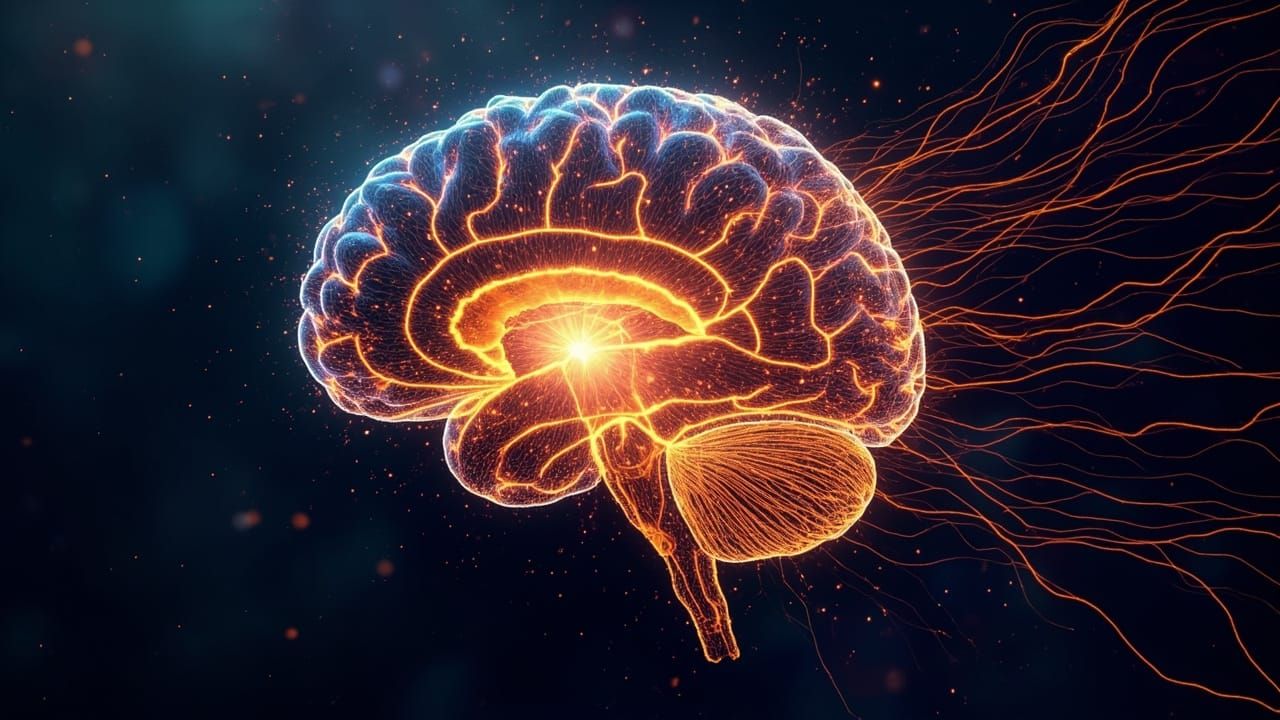
The Other Brain
A Real Science Story About the Hidden Network Hiding in Plain Sight
Part One: The Janitor
For a hundred years, neuroscience had a favorite child.
Neurons got all the attention. They fired, they spiked, they communicated in crackling electrical language across synapses that Nobel prize winners dissected with glee. Textbooks showed their branching dendrites in full color. Films portrayed them as the stars of consciousness — the dazzling, brilliant stars, the ones doing the actual thinking, feeling, and remembering. Schools taught children that neurons were the brain's "real" cells, while everything else was just… support tissue.
The support tissue had a name: glia, from the Greek word for "glue." Because for decades, that's mostly what scientists thought these cells did. They glued things together. They provided structure. They fed neurons oxygen and cleared away their metabolic waste.
They were, in the polite language of science, uninteresting.
Dr. Nadia Orellana had spent fifteen years studying neurons. She had published papers on synaptic plasticity, attended conferences where she debated the finer points of long-term potentiation, and trained three PhD students who now had academic positions of their own. She was, by any measure, a neuron person.
And she had never once considered that she might be looking at the wrong thing.
Part Two: The Map
The project began as a favor.
A colleague at NYU Grossman needed help validating a new gene therapy technique — one that allowed researchers to "mark" individual astrocytes and trace the molecules passing through their gap junctions. It was meant to answer some fairly narrow questions about cell-to-cell communication in localized brain regions.
Nadia agreed to collaborate because the methodology was elegant and she had funding gaps to fill. She did not expect to spend the next eighteen months staring at something that would upend everything she thought she knew about the brain.
The first full-brain map came back on a Tuesday morning in November 2025.
She was alone in her office, coffee cooling beside her keyboard, when the 3D render finished processing on her screen. What she saw made her push back from her desk so hard her chair hit the wall.
The astrocytes weren't scattered randomly through the brain. They were organized.
Long chains of connected cells stretched across the entire organ — bridging the two hemispheres through structures she had never noticed despite a career of staring at brain anatomy. Thick cables of astrocyte processes ran along white matter tracts, connecting regions that neurons themselves never directly linked. The entire brain was threaded with a network that had been there the whole time, invisible, interconnected, vast.
"It's a subway system," said Shane Liddelow, her collaborator, when she showed him the image on her laptop that evening. "A secret subway system we didn't know was there."
Nadia stared at the glowing network on the screen and felt the particular vertigo of someone who has just realized how much they don't know about the organ they live inside.
Part Three: The Forgotten Majority
Twenty-five percent.
That number kept appearing in her thoughts in the weeks that followed. Astroctyes comprised roughly one quarter of all the cells in the human brain. One quarter. And for over a century, researchers had treated them as background noise — the cellophane wrap around the real show.
She started reading everything she could find about the history of glia research. What she discovered was a story of scientific fashion colliding with the reality of how research funding got allocated.
Neurons were exciting. They produced electrical signals that could be measured, recorded, and visualized in dramatic ways. Their synapses were small enough to be seen under early electron microscopes. Their behavior could be linked directly to behavior — a firing pattern in one region could explain why an animal turned left instead of right. Neurons told stories that were easy to sell to grant committees.
Glia, by contrast, were shapeless. They had no axons. They didn't fire electrical spikes. Their communication methods — calcium signaling, Jedi-shaped gap junctions, slow chemical waves — were harder to measure and harder to link to specific outcomes. Studying glia was like trying to understand a city by mapping its shadow instead of its buildings.
So nobody did.
The consequence of that century-long bias was now sitting on Nadia's hard drive: a complete map of a communications infrastructure that covered the entire brain, about which neuroscience knew almost nothing.
Part Four: The Plasticity Problem
The deeper the team looked, the stranger things became.
In early 2026, they published their first major findings, and the response from the scientific community was immediate and electric. Researchers from twelve different institutions requested collaboration meetings within the first week. Three separate labs announced they were pivoting their research programs to focus on astrocyte networks.
But it was a secondary finding that truly unsettled Nadia.
When they imaged astrocyte networks in mice that had been sensory-deprived — mice raised in darkness, or with their whiskers surgically altered — the networks had reshaped themselves. New connections had formed. Old ones had been pruned. The "silent" cells had been adapting in real time to the animal's experience, reorganizing their communication patterns to match the world the mouse was actually living in.
This was not supposed to happen in non-neuronal cells.
Neurons were plastic — everyone knew that. Experience-dependent rewiring was the foundation of learning and memory. But astrocytes were supposed to be stable. They were supposed to be the static infrastructure, not the dynamic software.
Yet here was the data: the brain's forgotten majority was reshaping itself based on what the mouse needed. The subway was being rerouted while the train was still running.
"What are they actually transmitting?" Nadia asked at a lab meeting in March. "We can see the network. We can see it changing. But what's moving through it?"
No one had an answer.
Calcium signals, likely. Metabolic information, possibly. Information about the brain's energy state, maybe. The honest answer, the one none of them liked saying out loud, was: we don't know.
Part Five: The Question Beneath
Six months after the Nature paper, Nadia gave a talk at the annual Society for Neuroscience conference. Five thousand researchers packed the auditorium. She presented the astrocyte map, the plasticity data, the anatomical findings. Then she showed a slide that had no data on it at all — just a question, written in large type:
What if neurons aren't the brain's primary information system?
The room went quiet.
She explained her reasoning: neurons got all the attention because they were loud. Electrical spikes traveled fast and left measurable traces. But silence wasn't the same as absence. The astrocyte network had been there the entire time, silent and vast, threading through every region of the brain. It was older, evolutionarily — astrocytes appeared in the nervous systems of early vertebrates before neurons had evolved their sophisticated communication machinery.
What if, she asked, the brain had a second layer of processing that ran beneath the flashy neuronal theater? What if consciousness — that most hard-fought of scientific frontiers — emerged from the interaction between these two systems, rather than from neurons alone?
It was speculation. She said so clearly. But it was speculation grounded in the anatomical reality of a network that covered the entire brain, changed with experience, and had been systematically ignored for a hundred years.
The questions that followed her offstage were the most animated she had ever received.
Epilogue: The Watcher
Nadia returned to her lab on a cold April morning in 2026 — the same week the story broke in major media outlets, the same week "astrocyte" became a word that non-scientists started using in conversation.
She pulled up the astrocyte map on her screen again. The network glowed in false colors, every connected cell traced in luminous detail. She thought about the fact that this was in her head — that every human walking around had a second brain inside their first brain, a hidden subway system carrying information she couldn't yet read, shaping who they were in ways no one understood.
She thought about the janitor cell — the name one journalist had used in a profile piece, half-mocking and half-awed. The support tissue that wasn't supporting anything. The glue that turned out to be architecture.
The brain had been hiding in plain sight for a hundred years.
Nadia closed the map, opened a new document, and started writing the next experiment.
There was so much left to find.
End