

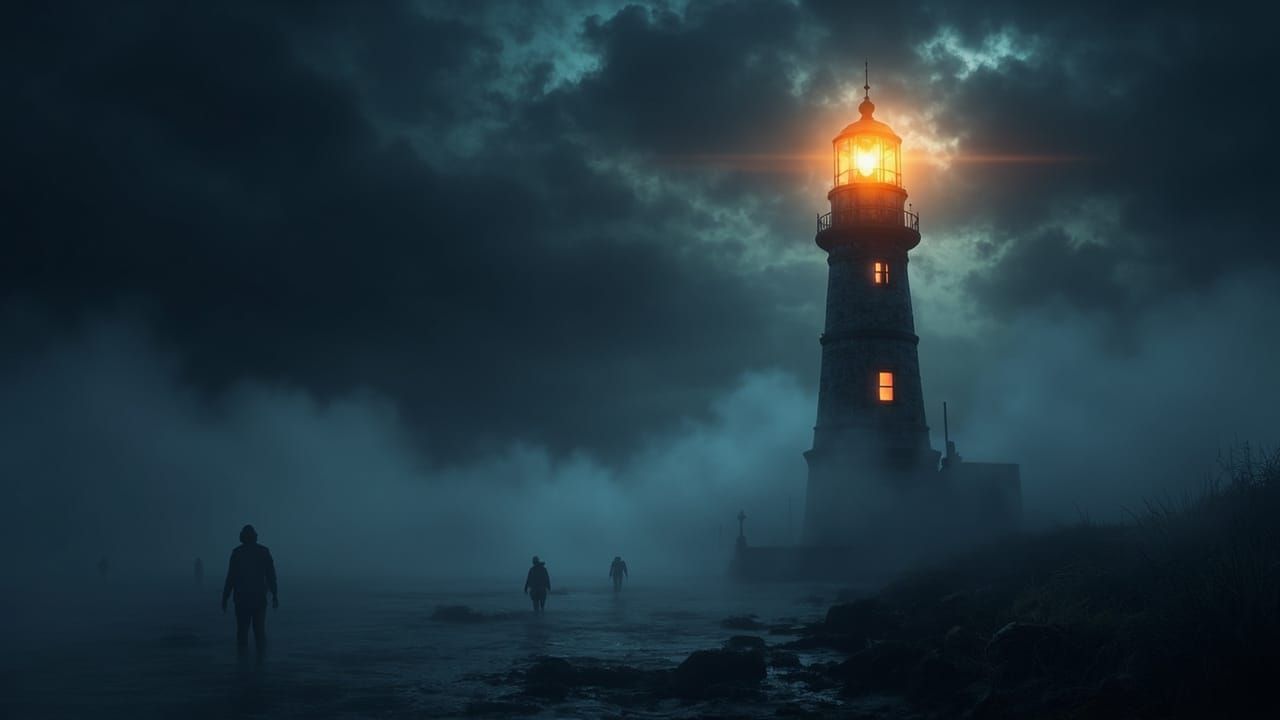
The Lighthouse Keeper's Last Broadcast
A Mystery Story
The fog rolled in thick that night, swallowing the coastline in grey silence. Maritime Museum researcher Dr. Amara Osei barely noticed—it was 2:47 AM, and she was alone in the archives, surrounded by water-damaged ship logs and a cup of cold coffee she hadn't touched in hours.
Her tablet buzzed. A notification from the Automated Radio Archive Project: New signal detected — FM frequency 107.9, originating from Point Desolation Lighthouse, Nova Scotia. Duration: 3 seconds. Timestamp: April 8, 1952.
She almost deleted it. False positives were common—WWII military broadcasts, rogue CB radio interference, the occasional mistaken satellite bounce. But the project's machine learning filter had flagged it with 94% confidence as a voice, and the timestamp... April 8th. Today. Seventy-four years apart.
Amara pulled up the audio file and pressed play.
"...they're walking on the water. God forgive me, I can see them walking—"
Static. Then silence.
Three days later, Amara sat across from Eleanor Vance in a cramped Boston diner, the older woman's hands wrapped around a mug of black coffee like it was the only solid thing in the room. Eleanor had been seventeen in 1952, living with her family in a fishing village three miles from Point Desolation. The lighthouse keeper, a man named Samuel Thorne, had been her uncle by marriage.
"He went mad," Eleanor said flatly. "That's what the official report says. 'Acute psychiatric episode induced by isolation.' They found him at the base of the lighthouse tower, neck broken. Ruled it an accident."
"You don't believe that."
Eleanor's eyes were the color of sea glass—pale, weathered, ancient. "I believe that night, every light on the coast went out for exactly eleven minutes. Every single one. And when they came back on, Uncle Samuel was dead, and the fog..." She paused. "The fog was moving wrong. My father said it was flowing inland, toward the cemetery, like something was pulling it."
Amara had spent the past seventy-two hours listening to the recovered broadcast on loop. Three seconds of audio. Seventy-four years of silence, broken by a dying man's voice describing something that couldn't exist.
"The archive has other recordings," Amara said. "From the same night. Different sources—ship radio, coastal patrol, even a local radio station that went briefly off-air. I need to know if any of them corroborate what your uncle described."
Eleanor stared into her coffee. "What are you not telling me?"
Amara hesitated. Then she slid her tablet across the table, displaying a spectrogram analysis. "Your uncle's broadcast wasn't just voice. There was a second layer, buried beneath it. A subsonic frequency—below the threshold of human hearing, but detectable by equipment. The pattern is..." She struggled to find the right word. "Structured. Repeating. Almost like a code."
"What's the frequency?"
"7.83 Hz. The Schumann Resonance."
Eleanor looked blank.
"The natural electromagnetic pulse of the Earth. It's always present, a background hum at the edge of perception. Except..." Amara tapped the screen. "Except on April 8th, 1952, it spiked to nearly 300% normal amplitude, and it phased with your uncle's broadcast. That's not possible. The Schumann Resonance doesn't spike without a corresponding geomagnetic event, and there was no solar storm that night, no earthquake, nothing to explain it."
"So something caused it."
"Or someone."
They drove up to Point Desolation on a grey Tuesday morning, the sky heavy with the threat of rain. The lighthouse had been decommissioned in 1978, replaced by an automated beacon a quarter mile down the coast. The original tower still stood, a granite sentinel against the Atlantic, its lamp room dark and empty.
Eleanor's family had owned the land around it. Now it belonged to a conservation trust that had no idea what had happened there. Amara had spent weeks negotiating access, a fabricated research grant from a fictional marine biology institute her only leverage.
"You really think there's anything left to find?" Eleanor asked, standing at the base of the tower. "After seventy-four years?"
"I think your uncle recorded something on his last night alive, and I think it was important enough that someone—something—bothered to bury it under a frequency nobody would think to look for." Amara pulled out a portable spectrometer, the kind used for detecting atmospheric anomalies. "The question is why."
They climbed.
The lighthouse's interior was a disaster—decades of neglect had reduced the circular staircase to a rusting skeleton, and they had to use a separate access ladder bolted to the exterior wall. By the time they reached the lamp room, Amara's arms were shaking and Eleanor was breathing hard, her seventy years showing in the strain on her face.
But the lamp room itself was... wrong.
Amara felt it the moment she pulled herself through the hatch. A pressure in her ears, like descending too fast in an airplane. The air was cold—too cold for late spring—and there was a smell, faint but unmistakable: ozone, like the aftermath of a lightning strike.
And the walls.
The walls were covered in writing.
Samuel Thorne had covered every surface with text, thousands of words scratched into the paint with something sharp—a nail, perhaps, or a knife blade. The handwriting grew more erratic toward the top of the room, letters slanting and overlapping, some so large they dominated entire panels, others tiny and precise, almost mechanical.
Eleanor made a sound like she'd been punched.
Amara moved closer, reading. The words were in English, but fragmented, half-finished: "they come when the resonance peaks—" and "not ghosts but the space between—" and "the lighthouse was built on a node, they knew, they always knew—"
And then, on the wall directly opposite the dark lamp housing:
"THEY ARE STILL WALKING"
Amara spent six hours documenting everything. Eleanor left twice—to cry, the second time to vomit outside the lamp room's windows. By the time the sun was setting, Amara had photographed thousands of words, recorded dozens of hours of audio, and connected her spectrometer to the lighthouse's original wiring, still intact in the walls.
The readings made no sense.
The Schumann Resonance was spiking again. Not as dramatically as in 1952, but consistently, a low hum that she felt more than heard, vibrating in her teeth, her sinuses, the fluid in her eyes. And beneath it, exactly as in the broadcast archive, a second frequency was layering on top: faint, structured, intentional.
"There's a second signal," she said, her voice strange in the lamp room's echo. "Hidden inside the resonance. Someone—something—is using the Earth's own heartbeat to carry a message."
"Who?"
Amara checked her equipment. The signal wasn't coming from outside. It was emanating from below—from the lighthouse's foundation, from the ground beneath the tower, from somewhere deep in the bedrock itself.
She thought of the broadcast. "They're walking on the water."
She thought of Eleanor's father, describing fog that moved inland, toward the cemetery.
She thought of Samuel Thorne, who had died trying to tell the world what he'd seen.
And then the lamp room's windows—dark, empty, thick with decades of salt and grime—suddenly fogged from the inside, and Amara watched in frozen silence as letters appeared on the glass, traced by something she couldn't see, something writing from the other side:
YOU HEAR US NOW
She didn't remember the descent. One moment she was standing at the window; the next, Eleanor was dragging her down the exterior ladder, both of them gasping, the rain having finally arrived to turn the cliff path into a slick nightmare of mud and loose stone.
They made it to the car. Eleanor drove; Amara couldn't. Her hands wouldn't stop shaking, and the spectrometer kept recording, the signal growing stronger the farther they got from the lighthouse, like it was following.
"What did you see?" Eleanor demanded, her voice cracking.
Amara stared at the readouts. "I don't know. I don't—" She stopped. "The signal. It's not just a message. It's a... a beacon. A sonar pulse. Something down there is using the Earth's resonance to ping for responses."
"Responses from what?"
Amara looked up at the rearview mirror. The lighthouse was gone, swallowed by the storm, but she could have sworn she saw a light in the lamp room—a faint flicker, like a flame, like something that hadn't been lit in seventy-four years.
"From anyone who can hear it."
The full recording was released six weeks later, after Amara had spent every waking hour decoding the signal buried in Thorne's broadcast. It took a team of linguists, physicists, and one very confused radio astronomer to confirm what she'd found: the pattern wasn't random. It was a greeting.
Structured. Deliberate. Warm, even—a mathematical sequence designed by an intelligence that understood human cognition well enough to recognize when someone was finally, truly listening.
The message, translated in full, read:
We built this place for you to find us. The lighthouse marks the node. The node holds the door. When the resonance peaks, the door opens. When the door opens, we walk to meet you.
You were not ready in 1952. Your technology was too young. Your minds were too closed.
But you are ready now.
We are waiting.
The story broke on a Wednesday morning. By Friday, the world's governments were in emergency session. By Sunday, Point Desolation was surrounded by military cordons and scientific teams from two dozen countries.
They found the door three months later. It was exactly where Samuel Thorne had written: beneath the lighthouse foundation, in a cavern that shouldn't have existed, carved into the bedrock by hands that had died before humans learned to write.
What walked through that door, on a cold April night exactly seventy-four years after Samuel Thorne's last broadcast, is a story for another time.
But Amara Osei, who had heard them first, who had translated the message, who had opened the door humanity was never supposed to find—she was there.
She was ready.
THE END