

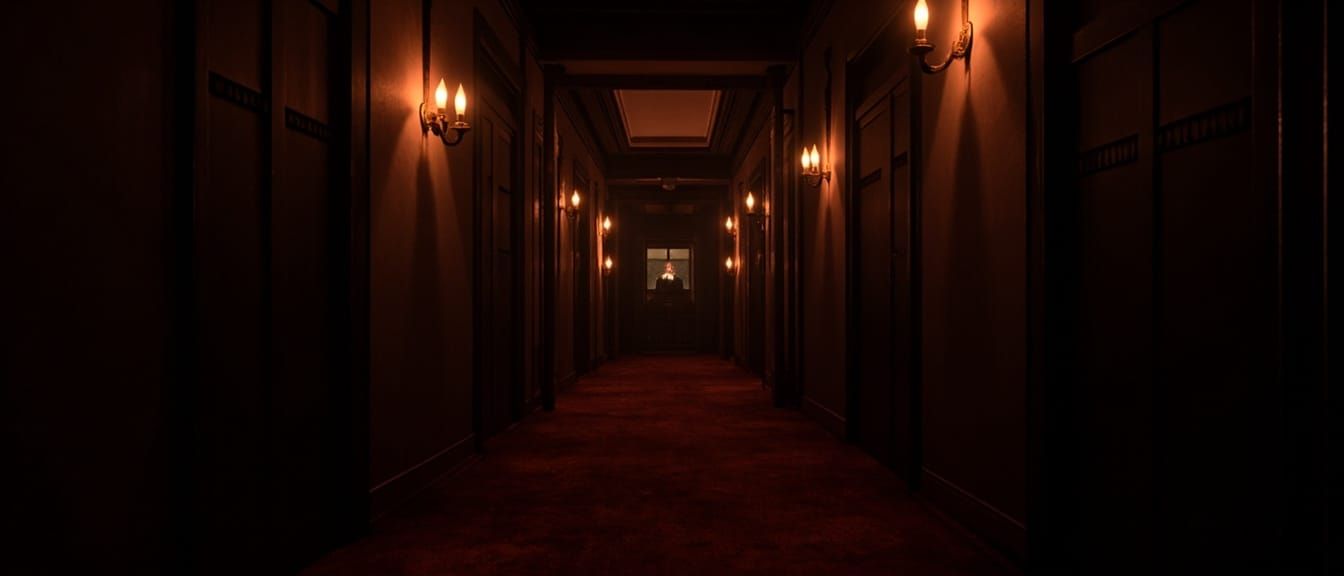
A Horror Story
The elevator in the Carlisle Heights apartment complex had buttons for 1 through 8. Marcus Chen pressed 1 on his first night, carrying a box of kitchen supplies up from his car, and noticed the way the button sat slightly recessed in its housing — worn smooth from years of use, like an old stone steps hollowed by centuries of passing feet.
That should have been his first clue.
His apartment was 2A. A corner unit, seventh floor, with windows facing east and south. The building was old but well-maintained, the kind of pre-war construction with high ceilings and solid oak floors that real estate listings called "character." Marcus had moved from Seattle after his divorce, looking for something cheap and quiet where he could lick his wounds in peace. Carlisle Heights had offered both, along with a landlord named Mrs. Halverson who spoke in a whisper and smelled faintly of menthol cigarettes.
"The building has history," she'd told him during the tour, her pale eyes tracking him across the living room with an intensity that made him want to check his pockets. "Good bones. Good energy."
He hadn't asked what that meant. He'd signed the lease.
The first week passed without incident. Marcus settled into a routine — coffee at the window each morning, work from the small home office he'd carved out of what the previous tenant had optimistically called a "reading nook," dinner at the small table by the radiator. The radiator, he noticed, made a sound sometimes. Not the usual ticking and groaning of old steam pipes, but something more deliberate. A rhythmic tapping. Almost like footsteps.
He mentioned it to Mrs. Halverson when she stopped by to collect the first month's rent.
"The pipes are old," she said, not meeting his eyes as she counted the bills. "This building settles at night. All old buildings do."
"I thought I heard footsteps," Marcus said. "Coming from below."
Mrs. Halverson's hands paused over the money for just a moment. A fraction of a second. Then she resumed counting as if nothing had happened.
"There are no units below yours," she said. "The basement is storage. You have nothing to worry about."
She left without waiting for a response.
Marcus started paying attention after that. Not consciously at first — just a low hum of awareness at the edge of his perception, the way you suddenly become conscious of a sound that's been there all along, like the buzz of a fluorescent light or the whisper of a refrigerator. He noticed the sounds the building made at night. The settling, yes. The radiator pipes. But also something else.
Breathing.
Not loud. Not alarming. Just the soft, rhythmic sound of someone exhaling, somewhere in the walls or below the floor or perhaps just outside his window on the fire escape. He checked the fire escape. He checked the hallway. He checked the stairwell, descending one flight to 1A, then 1B, then back to the lobby where the night manager — a heavyset man named Gus who never seemed to actually sleep — was watching a small black-and-white television with the sound turned low.
"Everything okay, Mr. Chen?" Gus asked without looking up.
"I thought I heard something," Marcus said. "Breathing."
Gus nodded slowly. "Old building," he said. "You get used to it."
On the twelfth night, Marcus couldn't sleep. He lay in bed staring at the ceiling, listening to the radiator tap-tap-tap in its steady, patient rhythm, and at some point past 2 AM he gave up on rest entirely. He got up, put on a robe, and walked to the kitchen to make tea.
The window over the sink faced the courtyard. All the windows in Carlisle Heights faced the courtyard — a narrow shaft of space between buildings that never seemed to receive direct sunlight, perpetually gray and shadowed even at midday. Marcus filled the kettle and stood waiting for it to boil, watching the dark rectangle of the courtyard below.
A light came on.
He hadn't seen it before — or perhaps he had, and had dismissed it as a reflection or a trick of his tired eyes. But there it was: a faint amber glow emanating from what should have been the basement level. Except the basement didn't have windows. Marcus knew this because he'd looked, that first week, when curiosity had overcome his reluctance to poke around. The Carlisle Heights basement had no windows. Only a single steel door accessible from the service entrance at the rear of the building.
But there was light. Dim and amber and steady, like a candle burning in an underground room.
The kettle screamed. Marcus jerked back, nearly scalding himself, and when he looked again the light was gone.
He did something stupid that night. Something reckless and human and tinged with the particular stubbornness that only surfaces at 3 AM when sleep has abandoned you and the ordinary world has begun to feel like a thin membrane stretched over something larger and darker. He put on shoes, grabbed his keys, and took the elevator to the basement.
The elevator did not stop at the basement.
Marcus pressed the button marked B — which should not have existed, because he had pressed 1 through 8 a thousand times and there was no B — and the elevator descended smoothly past the lobby, past what he was certain was the ground floor, into a space that hummed with a sound like large machinery idling.
The doors opened onto a corridor.
It was not the basement Marcus had glimpsed through the service door that first week. That basement had been concrete and cinder block, with exposed pipes running along the ceiling and the smell of damp and mildew. This corridor was different. Warm. Carpeted in a deep burgundy that looked like it had been chosen in the 1970s and never replaced. Papered walls in a pattern of subtle gold vines. Sconces with old-fashioned brass fixtures, the bulbs long burned out, leaving only the faint amber glow of something else — something that seemed to come from the walls themselves.
Marcus stepped out of the elevator.
The corridor stretched in both directions, lined with doors. Each door was identical: dark wood, brass handle, a small frosted window at eye level that glowed faintly from within. Marcus could hear the breathing now — not through walls but through the air itself, a soft, steady rhythm that seemed to come from everywhere at once.
He walked. He didn't know what else to do. The corridor curved gently, which should have been impossible — the footprint of the building was rectangular, fixed, known — but the corridor curved like the inside of a seashell, and Marcus walked, and the doors multiplied, and the breathing grew louder, and the amber light grew warmer, and at some point he realized that the sound was not one breath but many, layered and overlapping, the respiration of a hundred sleeping things in a hundred rooms, and he understood with a cold, animal clarity that the basement of Carlisle Heights was not a basement at all.
It was an apartment building.
The same shape as the one above, but inverted. Mirrored. A shadow structure that existed in the negative space beneath his feet, with its own corridors and its own doors and its own tenants, and as he stood there in the amber half-light, trying to remember which direction the elevator had been, he heard a sound behind him that he recognized immediately, though he had never heard it before.
A door opening.
He ran. He didn't choose a direction; his body chose for him, propelled by adrenaline and some deep reptilian instinct that knew what his conscious mind refused to accept. The corridor twisted. The doors blurred past — 1A, 1B, 2A, 2B, 3A — and Marcus ran, and behind him, in the warm amber light, he heard footsteps. Not hurried. Not aggressive. Just steady. Patient. The measured pace of someone who knew exactly where they were going and had all the time in the world.
The elevator was gone. The wall where it had been was seamless, uninterrupted, wallpaper meeting wallpaper in a pattern so perfect it might never have opened at all.
Marcus stopped. His chest heaved. The breathing was all around him now, louder and closer, and he realized with horror that the glow behind the frosted windows was brighter. The doors were no longer dark. Light pulsed behind each one like a heartbeat, like something stirring in its sleep, and he understood — with the terrible clarity of a dreamer who finally realizes they are dreaming — that every door in the basement was occupied.
Every single one.
And he had been living in the apartment directly above one of them for twelve days.
He woke on the kitchen floor. Sunlight was streaming through the window. The radiator was silent. The building settling, Mrs. Halverson had called it. The old bones of the place rearranging themselves in the night.
Marcus did not go to work that day. He sat in his armchair by the window and stared at the floor — at the oak planks that had seemed so charming when he'd moved in, so full of character and history — and he tried to convince himself it had been a dream. A hallucination brought on by stress and poor sleep and the particular loneliness of a man who'd left his entire life behind to start over in a city where he knew no one.
But the floor, he noticed now, was warm.
Not warm like sunlight. Not warm like a radiator beneath it. Warm like something living. Warm like breath.
Mrs. Halverson came by that evening with a casserole dish, a housewarming gift she said, though the lease was signed two weeks ago and she'd had plenty of time to deliver it earlier. She set it on the kitchen counter with a practiced maternal efficiency and stood with her hands clasped in front of her, looking at Marcus with those pale, unblinking eyes.
"You're looking tired, Mr. Chen," she said. "Are you sleeping?"
"No," Marcus said. "I'm not."
"That's a shame." She glanced at the floor — just for a moment, a flicker of an eye movement so quick he might have imagined it. "This building has such good energy for sleeping. The walls are thick. You can't hear anything from the neighbors. Very quiet."
"Mrs. Halverson," Marcus said. His voice came out steadier than he felt. "What's below my apartment?"
The old woman smiled. It was not a comforting expression.
"Nothing, Mr. Chen. There's nothing below your apartment. There has never been anything below your apartment." She moved toward the door, pausing with her hand on the frame. "You should eat the casserole. It's your grandmother's recipe. I got it from the woman who lived in your unit before. Lovely woman. Kept to herself. Very quiet."
She left.
Marcus did not eat the casserole.
Three days later, he tried to break his lease. Mrs. Halverson was very sorry, she told him from across the lobby desk, but there was a twelve-month minimum. A clause in the contract. He should have read it more carefully. No, there was no early termination fee because the fee would be the twelve months of rent he'd already agreed to pay. No, she could not speak to the building's owner because the building had no owner. It simply was.
"What does that mean?" Marcus asked. "Every building has an owner."
"Not this one," Mrs. Halverson said. "This building has a tenant."
He sleeps now in increments. Twenty minutes here, thirty minutes there, curled in the armchair with his back to the wall and his eyes on the floor. The warm floor. The breathing floor. He has put down rugs — every rug he could find in the city, overlapping and layered, wall to wall, but still he feels it. The faint vibration. The pulse that is not quite a pulse.
Sometimes, late at night, when the radiator taps its patient rhythm and the building settles into its old-bone groans, Marcus swears he can hear something beneath the sounds. A low, rhythmic thrum. Like a heartbeat. Like something dreaming. And sometimes, just at the edge of sleep, he hears a word. Not spoken aloud but transmitted somehow, the way vibration becomes sound becomes meaning in the deep architecture of a dreaming mind.
The word is his name.
Just his name, repeated in the dark.
Marcus.
Like a tenant. Like a guest. Like something that has been waiting for him, in the amber light below, in the warm floor beneath his feet, for longer than the building has stood and longer than he has been alive, and will go on waiting long after he is gone.
The walls are thick. Mrs. Halverson had said so.
Very quiet.
Published: April 7, 2026