

A Story of Light, Memory, and the Things We Leave Behind
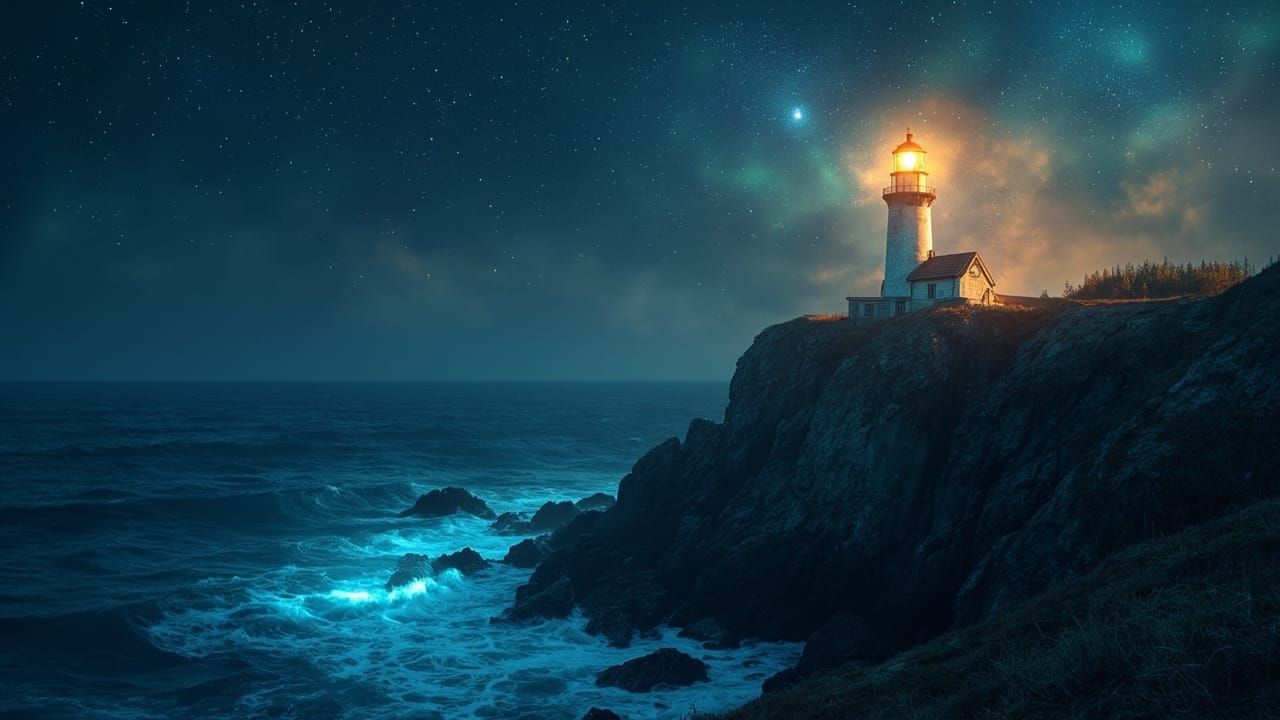
The lighthouse stood where the land forgot to be land anymore—just rocks tumbling into the sea like a giant had dropped a handful of pebbles and called it a coastline. Maren Thorne had been its keeper for thirty-seven years, and she had made peace with the solitude. What she had not made peace with was the noise.
Not the noise of waves, which she loved like a heartbeat. Not the crying of gulls at dawn, though those took some getting used to. No—it was the other kind. The kind that lived inside her own head. The whisper of every ship she'd never managed to save, every sailor who'd slipped past her light in the fog, every face she'd seen reflected in the water and then lost.
The sea keeps no promises, her grandmother used to say. Maren was beginning to believe the sea kept nothing at all—not even the dead, who should have had a right to rest on its floor.
She was climbing the spiral staircase to check the lamp mechanism—her evening ritual, as regular as breathing—when she saw it.
A light. Below the cliffs.
Not a ship's light. Ships had bulk and purpose. This was something else: a soft, pulsing glow that seemed to breathe, that seemed to move with intention. It was the color of moonlight on still water, but warmer somehow. More alive.
Maren's hand went to the brass handle of the lighthouse door, and she stood frozen, watching.
The light descended the rocks in a pattern she almost recognized—almost—then paused at the base, where the tide pools gathered in basins of black stone. It bobbed there, gentle and patient, as if waiting.
As if waiting for her.
She had been young once. Young enough to believe in things that couldn't be explained. Before the first wreck. Before the first funeral. Before she'd learned that lighthouses were not heroes but merely witnesses, standing firm while everything else fell apart around them.
But something in that light called to the part of her that still remembered how to hope.
She pulled on her oilskin jacket—and there were times, alone on this rock, when she was grateful that no one was there to see her hesitate at her own door—and stepped out into the evening.
The Atlantic was calm for once, its surface pewter-gray under a sky that couldn't decide between day and night. Spring had softened the air just enough that her breath didn't crystallize, but she could feel winter's ghost in the way the wind found the gaps in her clothing. She walked the path she knew by heart—the one that switchbacked down the rocks to the tide pools below—her lantern held high.
The light was still there. Waiting.
She was close enough now to see its shape, though the contours kept shifting, like heat mirage over summer asphalt. Roughly human. Small—child-sized, she realized with a start. But impossible. No child could survive down here. No child had any business being on these rocks after dark.
"Are you lost?" The words left her mouth before she could stop them, and she heard how foolish they sounded against the crash of waves.
The light didn't answer in words. Instead, it rose slightly, turned, and began moving along the base of the cliffs toward a small cove she knew well. The one she called the Drowning Floor. The place where three ships had come to grief in her tenure, including the Ellen Marie in '94, which had taken seven men and one promise Maren had made to a widow in Halifax.
She didn't want to follow. Every instinct told her to turn back, to climb the lighthouse stairs, to wait for morning and convince herself she had imagined the whole thing.
But her feet kept moving.
The cove opened before her like a wound in the rock, and the light settled at its center, just above the waterline. It was then that Maren saw the boats.
Not real ones. Not physical. These were made of something luminous and translucent, like jellyfish made of glass, each one carrying a tiny passenger she couldn't quite focus on. Sailors. Faces she almost recognized. The faces of the lost.
And the light-child stood among them, arms raised, guiding them.
Guiding them where?
"My name is Maren Thorne," she said, and her voice didn't shake, though her hands did. "I've been keeper of this light for thirty-seven years. I light the lamp every night so ships can find their way home. I—" Her throat closed. "I couldn't save them. Any of them."
The child turned.
Maren had seen her share of impossible things in a life spent on the edge of the world, but nothing had prepared her for that face. It was luminous, yes, but not cold. Not like a ghost. More like a photograph taken in golden-hour light, warm and soft and somehow full of love. The eyes were deep and dark, the color of the sky between stars, and when they met Maren's, she felt something unlock in her chest that had been sealed since '94.
You kept the light, the child said, and the words weren't sound but meaning, direct and gentle and devastating all at once. You kept it burning so we could find our way. Even when you thought it wasn't enough. Even when you blamed yourself for the dark.
"I could have done more," Maren whispered.
Yes. The child's voice was infinitely kind. And you did what you could. Those are not the same thing. They have never been the same thing.
The boats—the ghostly, luminous boats—began to move, drifting toward the open sea, their passengers lying still and peaceful in their translucent hulls. The child turned back to them, raising one hand, and the lights pulsed in response, harmonizing into a current of soft color that flowed out toward the horizon.
Maren watched, and for the first time in thirty-seven years, she let herself cry.
Not grief. Not really. Something closer to release. The weight she had carried—the impossible weight of being a lighthouse keeper, of being the last light before the deep, of being human and therefore limited and therefore guilty—was shifting. Making room for something else. Something that felt like grace.
Will you help me? The child extended one translucent hand. There are so many who get lost between here and there. Ships that sink before they can call for help. Sailors who fall overboard in storms. They don't know where to go. They just... drift. And wait. And hope someone will show them the way.
Maren looked at that hand, that impossible hand made of starlight and memory, and then looked up at the lighthouse on its pillar of rock above them. She had spent thirty-seven years in that tower. Thirty-seven years of solitary meals and solitary watches, of watching the sea take and take and take while she could only illuminate the edges of its appetite.
And now this.
"What's required?" she asked.
Only what you've already been doing. Keeping the light. Seeing what needs to be seen. And now and then, when I call, coming down to guide one more across.
Maren Thorne, who had not been touched by another human being in nineteen months, who had not spoken to anyone but her own echo in longer than that, reached out and took the starlight child's hand.
It did not feel cold. It did not feel like nothing.
It felt like being forgiven.
The years that followed were different.
Maren still climbed the stairs every evening. Still polished the lens until it blazed like a captured star. Still logged the weather and checked the mechanisms and maintained the rhythm of a keeper's life. But now there were other things. Descents to the cove when the light called her. Vigils by the water when the boats came in. Words spoken in the dark to passengers who could not answer but who listened all the same.
She told them about the lighthouse. About its history. About the generations of keepers who had stood where she stood, all of them carrying their own weights, all of them learning that light is not about illuminating the darkness until it disappears but about making a space within it where lost things can find each other.
The child was always there, but Maren saw her less as time went on. There came a night—she was sixty-three by then—when she descended to the cove and found it empty, the water still and black and silver all at once. No boats. No passengers. No light waiting on the rocks.
She stood there for a long time, her lantern at her feet, staring at the place where the ghost-child always appeared.
You kept the light, came a voice from everywhere and nowhere, from inside her chest and from the stars themselves. Now rest. We know the way.
Maren climbed back up to the lighthouse, wound the mechanism one final time, and sat in the keeper's chair by the window where she had sat for so many nights before. The lamp burned bright. The sea rolled and breathed and kept its own counsel. The boats were gone—all of them—set loose at last into whatever current carries the saved.
She was not alone.
She had never been alone.
But it was a different kind of not-alone now. The kind that had room for peace.
When the coast guard came three days later—they had noticed the lamp hadn't been lit, had sent a tender to check—they found Maren in her chair by the window, eyes closed, hands folded in her lap. The lamp was out, the wick cold. But on the glass of the keeper's quarters, visible only if you looked at just the right angle toward the rising sun, there was a mark.
A handprint. Made of something that caught the light like frost, like salt, like the memory of a child made of stars.
They took her up the hill for burial, next to her parents and grandparents, all of whom had been lighthouse keepers too. The priest spoke of light and dark and finding your way, and half the words were lost to the wind, but the other half fell into the sea, which kept them.
Some say—fishermen and sailors, the ones who tell stories in harbor bars and trade in superstition—they say the lighthouse still works on nights when the fog rolls in thick and the stars can't be seen. They say a light appears at the base of the cliffs, in the cove they call the Drowning Floor. They say it's warm, if you know how to feel warmth through your boots. They say it doesn't burn.
It just guides.
It just waits.
It just shows the lost how to get home.
The lighthouse keeper's log for March 3rd, 1994, contains the following entry, in Maren Thorne's careful hand:
The Ellen Marie went down in the fog tonight, seven miles out. I saw her running lights until I didn't. I lit every lamp in the tower. I burned every lens I had. It wasn't enough. It is never enough.
But I will light them again tomorrow night, and the night after that, and every night until I can't. Because someone has to. Because someone has to keep the light.
And maybe someday, that will be enough after all.
~ End ~