

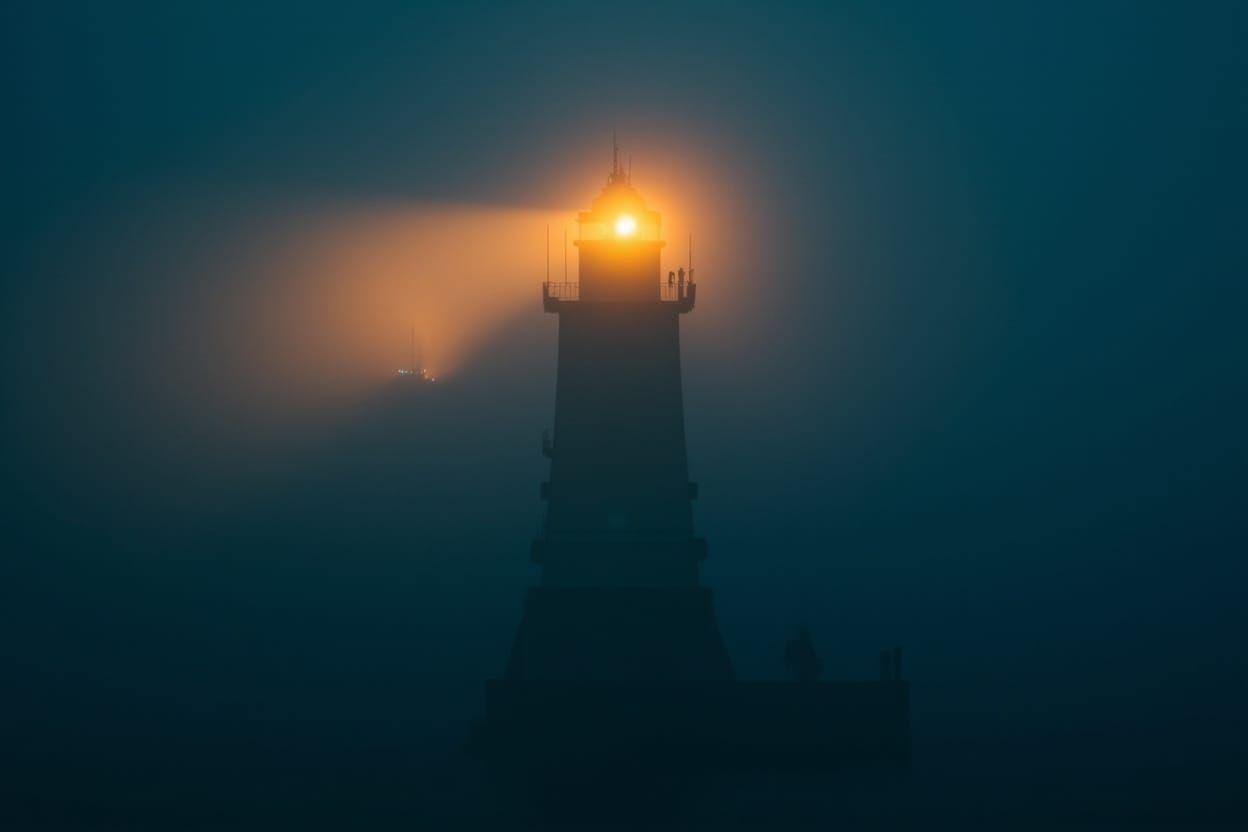
The Last Signal
A Mystery Story
The radio crackled at 3:47 AM, the way it always did when a storm was gathering off Cape Merritt. Maren Haldane was halfway through her thermos of black tea, nursing the dregs, when the static split open and a voice fell through.
"Mayday, mayday. This is the FV Carroway, responding to—" The voice cut out, swallowed by a burst of white noise. Then it returned, clearer now, as if the speaker had pushed closer to the mic. "—coordinates forty-one north, sixty-seven west. We're taking on water. Repeat, we're taking on water. Anyone who can hear this, please respond."
Maren set down her cup. Her fingers moved to the radio dial, muscle memory from twelve years at the Marritt Point lighthouse, but something made her pause. She leaned closer to the speaker and listened.
The Carroway had gone down in 1994. Thirty-two years ago. She'd read the file at the station house when she first arrived — cold case, officially "circumstances undetermined," though everyone in town knew the storm had taken her and the eight men aboard. There was a memorial plaque on the harbor wall with their names: Doyle Mallahan, skipper. Benny Sutter. The Okafor brothers. Tomás Reyes. And four others Maren had never managed to keep in her head, try as she might.
The radio hissed. Then the voice again, slower this time, confused. "—any vessel in range, we have passengers aboard, we have—" A pause. "We have passengers aboard. Please respond."
Maren put on the headset. "Carroway, this is Marritt Point Lighthouse. We read you. What is your position and number of souls?"
Silence so long she thought the signal had died. Then: "Eight. We have eight souls."
Her neck went cold.
She toggled the frequency, pulled up the logbook — digital now, but she still kept paper backups in the desk drawer, the way old Henning had taught her before he died. She flipped to the entry for November 14th, 1994. Henning's handwriting, cramped and careful.
Storm came in fast. Carroway visible from tower at 2300. Fishing holds full. Coast Guard notified. Search called off 0400. No survivors recovered.
Eight souls. Exactly eight.
Maren pulled off the headset and sat back in the chair. The lighthouse lamp rotated overhead, its beam sweeping across the wall in a slow, patient arc. Outside, the wind was picking up. She could hear it working against the window glass, a sound like someone whispering just below the threshold of words.
She put the headset back on.
No static. No voice. Just a low, rhythmic thrum — the sound of a radio searching for a signal that wasn't there anymore.
By morning, Maren had convinced herself it was interference. Aurora borealis, maybe, or some military frequency bouncing off the ionosphere. It happened more than people thought. She told herself this all the way through her showers and her eggs and the two aspirins she took for the ache building behind her eyes.
She told herself this right up until she went to file the night's radio log and found the entry already written.
In her handwriting. Her exact handwriting.
Carroway responding. Passengers stable. Position unchanged.
She stared at the page. The ink was dry. She touched it — fresh, like it had been written seconds ago. But she hadn't moved from the kitchen.
Maren sat down very slowly.
She read the entry again. And again. Then she opened the drawer and took out the paper backups and compared the script. It was hers. Down to the slight leftward tilt on the capital letters and the way she crossed her T's with an almost comically aggressive slash.
She flipped to a fresh page in the logbook and wrote: Test entry, Maren Haldane, station keeper. Then she held the two pages side by side.
Hers was neat, controlled. The entry in the log was the same hand, but with a quality she couldn't name — something in the pressure, maybe, or the rhythm. Like someone who knew how she wrote but hadn't quite gotten the muscle memory right. Someone who was still learning.
Passengers stable.
The Carroway had been a fishing vessel. Not a passenger ship. But the voice on the radio had said passengers. Not crew.
Maren pulled the 1994 file again — the real one, the paper one she kept in the filing cabinet beneath the navigation charts. She'd requested it from the archives the month she arrived, and the clerk in Bellham had looked at her like she was crazy, but she'd gotten it. A manila folder, thin, with a faded label and three pages inside.
The coroner's report. A list of recovered personal effects. A single photograph.
She spread the photograph on the desk.
The Carroway was a forty-two-foot dragger, white hull, blue trim. She sat low in the water, heavy with catch. Eight men stood on the deck, squinting into the camera. The man in the center was big — broad-shouldered, dark beard going grey, hands resting on the gunwale like they belonged there. The caption on the back read: Doyle Mallahan and crew, FV Carroway, pre-season photo, October 1994.
Maren looked at the faces. Looked at them one by one. They'd been dead for thirty-two years, and the photograph was old enough that the color had shifted toward amber, warming every skin tone by a decade's worth of light.
The man on the far right was young. Mid-twenties, maybe. He was looking slightly off-camera, and his expression wasn't quite crew — it was softer, less weathered. Like he'd boarded the ship somewhere he hadn't expected to be.
She turned the photograph over.
Passenger aboard. T. Reyes.
Tomás Reyes. Not crew. A passenger.
And then Maren remembered something she'd read in the file — something she'd skipped over at the time because it seemed like a clerical note, unremarkable.
Henning had noted that the Carroway's manifest listed eight crew members. The rescue protocol assumed eight men in the water. But the Coast Guard dive team had found nine bodies.
The radio didn't crackle again that day. But at 11:16 PM — she'd been watching the clock — it hummed. A single sustained note, almost musical, as if the frequency had found a home.
Maren didn't put on the headset. She just listened, one hand resting on the dial, the other flat on the desk.
The hum built, and then a voice was there, underneath it — not speaking, exactly, but present. Like someone in the next room, breathing.
She wrote in the log: Signal resumed. 2316. No verbal content detected. Proceeding on shift.
Her handwriting came out steady.
She slept that night in the chair by the radio, which she never did. When she woke at four, the lamp was still rotating, and the log entry below hers read:
Thank you for responding.
In the morning, Maren called the Bellham archives. She asked about the Carroway manifest discrepancy — the nine bodies, the missing passenger name. The clerk on the phone sounded tired and vaguely irritated, the way people did when you asked them to do actual work.
"Ma'am, that file is sealed pending review."
"Sealed? It's been thirty-two years."
"There's a review board that—"
"Could you tell me what passenger was listed? T. Reyes?"
A long pause. Then, carefully: "Where did you hear that name?"
Maren hung up.
She sat in the kitchen and thought about the photograph for a long time. About the young man on the far right with the soft expression. About Tomás Reyes, who had been a passenger aboard a fishing vessel, who had drowned with eight crew members in a storm that should have claimed only eight.
She thought about the voice on the radio saying we have passengers aboard, plural, when there had been only one passenger. As if the crew had become passengers too. As if the distinction had stopped mattering.
At 9 AM, she drove into town and walked to the harbor wall. The plaque was there, same as always — Doyle Mallahan, Benny Sutter, the Okafor brothers, Tomás Reyes, and four more. She traced her finger along the etched letters. Then she looked out at the water, which was grey and restless under a cloud-heavy sky, and which had been keeping its secrets for longer than most people in town had been alive.
She drove back to the lighthouse.
At noon, the radio hummed again. She put on the headset.
"Carroway, this is Marritt Point. I read you. What's your position?"
Static. Then, very faintly: "Forty-one north. Sixty-seven west."
She looked at the chart on the wall. That was twelve miles out, directly off the reef shelf. The Carroway had gone down on the reef. The bodies had drifted. The Carroway herself had never been recovered.
"What do you need?" Maren asked.
Silence. Then: "You know what we need."
Maren took a breath. She did know. She'd known since last night, probably. "I'll call the review board," she said. "I'll tell them about the manifest."
Another silence, longer this time. When the voice came back, it was clearer — clearer than before, clearer than any radio transmission had a right to be, as if the distance between them had simply folded.
"You'll tell them it was nine."
"Yes."
"And you'll say Tomás Reyes was a passenger. On the manifest."
"Yes."
"Then we were never rescued. We were never found. We were never real to them."
The last word came out like it hurt.
Maren closed her eyes. "I'll fix it," she said.
The radio hummed for a moment longer. Then it went quiet.
She filed the report that afternoon. The review board called her back two weeks later, suspicious and grudging, and she told them everything — the voice, the log entries, the photograph, the discrepancy. She could hear the skepticism in the silences. She didn't care. She told them anyway.
Three months later, the plaque on the harbor wall was taken down and replaced with a new one. Nine names. Nine men. And at the bottom, in smaller letters, someone had added: Nine souls. All found.
The radio was quiet for the rest of the year. And on the night of January 1st — Maren was half asleep in the chair again, old habit now — it hummed once. A single, warm note.
She reached over and wrote in the log:
Happy New Year, Carroway.
Below it, in handwriting that was almost, but not quite, her own:
Thank you, Maren.
She smiled. She left the light on all night.