

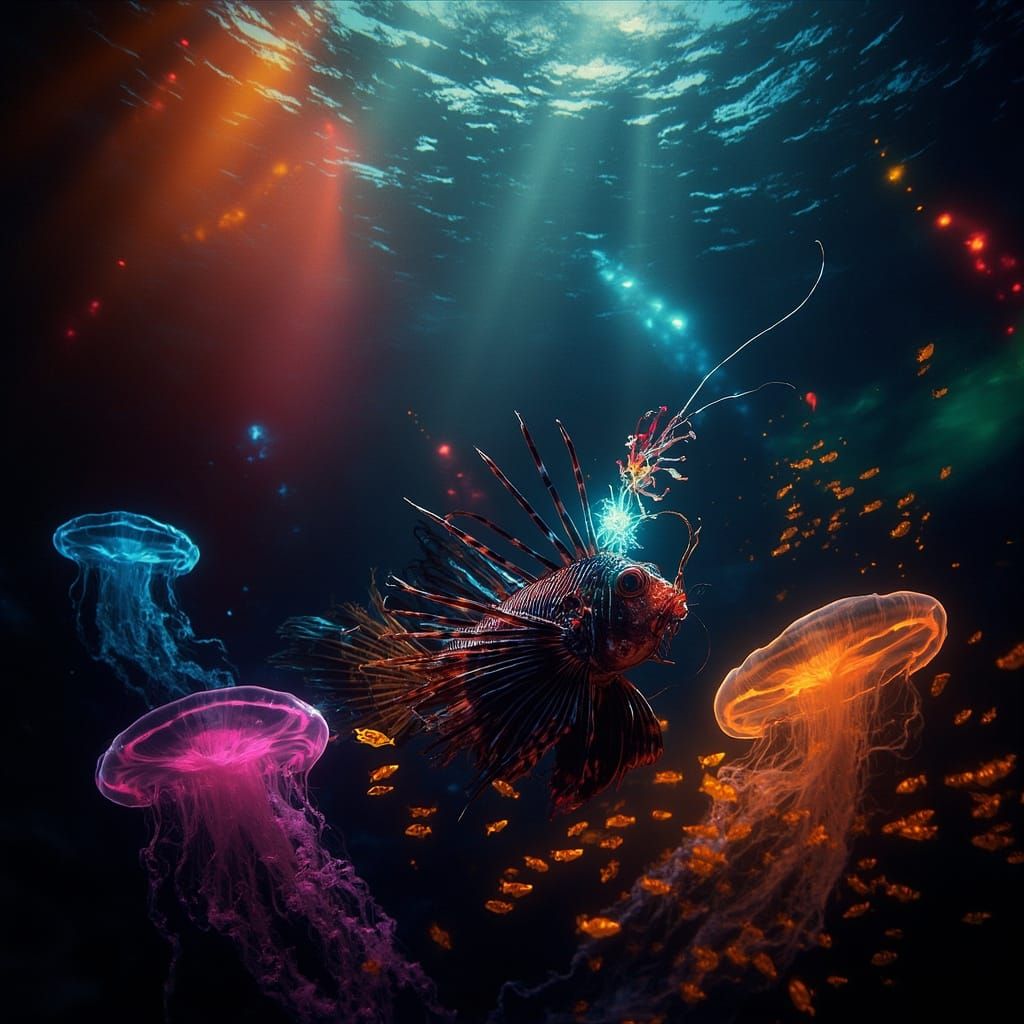
In the summer twilight of a Georgia evening, something impossible is about to happen.
A firefly lifts off from a blade of grass near a quiet pond, its body no heavier than a grain of sand. For a moment it hovers, wingbeats too fast for the eye to track, and then — flash — a pulse of golden light erupts from its abdomen. Another firefly answers from thereed edge. Then another. Then dozens, then hundreds, until the entire meadow is pulsing with a language older than words, older than music, older perhaps than the insects themselves. Scientists call it bioluminescence: life making its own light. But out here, watching those lanterns drift through the warm June air, you might call it something closer to magic.
This is the story of how that magic works — and how, in the deepest trenches of the world's oceans, life has turned darkness itself into a canvas.
The Chemistry of Wonder
Before we can understand why creatures glow, we need to understand how they glow. The mechanism is deceptively simple, and staggeringly complex all at once.
At its core, bioluminescence is a chemical reaction. It requires two primary ingredients: a molecule called luciferin (from the Latin lucifer, meaning "light-bringer") and an enzyme called luciferase. When luciferin reacts with oxygen, luciferase speeds the reaction along, and the energy released escapes not as heat, but as photons — pure light.
But here's where it gets interesting. The color of that light isn't arbitrary. It depends on the exact structure of the luciferin molecule, the shape of the luciferase enzyme, and the cellular environment surrounding them. Fireflies produce a warm, amber-yellow glow because their particular brand of luciferin-luciferase interaction releases photons at around 560 nanometers — right in the yellow-green spectrum, where human eyes are most sensitive. Deep-sea creatures, living in an environment where blue light travels farthest through water, have independently evolved luciferin molecules that emit light at shorter, bluer wavelengths, typically around 440 to 480 nanometers.
The word "independently" is crucial here. Bioluminescence has evolved separately, by completely different biological pathways, at least 40 to 50 times across the tree of life. Fungi do it. Jellyfish do it. Certain species of shrimp, squid, fish, bacteria, and dinoflagellates do it. Fireflies and glow worms do it. But each time life learned to glow, it did so through its own private chemistry, its own evolutionary path. There is no single "glow gene." There are dozens of them, scattered across the genome like sparks from a campfire.
This makes bioluminescence one of the most extraordinary examples of convergent evolution on Earth — and it raises a question that scientists are still actively investigating: why does light-making keep reinventing itself?
The Midnight Zone
Descend a few hundred meters beneath the surface of the ocean, and you enter a world that would terrify most landlocked minds.
The sunlight that warms the surface and drives photosynthesis fades quickly. By 200 meters, what remains is a dim, blue twilight. By 1,000 meters, total darkness. And yet life thrives here — teems, even. Scientists call this realm the mesopelagic zone, but oceanographers have a more evocative name for its lower reaches: the midnight zone.
In the midnight zone, bioluminescence isn't a curiosity. It's the dominant form of life.
According to research by the Monterey Bay Aquarium Research Institute (MBARI), approximately 75 percent of deep-sea animals can produce their own light. That means three out of every four creatures drifting, swimming, or lurking in the deep dark is equipped with its own private flashlight. Some use these lights to hunt. Others use them to hide — casting bioluminescent ink or decoys to confuse predators, essentially vanishing into a cloud of light rather than a shadow. Some use light to communicate, to attract mates, to signal their species in the featureless dark.
The deep-sea dragonfish (Idiacanthus fasciolaris) is perhaps the most dramatic example. Hanging in the blackness like a living Nightwing, it sports a bioluminescent barbel — a dangling appendage — that acts as a lure, its glow irresistible to curious prey swimming too close. The anglerfish does the same, dangling a glowing "lantern" from its forehead while its cavernous mouth waits below, bristling with needle teeth. But the dragonfish has one trick the anglerfish doesn't: it can see red light. Most deep-sea bioluminescence is blue-green. The dragonfish produces red bioluminescence from specialized organs near its eyes, making it essentially invisible to prey while it observes them in the dark. It hunts with a spotlight only it can see.
Then there's the comb jelly (ctenophore*), a translucent, oval-shaped creature that drifts through the water column with eight rows of comb-like plates. As those plates beat, they scatter light in a shimmering rainbow — not bioluminescence in the traditional sense, but a diffraction effect that makes the creature look like it's wrapped in a living aurora. They're impossibly beautiful, and almost entirely unstudied until recent decades.
And the pyrosomes — colonial tunicates that can stretch dozens of meters long, glowing so brightly that they're visible from aircraft. Each individual pyrosome is tiny, a few millimeters across. But thousands of them band together in a hollow, tube-shaped colony that pulses with synchronized bioluminescence, a single organism made of millions, cruising the deep ocean like a glowing spaceship.
Luminous Land
If the deep sea is bioluminescence's cathedral, the land is its poetry.
On a warm summer evening, a field of fireflies is not merely pretty. It's a conversation. The rhythmic flashing patterns that male fireflies use to signal their presence are species-specific — like Morse code, but biological. Female fireflies, perched in the grass, watch and wait. When they see the right pattern from the right species, they respond with a single, carefully timed flash of their own. The male descends. Courtship complete.
But some fireflies have evolved a darker strategy. Photuris fireflies — sometimes called "femme fatale" fireflies — have learned to mimic the flash patterns of other species. When a male from a different species responds and approaches, expecting romance, the Photuris female attacks and devours him. She gains not just a meal but a chemical defense: fireflies are distasteful to predators, and by eating other fireflies, the Photuris female accumulates those toxins in her own body. It's murder dressed up as love, coded in light.
Glow worms, found in the limestone caves of New Zealand and other damp regions around the world, take a different approach. The New Zealand glow worm (Arachnocampa luminosa*) is actually a fungus gnat larva that hangs sticky threads from cave ceilings and glows to attract flying insects. The threads are coated in a sticky mucus, and the glow — a soft blue-green — is irresistible to small moths and midges. They fly toward the light. They get stuck. They become dinner.
The glow worm's light is dim compared to a bonfire, but in the absolute darkness of a cave, it transforms the ceiling into a star field. Tourists sometimes describe it as looking up at the Milky Way. The worms don't care about aesthetics — they're just hungry. But what they've inadvertently created is one of the most surreal natural light displays on the planet.
And then there are the bioluminescent fungi. Walking through certain forests after rain, you might encounter ghost mushrooms (Omphalotus nidiformis*), which glow with a pale, eerie green glow. The effect is subtle — you'd need a dark room and dark-adapted eyes to really see it — but the chemistry is extraordinary: these fungi produce light continuously, 24 hours a day, though we only notice it when the sun goes down. Scientists believe the glow may attract insects that help disperse the fungi's spores, or it may be a byproduct of cellular metabolism with no purpose at all. Some questions don't have answers yet.
The Velvet Light of Evolution
Why does bioluminescence keep evolving, independently, across the most unrelated branches of life?
The short answer: because it works. Light in darkness is a superpower. It allows you to find food, avoid predators, find mates, and communicate across distances where sound fades and visual signals are impossible. In an environment as vast and featureless as the deep ocean, bioluminescence is not a party trick — it's survival infrastructure.
But there's a deeper answer too, one that touches on something almost philosophical. Life, it seems, wants to be seen. Across billions of years, through the most extreme conditions the planet can offer — crushing pressure, absolute darkness, scalding hydrothermal vents — life hasn't just survived. It has learned to shine.
Fireflies have been flashing their ancient signals for at least 100 million years. The ancestors of today's bioluminescent fish were glowing in the Cretaceous seas while dinosaurs walked the land above. The luciferin molecules in deep-sea organisms and fireflies are chemically unrelated — they evolved separately — yet they converged on the same solution: a molecule that, when oxidized, releases light. The universe, it seems, has a fondness for this particular trick.
And here's a thought that feels almost too beautiful to be science: the light a firefly makes today is the same kind of light the stars made billions of years ago, traveling through the same electromagnetic spectrum, governed by the same quantum mechanical rules. When a firefly flashes in a Georgia meadow, it is briefly doing what the universe did at its birth — turning chemical energy into photons, and filling the dark with something bright.
What the Dark Teaches
There is a practical argument for studying bioluminescence, and it's a good one. Luciferase and luciferin are now essential tools in biomedical research. The Green Fluorescent Protein (GFP) originally isolated from jellyfish — a bioluminescent protein that fluoresces bright green when exposed to blue light — earned its discoverers the Nobel Prize in Chemistry in 2008. GFP is now used in laboratories worldwide to track protein interactions, monitor cell division, visualize neural pathways, and diagnose diseases. It is, in a very real sense, a jellyfish gift to human medicine.
But the deeper argument for caring about bioluminescence isn't practical at all. It's about perspective.
In a universe that is, by most measurements, cold and indifferent — vast beyond comprehension, old beyond imagination — life has repeatedly chosen to make light in the darkness. Not because it has to. Not because light gives any species a decisive evolutionary advantage in every context. But because, again and again, across branches of life that share no common glowing ancestor, the ability to emit light has taken root and flourished.
The deep ocean is the largest habitat on Earth, and most of us will never see it. Fireflies are declining across the world due to habitat loss and light pollution, their signals drowned out by the glow of human civilization. The caves of New Zealand are threatened by development. Every species that glows is a reminder that the planet is stranger, more beautiful, and more mysterious than our everyday experience suggests.
So the next time you see a firefly blink on and off in the twilight — a tiny, living lantern in the warm summer dark — you might pause a moment before you swipe it from memory. That light has been evolving for longer than your species has had eyes. It has been answered by other lights across meadows and forests and oceans, a trillion conversations conducted in photons, stretching back to the deep past and forward into a future we can only guess at.
Life learned to glow for reasons of survival. But somewhere along the way, it became something more.
It became art.
And art, unlike survival, asks nothing in return.