

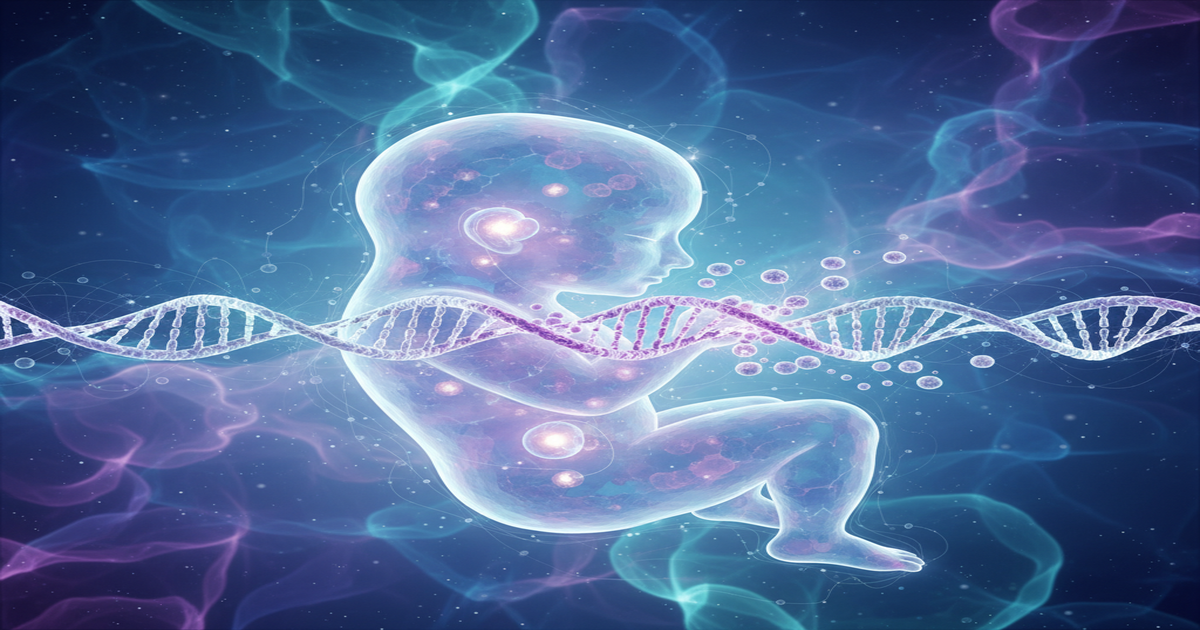
In 2016, a child was born who carried DNA from three people. This wasn't science fiction—it was the result of a groundbreaking medical procedure that would change how we think about inheritance, identity, and what it means to be human.
The Inherited Curse
Sarah Chen had watched her mother die slowly, piece by piece. First came the tremors, then the loss of motor control, finally the inability to breathe on her own. Leigh syndrome had stolen her mother's life, and it was hiding in Sarah's genes, waiting to potentially strike her children.
Mitochondria are often called the powerhouses of the cell—the tiny organs that generate the energy our cells need to function. But for Sarah, these microscopic powerhouses were time bombs. Mutations in mitochondrial DNA had already claimed her mother, her uncle, and two of her cousins.
The cruelest aspect? There was no treatment, no cure. The mutations passed exclusively from mother to child through the mitochondria in the egg. Sarah faced an impossible choice: never have children, or risk passing on a fatal inheritance.
The Solution
In 2015, the United Kingdom became the first country to legalize a radical procedure: mitochondrial donation. The technique combines the nuclear DNA from two parents—the genetic material that determines who we are—with healthy mitochondrial DNA from a donor.
Dr. James Wells and his team at Newcastle University developed three methods to accomplish this. The most famous, nicknamed "three-parent IVF," involves creating two embryos: one from the intended parents and one from a donor. The nuclear DNA is carefully extracted from the parents' embryo and placed into the donor's embryo, which retains its healthy mitochondria but accepts the new nuclear instructions.
The resulting child inherits 99.9% of their DNA from the two intended parents—just like any other child. The donor contributes only 0.1%, a tiny fraction that provides the healthy mitochondrial machinery needed to prevent fatal diseases.
The First Child
In 2016, the first child conceived using this technique was born in Mexico (where regulations were less strict than in the UK). The birth made international headlines, spawning debates about "designer babies" and the ethics of genetic modification.
But for Sarah, it represented something different: hope.
"I watched my mother die from something that came from inside her—something she couldn't control," Sarah said in a 2023 interview. "When I learned about mitochondrial donation, I realized I could have children without passing that death sentence to them."
Beyond Three Parents
Mitochondrial donation raises profound questions. Is the child truly the child of the donor? Does it matter that they share less than 0.1% of their genetic material with a stranger? These questions don't have clear answers, but the technology continues to advance.
In 2023, researchers announced improvements to the technique that could help thousands of women like Sarah. The UK reported its first successful births using the procedure, and other countries are considering similar legislation.
The Future of Inheritance
We used to think our genes were our destiny—written before birth, immutable through life. But mitochondrial donation shows that we can edit even the most fundamental parts of human heredity.
The three-parent child isn't a science fiction nightmare. They're a reality—a living symbol of how science can heal where nature failed. And for families like Sarah's, they're proof that sometimes, the most human thing we can do is ask for help from a stranger.