

A Mystery of Ghosts, Grief, and the Train That Wouldn't Stop
The town of Hollister had exactly three things going for it: a grain silo, a Lutheran church, and a railroad track that no one used anymore. Eleanor Vance had moved there to escape all three, but somehow, after fifteen years, she'd ended up as the unofficial historian of all of them.
It was the railroad that interested her most—not the trains themselves, but the stories people told about them. Forty years ago, a passenger train had derailed at the old depot, killing seventeen people and injuring dozens more. The official cause was listed as "mechanical failure," but the people of Hollister had their own theories, passed down like folklore through church picnics and bar conversations.
The most persistent rumor was simple and terrifying: the train never stopped. Its spirit, they said, still ran the route at midnight, visible only to those who were meant to find it. Passengers who boarded never arrived at their destinations. They simply... vanished into whatever waited beyond the veil.
Eleanor didn't believe in ghosts. She believed in patterns—in the way old towns held onto their traumas like children clutched favorite toys, unwilling to let go. The Midnight Train was a collective coping mechanism, a story that let the people of Hollister process their grief without ever having to confront it directly.
She was wrong. But she wouldn't learn that until the night she heard the whistle.
It came at 11:58 PM on a Thursday in October, two weeks before the anniversary of the derailment.
Eleanor was in her office at the back of the old depot—she'd convinced the county to let her use it as a makeshift museum, filing cabinet stuffed with archived photographs and newspaper clippings and a space heater that worked approximately forty percent of the time. She was supposed to be cataloging a new donation: a box of personal effects from the family of a woman named Margaret Chen, one of the seventeen who hadn't survived.
The box contained a handkerchief, embroidered with initials that weren't M.C. A locket with a photograph too faded to identify. A handwritten letter, its ink blurred by water damage, addressed to someone named "my dearest Samuel."
And a train ticket. dated October 15th, 1986. Final destination: nowhere.
The ticket was what caught her attention. It was a standard pullman-class ticket, the kind that would have been punched by a conductor on the platform, but instead of a printed route, there was only a handwritten notation in the margin: Board only if you're ready.
Eleanor turned the ticket over, looking for more information. On the back, in the same handwriting, was a single line:
I can hear it coming. I can finally hear it.
The whistle sounded.
She knew trains. Her father had been an engineer for thirty years, and she'd grown up understanding the difference between a freight horn and a passenger signal, between the particular pitch of a locomotive approaching a grade crossing and the distant echo of one just passing through. This sound was unlike anything she'd ever heard.
It started low—too low to be mechanical—and built in waves, each crest higher than the last, until the walls of the depot began to vibrate and the photographs in her makeshift museum rattled against their frames. The space heater died. The overhead light flickered. And then, beneath the whistle, she heard something else.
Voices. Dozens of them. Speaking in fragments, half-heard, like a radio tuned between stations.
"—told them the brake lines—"
"—doesn't understand, he's not supposed to be on this train—"
"—please, I just want to go home—"
The depot door slammed open. Eleanor spun around, her heart hammering, her hand going to the letter opener on her desk—but there was no one there. Just the October wind, cold and sharp, threading through the empty building like a living thing.
And beyond the door, in the darkness of the old platform, a light.
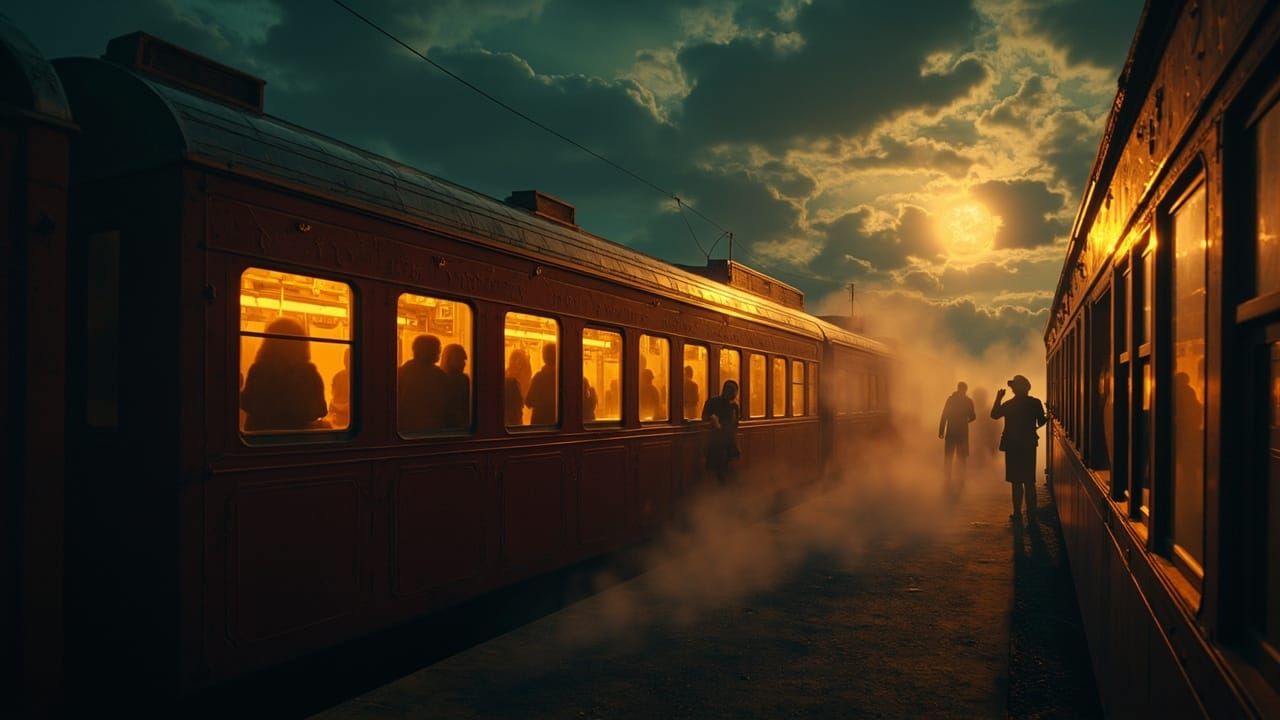
Not the headlight of a locomotive. Something softer. Warmer. The amber glow of antique lamps filtered through velvet curtains, visible through windows that hadn't existed thirty seconds ago.
The train had arrived.
She should have run. Any reasonable person would have. But Eleanor had spent fifteen years studying this tragedy from a safe academic distance, and something in her—the same something that had driven her to collect all these photographs and letters and artifacts—refused to let this moment pass unexamined.
She walked to the platform.
The train was impossible. It was also undeniably there.
It was a Pullman car from the 1940s, all art-deco curves and polished brass fittings, its exterior a deep burgundy that gleamed like fresh blood in the moonlight. The windows were lit from within, warm and inviting, and through them she could see silhouettes moving slowly—passengers settling into their seats, preparing for a journey that had been delayed forty years.
The door was open. Waiting.
On the platform beside the steps, someone had left a bouquet of white chrysanthemums—the funeral flower, Eleanor knew, often used to express grief and condolences. Tucked into the stems was a small card. She picked it up, her fingers trembling.
For Margaret. We never stopped waiting.
Margaret Chen. The woman whose belongings now sat in a box on Eleanor's desk. The woman who had died in a derailment forty years ago, along with sixteen others.
The train whistle sounded again—shorter this time. A signal. An invitation.
Board only if you're ready.
Eleanor thought of her father, who had spent his life on trains and never once been afraid. She thought of the letter opener on her desk, and the letter from someone named Samuel to someone who might have been Margaret Chen. She thought of all the stories she'd collected over fifteen years, all the grief she'd tried to understand from a safe, analytical distance.
She climbed aboard.
The interior of the car was exactly as she'd imagined it from the photographs: plush velvet seats in forest green, brass fixtures dulled by decades of tarnish, overhead luggage racks built to hold steamer trunks. The lamps flickered with the same amber warmth she'd seen from the platform, and the windows showed not the depot platform but a landscape that shifted like a dream—fields of wheat gold under a setting sun, mountains blue with distance, a city skyline she didn't recognize.
The other passengers were there.
They sat in their seats, some alone, some in pairs, all of them translucent at the edges, like photographs beginning to fade. They didn't look at her as she entered—not with malice or confusion, but with the easy familiarity of people who had been waiting a very long time and were no longer surprised by anything.
She recognized some of them from the photographs in her archive. A young man in a newsboy cap, clutching a messenger bag. An elderly woman in a flowered dress, her hands folded in her lap. A child—God, a child—no older than eight, sitting alone in a seat by the window, her face turned toward the shifting landscape outside.
Margaret Chen was two rows back, on the right side.
She was older than her photograph—late thirties rather than early twenties—but her face was the same. High cheekbones. Dark eyes that held a kind of weary patience. Her hair was pinned up in a style Eleanor associated with old photographs, and she wore a traveling dress that looked expensive, practical, made for long journeys.
She was reading a book. When Eleanor entered, she looked up, and smiled.
"You came," she said. Her voice was clear and warm, utterly unlike the fragmentary whispers Eleanor had heard from the platform. "We wondered if you would."
"You're real," Eleanor said. It was all she could think to say.
Margaret closed her book—she was reading poetry, Eleanor noticed, something with a leather spine and gilt lettering—and gestured to the empty seat across the aisle. "Sit. We have a few minutes before the train leaves."
Eleanor sat. The seat was solid beneath her, real in a way that surprised her. "The derailment—"
"Was an accident. Yes. Though there are those who disagree." Margaret's smile didn't waver. "Does it matter? What happened, happened. The question is what happens next."
"What happens next?"
"The train takes us where we need to go." Margaret looked out the window, at the shifting landscape beyond the glass. "Some of us have been waiting a long time. Some of us arrived only recently. But we all have the same destination."
Eleanor's mind raced. She was sitting on a ghost train, talking to a woman who had died forty years ago, and none of it felt like a dream. The seat was too solid. The air was too cold. The lamp light was too warm.
"Why me?" she asked. "Why now?"
Margaret considered the question. "Because you listened. Because you spent fifteen years collecting our stories, our photographs, our letters and tickets and small, forgotten things. Because you cared enough to be afraid of the truth and curious enough to look anyway."
She reached into her bag—a small leather satchel that looked like it belonged in an antique shop—and pulled out a photograph. She handed it to Eleanor.
It was Margaret and a man, young and serious-faced, standing on a platform very similar to the one Eleanor had just left. They weren't quite touching, but the way they leaned toward each other suggested intimacy, history, a future that had been cut short.
"Samuel was supposed to be on that train," Margaret said. "He'd missed the connection—his meeting ran late, and by the time he arrived at the station, we were already moving. He watched from the platform. He saw what happened."
"And then?"
"And then he spent the rest of his life trying to understand. He became an engineer himself, thirty years on the rails, always looking for the answer to a question no one else was asking." Margaret's voice was steady, but her eyes glistened. "He never remarried. He never stopped searching. And when he died three years ago, he left everything he had to the Hollister Historical Society."
Eleanor's breath caught. The donation. The box of personal effects. The letter addressed to Samuel.
"He wrote that letter the morning of the derailment," Margaret continued. "He'd planned to give it to me when I arrived at my destination. Instead, it followed me here, into this in-between place, where trains wait for passengers who are ready to board."
The train shuddered. A low mechanical groan echoed through the car, and Eleanor felt the floor begin to move beneath her.
"We're about to leave," Margaret said. "Which means you need to decide."
"Decide what?"
"Whether you stay or go." Margaret stood, smoothing her traveling dress. "The train will take you wherever you need to go—but it's not a return trip. Once you step off, you'll forget everything you've seen tonight. The stories, the passengers, the letters... they'll all fade. Like a dream you can't quite remember upon waking."
"And if I stay?"
"Then you become part of the story. Part of the collection." Margaret smiled again, and this time, there was something wistful in it. "That's not so bad. I've been here forty years, and it's been peaceful. Strange, sometimes, but peaceful."
Eleanor looked around the car. The other passengers had turned to watch her now—not with fear or judgment, but with the patient curiosity of people who had already made their choice and were curious to see what she would decide.
The child by the window waved.
Outside, the landscape was shifting again—faster now, the wheat fields giving way to something darker, something that glowed faintly at the edges like the northern lights Eleanor had seen once as a girl.
She thought of her father, who had loved trains all his life. She thought of Samuel, who had spent forty years searching for answers. She thought of all the photographs and letters and artifacts in her archive, all the stories waiting to be told.
She thought about the letter on her desk, the one addressed to Margaret, written by a man who had loved her and lost her and never stopped searching.
"Give me the letter," she said. "Please. I want to read it before—"
Margaret handed it to her.
The letter was blurred, water-damaged, but Eleanor could make out enough.
My dearest Margaret,
If you're reading this, then I wasn't there when you needed me. I failed you in the most fundamental way a person can fail another: I wasn't there.
I've spent forty years trying to understand what happened. I've read every report, interviewed every survivor, examined every piece of the locomotive we could recover. I know more about that night than anyone alive. And I still don't have an answer.
But I've decided to stop looking.
Not because I don't care. But because I've finally understood that some things aren't meant to be understood. They're meant to be carried. They're meant to be remembered. And then they're meant to be released.
I loved you. I love you still, in whatever way ghosts love, in whatever way memory persists beyond the boundaries of flesh and time. And I want you to know that I'm letting you go.
Not forgetting. Never forgetting. But releasing. So that you can finally board the train you've been waiting for.
Go well, my dearest. Go where I can't follow.
Yours, always, Samuel
Eleanor looked up, tears running down her face. The train was moving faster now, the landscape outside blurring into streaks of light and color, and she could feel the pull of something vast and unknowable at the far end of the journey.
Margaret was standing by the door, ready to disembark. The other passengers were gathering their things, forming a line with the patient choreography of long practice.
"Will you remember?" Eleanor asked. "Will any of you remember?"
Margaret paused at the threshold. "We'll remember," she said. "That's what we do. That's what we are. Memories of people who loved and lost and kept going anyway."
She held out her hand. Not to take Eleanor's, but to receive.
Eleanor gave her the letter.
Margaret pressed it to her chest, then held it out toward the window. The paper caught fire—not with flame, but with light, a soft golden glow that spread from edge to edge until the letter was indistinguishable from the sunlight streaming through the glass.
"I'll carry this with me," Margaret said. "And every time I read it, I'll think of you. The historian who listened. The keeper of stories. The woman who rode the Midnight Train and chose to remember."
She stepped off the train.
The door closed behind her, and Eleanor felt the lurch of acceleration, the sudden snap of forward momentum, the world outside the window resolving into a single point of light that grew and grew until there was nothing else.
She woke on the depot platform, the October wind cold on her face, the dawn just beginning to lighten the eastern sky.
The train was gone. The box of Margaret Chen's belongings sat on her desk, exactly where she'd left it. The letter was there too—but now it was clear, the ink sharp and legible, as if it had been freshly written.
She read it again. Then she folded it carefully, placed it back in the box, and began to write the story.
Not the official story. Not the "mechanical failure" that had been checked off in a county report and never spoken of again. The real story. The story of seventeen passengers and the train that wouldn't stop, of grief that persisted for decades, of love that outlasted death and a historian who had finally learned to listen.
She wrote until noon. And when she was finished, she walked to the old depot platform, stood where Samuel had stood forty years ago, and whispered into the morning air:
"It's time to let go."
Somewhere, far away, she could have sworn she heard a train whistle.
Not the Midnight Train. Just a freight, passing through on its way to somewhere else, carrying something ordinary and precious and alive.
Epilogue: One Year Later
The Hollister Memorial Museum opened on the anniversary of the derailment, forty-one years after the accident.
Eleanor had spent the year collecting stories—not just from survivors, but from the families of those who hadn't made it, from the engineers who'd inspected the track afterward, from the conductors and brakemen who'd carried the wounded to hospitals that no longer existed.
The centerpiece of the museum was a single exhibit: a Pullman car seat, forest green velvet, recovered from the wreckage and preserved behind glass. Beside it, in a frame, was a handwritten note on yellowed paper:
Board only if you're ready.
Beneath the note, a small card explained the story—the real story—of the Midnight Train. Not the ghost story that had circulated through Hollister for decades, but the truth: that sometimes, the people we lose don't really leave us. They become part of the landscape. Part of the journey. Part of the stories we tell to make sense of the senseless.
And sometimes, if we're very lucky, they come back one last time—to say goodbye.
Eleanor never saw the Midnight Train again. But she kept the letter on her desk, where she could see it every day. And every year, on the anniversary, she would stand on the depot platform and listen for a whistle that never came.
And she would smile.
Because she knew now that the train wasn't coming back. It had delivered its passengers. It had carried Margaret home.
And it had taught Eleanor the most important lesson a historian could learn:
Some stories are told not to be understood, but to be honored.
And honor, unlike grief, never fades.
~ End ~