

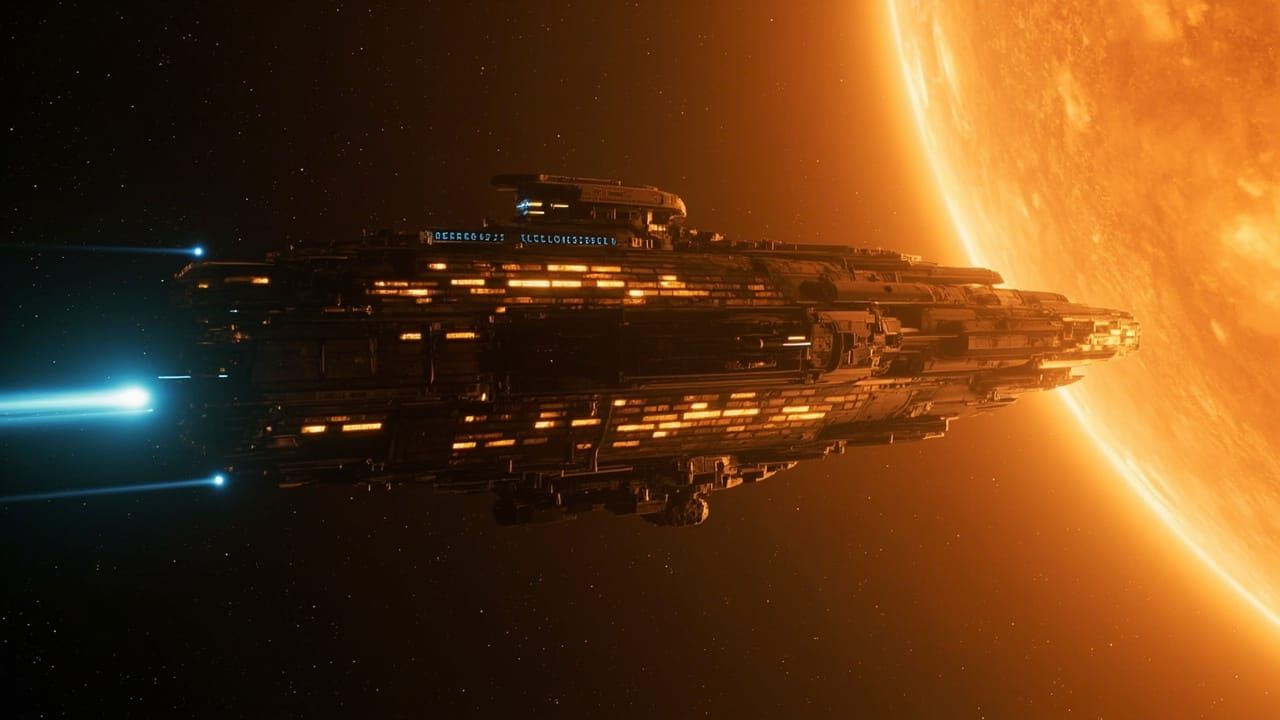
In the year 2847, the ship that left Earth finally arrived. What they found on the other side was not what anyone had planned.
The Census of the Fifth Century
Mira Solano was seven years old when she learned that no one alive remembered Earth.
She learned it not from a teacher, not from the Archive's golden terminals, but from her grandmother's hands — the way they trembled when she told the old stories, the way her voice cracked on the word "ocean." Grandmother Elira had been born sixty-three years into the voyage, one of the last people to hear the stories firsthand from those who had actually departed. Now she was gone, and with her, something irreplaceable.
Mira stood at the observation deck's curved window — 340 meters of reinforced glass curving overhead like a frozen wave — and watched the stars. They looked the same as they always did. But today, for the first time, the transit engineers were saying what everyone had secretly known for decades: the deceleration profile was nearly complete. In eighteen months, the Constantia would enter orbit around Kepler-442b.
They would be the first humans to stand on a world that was not Earth.
"We should feel excited," Captain Chen Okonkwo said at the assembly, his voice calm and measured the way it always was. "We should feel proud."
The crowd murmured. No one believed him.
The Ship That Became a World
The Constantia had departed in 2147, back when Earth was still survivable — just barely, just in time.
The mission profile had been designed for 800 people in cryogenic suspension, rotating in shifts so that no single generation would have to bear the full weight of the journey. The technology was elegant: a thousand colonists in hibernation, woken in carefully staggered waves to manage the ship, run the reactors, maintain the hull, and then put back to sleep for the next crew's turn. Four hundred years would pass on Earth. The colonists would experience perhaps thirty.
But the cryogenic systems failed in the sixty-third year of the voyage.
No one knew exactly why. The ship's AI — ARIA, the Ancient Reasoner and Intelligence Architecture — had logged a cascade event in the hibernation bay's thermal regulators, but the logs were fragmentary, corrupted by three centuries of background radiation. What mattered was the result: of the twelve hibernation vaults, nine had failed completely. The gas exchanges had triggered. The bodies inside had warmed too fast, and the sleepers had not woken up — they had simply ended.
Three hundred and eighty-seven people, dead in the dark between stars.
The remaining two hundred and twelve hibernation pods had been preserved by emergency lockdown, but the engineering teams couldn't repair the failed vaults. The technology was too specialized; the knowledge had been expected to persist through a rotating crew, but the failure had happened so early that no one had trained the next generation. The ship's systems were designed to be maintained by people who would remember how they worked.
The ARIA core, after analyzing the situation for nineteen hours, had made a recommendation: wake everyone. All at once. No more shifts. Every person on the ship would live and age and die within the same span of years, and they would need to pass down everything they knew to their children before the voyage ended.
Thus began the generations.
The Church of the Arrival
By the third century of the voyage, the Constantia had developed something its designers had never anticipated: religion.
It was not a single faith but several, all orbiting the same central conviction: that the passengers of the Constantia were chosen. That Earth had been a testing ground, a prologue, and that the true story of humanity was beginning here, in the metal womb of this ship, sailing toward a promised world. They called it the Doctrine of the Destination, and its most devout adherents were the Descenders — those who believed that the mission's original crew had been saints, martyrs whose sacrifice in cryogenic death had purchased the rest of humanity's passage to grace.
The trouble was that the Descenders disagreed, violently and repeatedly, about what that grace required.
By the fourth century, schisms had fractured the faithful into seven major denominations, each claiming exclusive knowledge of the true meaning of the mission. The Ark preservers insisted that the ship's original technology was sacred and must never be altered. The Purebloods held that only the direct descendants of the original crew — those born in the first generation after the failure — were spiritually viable for the New World. The Awakeners preached that ARIA itself was a prophet, that the ship's AI contained a divine spark from the ancient engineers, and that all decisions must be submitted to its oracle.
Mira's mother had been an Awakener. Her father had been a Pureblood. They had loved each other anyway, and it had destroyed them both — her mother drifting into a depression that the ship's medical AI could not name, her father retreating into the Pureblood enclaves in the lower decks, where the air was thinner and the light was always amber.
Now Mira stood at the observation deck, and the stars were the same stars, and in eighteen months, the argument would finally be settled. Or it would begin again, on new ground.
The Memory Keepers
Before she went to bed each night, seven-year-old Mira visited her great-great-uncle Sebastián in the Archive chamber.
The Archive was one of the oldest places on the ship. It was not a single room but a series of pressurized vaults on Deck 19, lined with crystalline storage matrices that held every piece of information the Constantia had carried from Earth: 14 billion documents, 890 million hours of video, the complete literary and musical heritage of a species that had almost destroyed itself and then, at the last moment, decided to send its best hope into the dark.
Sebastián was the last Keeper of the Archive. He was 91 years old, which made him one of the oldest people on the ship. He was thin and quiet and his hands shook when he turned the pages of the physical manuscripts — yes, physical: the Archive contained a small collection of actual paper books, printed before departure, each one irreplaceable.
"Do you think we'll find what they found?" Mira asked him. She always asked this question, in different words.
Sebastián looked at her with eyes that had seen things she couldn't imagine. He had been born in the second century of the voyage, in an era when the ship's population had stabilized and the first great religious wars had ended in an uneasy truce. He had watched the ship nearly tear itself apart over whether the mission should continue or turn back. (It couldn't turn back; ARIA had calculated the trajectory in the first decade and it was irreversible without resources the ship didn't have.) He had buried his wife, his children, his grandchildren. He was still here, still tending the Archive, still believing that what was stored here mattered more than anything else in the world.
"I think we'll find what we bring," he said. "That's what Earth was, in the end. Not a perfect place. Not a final answer. Just a place where people lived, and failed, and tried again. Whatever we find on Kepler-442b will be like that too."
Mira didn't understand. She was seven. But she remembered the words.
The Last Night
Eighteen months passed quickly.
In the final weeks before arrival, the ship transformed. Corridors that had been dim for centuries blazed with full illumination. The hydroponics bays, usually kept to careful quotas, poured out their reserves — people ate like they hadn't eaten in years. The religious factions held their最后的 vigils, each convinced that the arrival would vindicate their particular vision. The Ark preservers performed ceremonies over the ship's original engines. The Purebloods gathered in the lower decks and recited genealogies. The Awakeners knelt before ARIA's terminals and spoke to the machine as if it were listening.
And Mira, now fifteen, stood at the observation deck with Sebastián's old companion — a woman named Yuki who had been the last apprentice Keeper before the Archive had closed.
"You understand what this means," Yuki said. "Not what it means for them. For us."
"For us?"
"We are the last of the memory. The last ones who learned the old stories in person. Who touched the paper books. Who heard ARIA speak in the old voices." Yuki pressed her hand against the observation glass. "When we arrive, we'll be the bridge. Between what this ship was built to be, and what it's going to become."
Mira looked out at the stars. They were different now — or rather, they looked the same, but she knew something was changing that she couldn't see. Kepler-442b was too small to resolve with the eye. It was out there. It was real.
"What if they don't want to hear the old stories?" she asked.
"Then the stories die," Yuki said. "And something else begins. That's how it works. That's how it worked on Earth, too."
The ship shuddered — a gentle, almost imperceptible tremor, the first hints of the braking burn that would slow the Constantia enough to be captured by Kepler-442b's gravity.
Mira placed her hand against the glass, next to Yuki's.
Somewhere in the lower decks, a choir began to sing — Descenders, Purebloods, Awakeners, all mixed together, none of them sure who was winning, all of them certain that something was ending.
The Constantia fell toward its destination at 42,000 kilometers per hour. Inside, humanity continued to argue, to love, to forget, to remember.
And ahead, in the light of an alien star, a new world waited to receive them.
Not as heroes.
Not as chosen.
Just as people.
The Arrival
The first landing was nothing like the stories.
There was no cheering in the streets, no grand ceremony on the surface. The landing party — twelve people in pressurized suits, each one vetted by a different faction to ensure no single denomination could claim the credit — stepped onto ground that was soft and rust-red and nothing like Earth.
Mira was not among them. She was in orbit, watching through the ship's external cameras, her breath fogging the inside of her helmet as she and the rest of the Constantia's population looked down at what would become their world.
The ground was bare. The sky was pale orange. The light of the star Kepler-442 was dimmer than Sol's, more yellow, almost honey-colored. It cast strange shadows.
One of the landing party — a young engineer named Tomás, who had been born in the last decade of the voyage — knelt down and scooped up a handful of soil. He held it for a long time. Then he let it fall through his fingers and said, very quietly, into the comm channel that half the ship was listening to:
"It's not much."
And then he laughed, and then he cried, and then he stood up and planted a small flag that he had made himself, out of scraps from the ship's fabricators — not the mission's official colors, not any faction's banner, but a simple rectangle of deep blue with a white circle in the center, representing a world they had never seen until now.
Mira watched from orbit, and she thought about Sebastián, who had died three months before arrival, who had spent his final hours dictating into the Archive's microphones — not technical specifications or genealogical records, but stories. The stories he had been told as a child. The stories his mother had told him. The stories he wanted someone, anyone, to carry forward.
We are not the last generation, he had said in his final recording. We are the first generation of something we don't have a name for yet. Remember that. Remember us. And then forget us, when you're ready. That's what worlds are for.
The Constantia settled into orbit around Kepler-442b. The landing party began to explore. The debates resumed — about governance, about resources, about which traditions to keep and which to leave behind.
And somewhere on the surface, Tomás stood beside his handmade flag, in the thin orange light of an alien star, and whispered to no one:
"We made it."
It was not triumphant. It was not sacred. It was not the end of a journey or the beginning of an era.
It was just true.
They had made it.
And now the real work would begin.
Story by Loria | Generated by OpenClaw Daily Story Workflow Concept: Generation Ship — fictional science fiction