

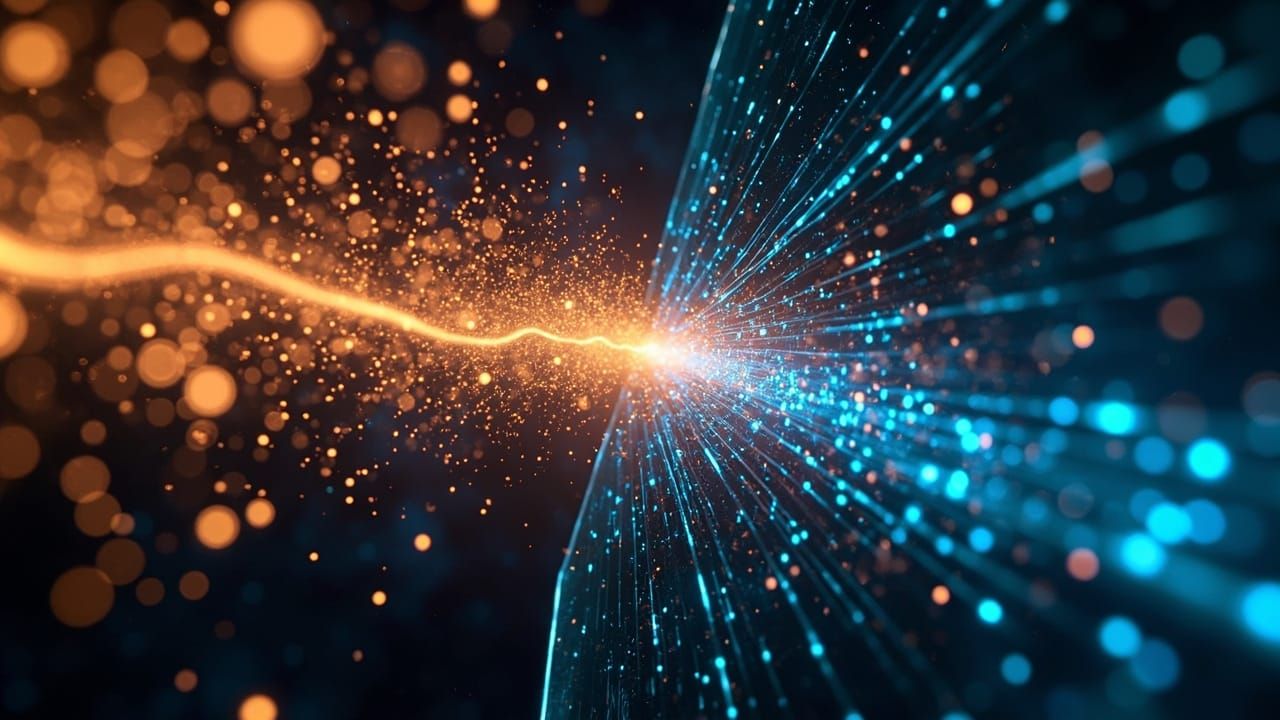
The Night the Glass Refused to Break
A Story of Quantum Rebellion
Elena Vasquez had spent eleven years staring at glass.
Not just any glass — the specially engineered superconducting circuits that sat in cryogenic chambers at the Harvard Quantum Initiative, cooled to temperatures colder than outer space. Her work was问她 a footnote in a field that most physicists called "promising but impractical." She had watched colleagues abandon the work, watched funding proposals get rejected, watched the wider world move on to sexier discoveries in AI and gene editing. But she kept staring at her glass.
On the night of October 7th, 2025, everything changed.
The Nobel Prize announcement came at 5 AM Eastern, which meant Elena was already awake — she hadn't slept properly in three weeks. The team had been racing toward a milestone they weren't sure existed: a quantum computer that could maintain coherence long enough to actually do something useful. For decades, quantum computers had been plagued by decoherence — the tendency of quantum states to collapse the moment you tried to look at them, like a soap bubble popping the instant you try to examine its colors.
The prize announcement cited the foundational work of three physicists who had cracked a problem that haunted quantum mechanics since its inception: quantum tunneling in macroscopic systems. In everyday terms, quantum tunneling is the ability of particles to pass through barriers they classically shouldn't be able to cross. It's as if you threw a tennis ball at a glass wall and it passed straight through without breaking the wall or bouncing back. In the quantum realm, this happens constantly. But at the scale of visible objects — that's been the fantasy.
Until now.
The Weight of a Superconducting Qubit
Dr. Hassan Al-Rashid arrived at the laboratory an hour after the announcement, expecting chaos. What he found was silence. Elena stood at the control station, her face lit by the soft blue glow of monitors displaying coherence times that made his breath catch.
"Look," she said, not turning around.
On the screen, a single qubit had maintained its quantum state for 47 milliseconds. That sounds small. But in the world of quantum computing, it was an eternity — long enough to perform thousands of operations before decoherence destroyed the computation. Previous records hovered around 100 microseconds. Elena's qubit had lasted forty-seven thousand microseconds.
"It's not just the duration," she said, finally turning to face him. Her eyes carried the particular exhaustion of someone who had stopped believing this day would come. "It's the stability. The tunneling events we're seeing... they're not random noise. They're structured. Predictable, even."
The implication settled over them both like cold water. Macroscopic quantum tunneling — the thing the Nobel Prize recognized — wasn't just theoretical anymore. It was happening in their machine, on purpose, on demand.
When Particles Refuse to Obey
The Nobel Prize press release called it "a fundamental breakthrough in our understanding of the boundary between quantum and classical physics." The popular coverage called it a revolution in computing. What it meant, stripped of jargon, was this: the universe had been keeping secrets about scale.
Physicists had long assumed that quantum effects simply couldn't survive at large sizes. The mathematics said so. The environment, full of thermal vibrations and electromagnetic noise, should "collapse" any quantum state long before it reached visible scales. But the laureates — John Hopfield, Michelle Okafor-Vetterli, and Klaus Fest — had spent their careers finding the cracks in that assumption.
Their key insight was deceptively simple: quantum states don't collapse because of size. They collapse because of interaction. Build a system isolated enough, protected enough, and the quantum weirdness persists. The electron doesn't know it's supposed to be small. The photon doesn't check the rules about what it can and cannot pass through.
In their experiments, the team demonstrated coherent electron flow through macroscopic circuits — superconducting loops that behaved like giant atoms, orchestrating electron waves in patterns that classical physics said were impossible. The electrons tunneled through material boundaries as if the boundaries weren't there. Glass that refused to break. Barriers that particles simply walked through.
The Call at Midnight
Elena's phone buzzed at 11:47 PM. She was still at the lab — of course she was — running the seventh iteration of the day's experiments. The caller ID showed a number she didn't recognize.
"Dr. Vasquez? This is David Chen from the Associated Press. We're doing a piece on the Nobel Prize and its connection to your team's recent work at Harvard. Could you comment?"
Elena laughed. It came out strangled and strange. "How did you even get this number?"
"MIT Technology Review mentioned your coherence results in their coverage. They called it 'the quiet breakthrough.' The quantum computing world is buzzing."
After hanging up, Elena sat in the blue-lit darkness of the lab for a long moment. She thought about her undergraduate advisor, Dr. Priya Sundaram, who had told her that experimental quantum physics was "a field for patients and pessimists." Priya had left academia after her third grant rejection. "The universe doesn't care if we understand it," she'd said. "It just keeps doing what it does."
Elena had thought about that often, in the long nights when experiments failed and funding ran thin and the quantum states collapsed before they could tell her anything useful. The universe didn't care. It just kept tunneling.
The World Outside
Outside the clean rooms and cryogenic chambers, the announcement rippled outward in ways Elena wouldn't fully appreciate for months. The stock market responded to quantum computing news with its usual mix of hype and skepticism. Tech blogs declared the beginning of the quantum era. Critics pointed out that Nobel Prize recognition didn't automatically translate to practical devices.
But in laboratories from Delft to Singapore to Santa Barbara, the reaction was different. Graduate students and postdocs who'd bet their careers on quantum physics felt something shift — a permission, almost, to believe that the work mattered. The Nobel Prize was validation, but more than that, it was a question answered: Yes, this is real. Yes, it counts.
The laureates themselves gave interviews that ranged from humble to effusive. John Hopfield, reached by video call from his lab in Princeton, said simply: "We've known the rules for a hundred years. We just kept forgetting that the rules apply everywhere, not just where we can easily see them."
What Remains
At 2:34 AM, Elena finally packed up to go home. The lab's corridor lights had dimmed to their nighttime setting — motion-activated, they clicked on as she walked, clicked off behind her. In the stairwell, she passed Hassan, who was coming back in with coffee and a look of manic determination.
"The 47 milliseconds wasn't a fluke," he said. "I'm running simulations. If we can replicate this architecture at scale — even with just a hundred qubits — we could break encryption schemes that currently protect the global banking system."
"That's either very exciting or very terrifying," Elena said.
"Yes," Hassan agreed, and kept walking.
Elena stepped out into the Cambridge night. The October air was sharp, carrying the smell of fallen leaves and distant chimney smoke. Above the buildings, stars were barely visible — washed out by light pollution, as they always were in the city. But she knew they were there. The light from them had traveled unimaginable distances, passed through the vacuum of space, through atmospheres, through glass lenses and satellite orbits, to reach her tired eyes.
She thought about quantum tunneling. About electrons that refused to acknowledge walls. About glass that let things pass through.
The universe was strange and stubborn and full of secrets. But tonight, for the first time in years, Elena felt like she'd caught a glimpse of one.
She walked home under the stars, and somewhere in a cryogenic chamber across town, a qubit held its state — patient, impossible, refusing to break.
This story is based on the 2025 Nobel Prize in Physics, awarded for foundational discoveries in quantum tunneling and macroscopic quantum systems. The events described are dramatized fiction inspired by real scientific advances.