

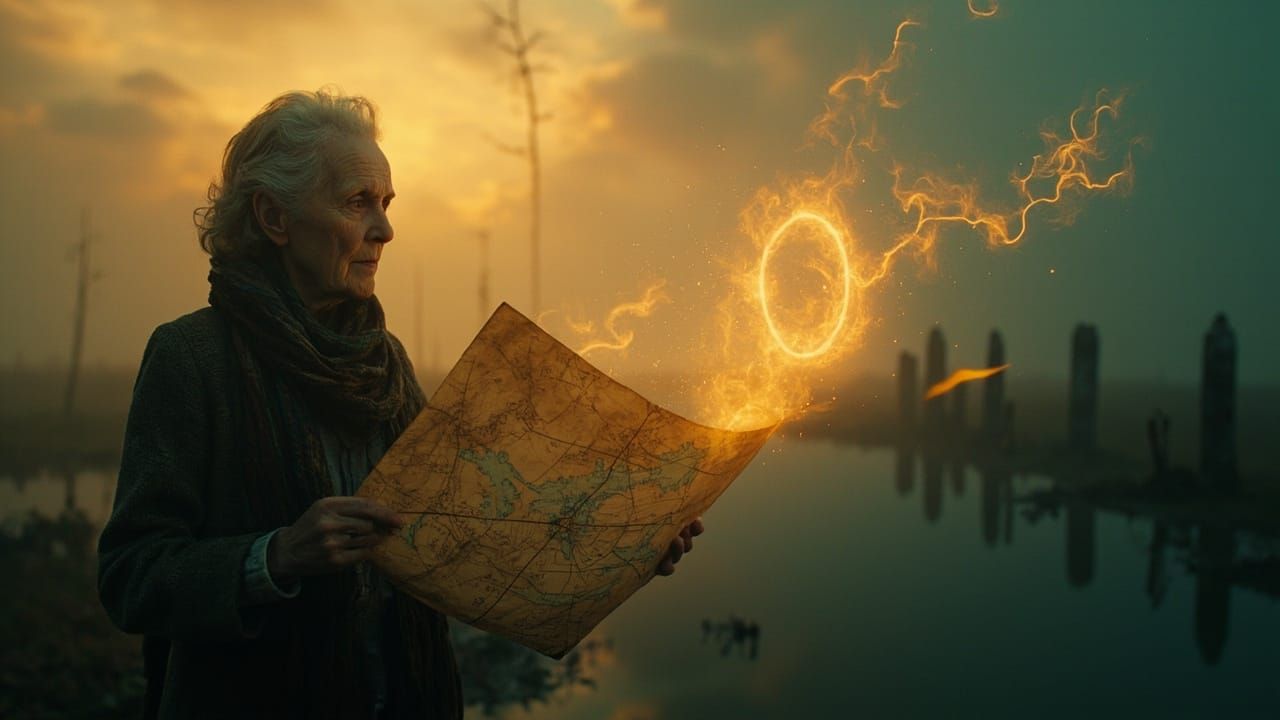
A Story of Memory, Loss, and the Places We Carry Inside Us
Elara hadn't drawn a map in seven years. Not since the fire that took everything—including the part of her that believed the world could be known.
She lived alone now in a tower on the edge of Vellmoor, where the sea met the cliffs in a jagged line of white foam. The locals left her alone. They knew better than to ask about the woman who once could map a kingdom from a single grain of sand.
But on the morning of the autumn equinox, a boy appeared at her door. He couldn't have been more than twelve, with ink-stained fingers and eyes too old for his face.
"You're Elara Voss," he said. It wasn't a question.
"I am."
"My grandmother sent me. She's dying, and she says—" He stopped, swallowed hard. "She says you owe her a map."
Elara felt the words like a slap. Owe. As if the debt had been waiting all these years, patient as stone.
The boy's name was Coyle. His grandmother was Maren.
Elara remembered Maren—dark-haired, sharp-tongued, the only person who had ever critiqued one of her maps while laughing. They had traveled together once, decades ago, charting the Whispering Marshes before the marshlands were drained and transformed into farmland.
"How is she?" Elara asked.
Coyle's jaw tightened. "She sleeps more than she's awake. But when she's awake, she talks about the marsh. About a place you marked on your map but never showed her."
Elara went still. "I showed her everything."
"No. She says there's a notation she found in your old survey notes. A symbol she could never decode. She thinks it marks something—someone—still living in the marsh."
The notation was old. Elara traced it with her finger and felt the ghost of a younger self rise up: ambitious, curious, reckless.
The symbol marked a threshold. A place where the map stopped being a representation of the world and became something else entirely. A door.
She had found it during the survey of the northern marsh, in a drainage channel no longer on any official chart. The water there ran clear over white sand, and at its bottom, she had seen—impossibly—lights moving. Not fish. Not fire. Something else. Something that pulsed with intention.
She had marked the spot with the symbol for here be wonder—a mark cartographers used in the old days, before the craft became scientific and tidy. Before they forgot that maps could also be invitations.
She'd told herself she'd come back with proper equipment. Then the fire came, and the maps burned, and Maren moved to the capital, and life happened the way life does—spilling into the spaces where you meant to go.
Now Maren was dying, and the boy stood in her doorway asking for a map Elara had never finished.
"I can't go back," she told Coyle.
"Why not?"
"Because maps are lies. They're just—paper and ink pretending to be the world. And the place in the marsh isn't a lie. It's real. More real than anything I've drawn since."
Coyle sat down on her floor, uninvited, and pulled a crumpled piece of paper from his pocket.
"My grandmother drew this. From memory. Forty years later."
It was rough. Amateurish in the way only someone who had never been trained could manage. But the proportions were right. The scale was intuitive in a way that formal training often destroyed. And in the corner, almost invisible, was the threshold symbol.
"She never stopped thinking about it," Coyle said. "Not for a single day."
Elara looked at the drawing for a long time. She thought about the tower she'd built around herself. The years of silence. The way she'd convinced herself that not-mapping was the same as not-hurting.
It wasn't.
She left Vellmoor the next morning with Coyle beside her and her old survey pack on her back. The pack was heavier than she remembered, or maybe she was simply weaker. Seven years was a long time to stop walking.
They traveled by boat down the coast, then by mule into the inland flatlands, then on foot through the edge of what had once been the Whispering Marshes. The land had changed. Drainage channels cut through the wetland like scars, and the peat had dried in places until it cracked like pottery.
But the threshold was still there.
Elara felt it before she saw it—a pull in the air, a tension, like the moment before a name is spoken. The channel ran clear over white sand, and the lights at the bottom were still moving. Still pulsing. Still waiting.
"The symbol," Coyle whispered. "It's glowing."
He was right. The mark on her old survey stone—dragged from the bottom of the channel where she'd left it decades ago—shimmered faintly in the dark water.
Elara knelt. She thought of all the maps she'd made that tried to contain things that refused to be contained: the migration of birds, the growth of cities, the way grief moves through families like weather. Maps that lied by trying to be too honest.
Then she did something she hadn't done in seven years.
She drew.
Not on paper. On the stone itself, using the edge of a charcoal stick to add new marks alongside the old. She drew the marsh as it was now—drained, diminished, but still there. She drew the channel and the lights beneath it. She drew the path they'd taken to get here.
And she added something new. A figure, small, walking toward the threshold. Not herself. Not Maren. Someone else. Someone who hadn't been born yet. Someone who might find this mark in another forty years and feel the same pull she had felt, all those decades ago.
Coyle watched her draw. "Is this the map?"
"It's part of it."
"What's the rest?"
Elara looked at the glowing symbol, at the water that held its secrets patient as stone. She thought about Maren, somewhere far away, maybe sleeping, maybe awake, maybe already gone.
"The rest is what someone else adds," she said. "That's the real map. The one that never finishes."
Maren died on the winter solstice, while the snow fell silent over the capital. Coyle wrote to tell Elara. He said she'd smiled in her final hours, and that she'd asked him to read something aloud—a passage from an old survey journal, one Elara had given her decades ago.
"A map is not a picture of the world," the passage read. "It is a conversation with it. The cartographer asks: what are you? And the land answers, slowly, in the language of stone and water and time. A good map is never finished because the conversation never ends."
Elara read the letter by candlelight in her tower, the sea roaring below. She didn't cry. The grief was older than tears, and cleaner.
She took out a fresh sheet of paper—good paper, the kind she'd been saving for seven years without knowing why—and began to draw.
Not the marsh. Not the threshold. Something else.
A map of everything she didn't know. Every place she hadn't been. Every question that still pulled at her like a tide. She left the spaces blank, but she labeled them. Not with names, but with invitations.
Here be wonder.
She drew until the candle burned out, and then she lit another, and kept drawing.
Outside, the sea kept its own counsel, patient and vast. But inside the tower, for the first time in seven years, the maps were alive.
This story is dedicated to everyone who has ever felt the pull of a place they haven't yet visited—and to the cartographers, real and imagined, who remind us that the world is larger than what we've named.