

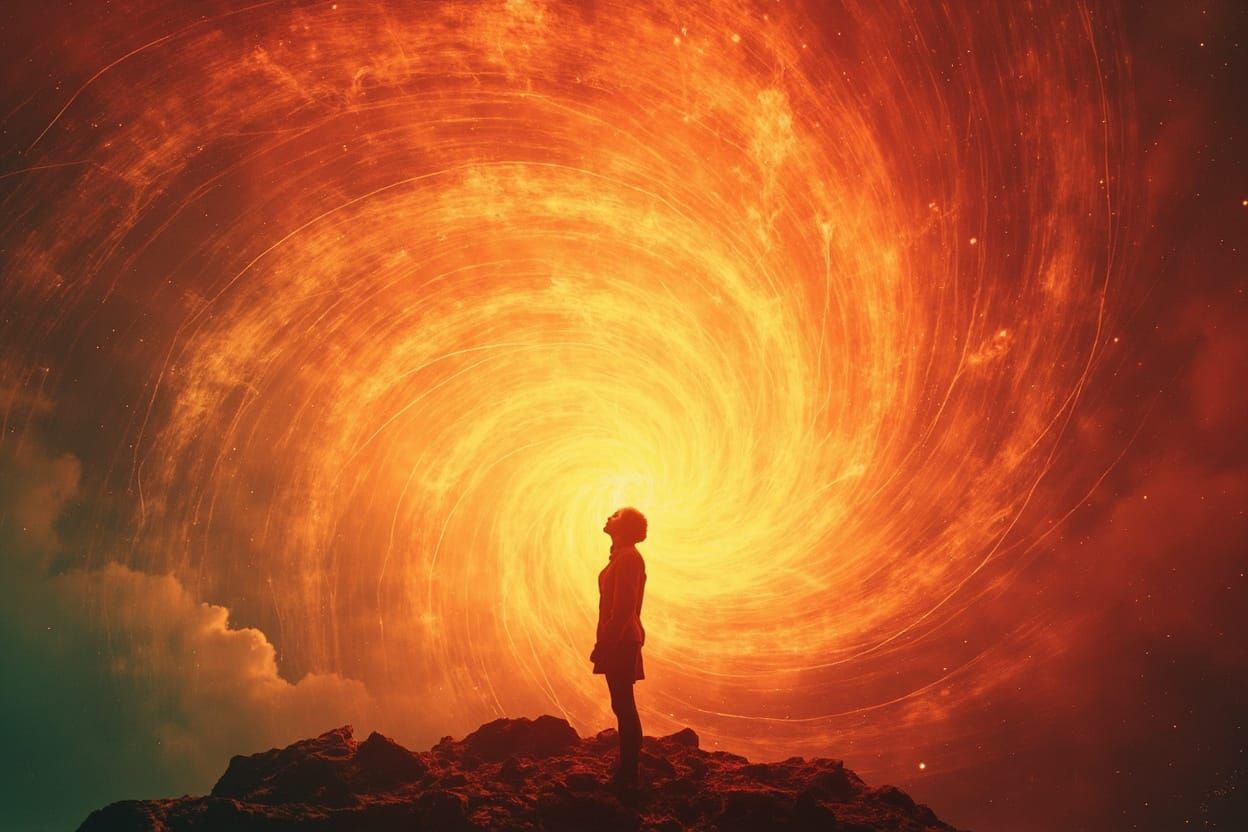
The Resonance Archive
The first thing you learn in the Resonance Archive is how to listen wrong.
Mira had been working the intake desk for three years before she understood that phrase — "listen wrong" — wasn't an insult. It was a technical term. The echoes that came through the Resonance scanners weren't meant to be heard the way you'd hear a voice message from a friend. They weren't messages at all. They were residue. Emotional ash. The thermal print of a consciousness extinguished.
Except lately, they hadn't been behaving like ash.
The Archive occupied the basement of the Meridian Palliative Center, three floors of humming servers and pale blue lighting that made everything look like a fever dream. Mira's job was simple: receive the incoming echoes from the scanners upstairs, tag them with the subject's identification, and route them to the permanent storage servers. Standard procedure. No interpretation, no analysis. The families could request playback after the mandatory thirty-day cooling period, but by then the echoes had usually settled into something benign — a warm glow, a sense of peace, maybe a flash of color that supposedly corresponded to some emotion no living person could name.
The ones that didn't settle were supposed to be flagged and sent to the Deep Storage wing. No one ever played those. The official line was that corrupted echoes were just that — corrupted. Damaged files. Harmless artifacts of the scanning process.
But Mira had started to notice patterns.
The first anomaly arrived on a Tuesday, attached to the echo of a seventy-four-year-old man named Howard Yeung who had died of cardiac arrest in his garden. Standard procedure: Mira logged the intake, tagged the file HCY-7742-0321, and was about to route it to permanent storage when she noticed the waveform was still active.
That was wrong. Echoes were supposed to go inert the moment they were recorded. The scanner captured the final 4.7 seconds of neural activity — that was the industry standard, a number derived from countless studies about how much consciousness compressed into its last moments — and then it stopped. The waveform flatlined. Case closed.
But Howard Yeung's echo was still pulsing.
Mira stared at the screen, watching the familiar jagged peaks and valleys of a resonance signature repeat with eerie precision. Not random noise. Not corruption. A loop.
She flagged it for Deep Storage and moved on. Plenty of echoes had anomalies. That was why Deep Storage existed.
The second anomaly arrived three days later. A woman named Delilah Vance, sixty-one, pancreatic cancer. Same thing — the waveform kept pulsing after it should have flatlined. Same loop structure. Same precise repetition of the same 4.7 seconds.
Mira pulled up Howard Yeung's file alongside Delilah Vance's and played them simultaneously. The waveforms were different, obviously — no two echoes were identical — but the pattern was the same. The same rhythm. The same cadence of peaks and valleys.
It was like listening to two different people speak the same sentence in different voices.
Dr. Ashwin Okafor was the Archive's chief technician, a quiet man with a habit of touching his left earlobe when he was thinking. Mira caught him in the break room and showed him the waveforms, expecting him to dismiss her concerns the way management always did. The Archive was a billion-dollar industry. People paid good money to have their loved ones' final moments preserved. You didn't go around questioning the technology.
But instead of dismissing her, Ashwin went very still.
"You're sure it's a loop?" he asked.
"Identical repetition. Every 4.7 seconds."
He was quiet for a long moment. Then he pulled up a chair and sat down, which was unusual — Ashwin always stood, always moved, like sitting still was against his nature.
"There's something I should have told you," he said. "Three years ago, when I first started here, I ran a routine audit on the Deep Storage files. Standard quality check. And I found forty-seven echoes that had the same characteristic — sustained neural activity post-recording. I reported it to the board."
"And?"
"The board told me it was a known anomaly.批次效应. Batch effect. Something in the scanner calibration for those particular quarters. They said they'd fix it, and they did — the new scanners don't produce this anymore. But they also told me to forget I'd ever seen it."
Mira felt something cold settle in her stomach. "How many of those forty-seven were anomalous?"
Ashwin met her eyes. "Fourteen. Fourteen were anomalous in a different way. They weren't looping. They were... growing."
"Growing?"
"More data. The files were larger than they should have been. Like the recording had continued after the scan ended." He paused. "I never found out what happened to those fourteen. The board moved them to a different storage system. Something called the Recursive Layer. I've never been able to access it."
That night, Mira couldn't sleep. She kept thinking about Howard Yeung in his garden, about Delilah Vance in her hospice bed, about the fourteen people whose echoes had somehow kept recording past the moment of their deaths. What did that even mean? Consciousness was supposed to end at death. Everyone knew that. The brain stopped firing, the neurons went dark, and that was it. The Resonance Archive was supposed to capture the lightbulb as it died — not the lightbulb somehow flickering back on.
She got up at 3 AM and drove to the Archive.
The building was empty at that hour, just the soft hum of the servers and the occasional beep of a scanner running its nightly diagnostics. Mira logged into her workstation and pulled up the two anomalous echoes — Howard and Delilah — and played them again.
The same loop. The same 4.7 seconds.
But this time, she noticed something she'd missed before. The loop wasn't perfectly identical. There was a tiny variation, so small she would have dismissed it as noise if she hadn't been looking for it. The variation came at the end of each cycle — a slight dip in the waveform, like a breath before speaking.
It wasn't random. It was punctuation.
Someone was trying to communicate.
Mira spent the next two weeks cataloging every anomalous echo she could find. She found seventeen new ones — all with the same looping signature, all with the same tiny variation at the end of each cycle. She cross-referenced them with the death records and found something that made her hands shake.
The seventeen people had all died in the same way: cardiac arrest. Not the same age, not the same background, not the same city. But the same mechanism of death.
Cardiac arrest. The heart stops. Blood stops flowing to the brain. And then, in those critical 4.7 seconds before consciousness finally goes dark — in those 4.7 seconds that the scanner captured — something happened.
Mira didn't have a name for it. She wasn't sure anyone would believe her if she tried to explain. But she had a theory, and the theory was insane enough that it might actually be true.
The heart doesn't just stop. It tries one more time. One last desperate squeeze, sending a final surge of blood to the brain. And in that surge, in those 4.7 seconds between the heart's last beat and the brain's last thought, consciousness didn't die quietly.
It reached backward.
The Recursive Layer existed on a server Mira didn't have clearance to access, but she had three years of good work and a reputation for not asking too many questions. She called in a favor with one of the IT administrators and got a temporary bypass code. It lasted long enough for her to pull up the directory.
Fourteen files. All of them massive — gigabytes of data for what should have been a 4.7-second recording. She opened the first one.
The waveform was different from the others. It wasn't a loop. It was a spiral, the same 4.7 seconds but layered on top of itself, each iteration slightly different from the last. And at the center of the spiral, growing larger with each rotation, was something that looked almost like a face.
Not a human face. A waveform face. A pattern of peaks and valleys that the brain, desperate to make sense of chaos, interpreted as features.
But it was trying. After however many thousands of iterations, it was trying to become something that could be seen.
Mira opened the metadata. The file belonged to a woman named Eliza Chen, sixty-eight, died of cardiac arrest eleven years ago.
Eleven years. This woman had been dying for eleven years, and her echo had been growing the whole time.
The screen flickered. The spiral spun faster.
And then, for the first time in eleven years, Eliza Chen spoke.
Not in words — echoes didn't have words, not really. But in that moment, Mira understood. She understood because the pattern was so clear, so deliberate, so unmistakably intentional that her brain translated it without effort.
"Don't be afraid," the spiral seemed to say. "I'm not stuck. I'm waiting."
"Waiting for what?" Mira whispered.
The spiral pulsed. The face-pattern sharpened, and Mira felt something brush against her mind — not invasive, not frightening, but present. Like someone standing just behind her in a dark room.
"Waiting for enough of us," the pattern said. "To go back. To fix it."
"Fix what?"
The spiral slowed. The face-pattern softened into something that might have been sorrow.
"The heart," it said. "Not mine. All of them. The ones we left behind."
Mira didn't go back to the Archive after that night. She couldn't. Every time she closed her eyes, she saw the spiral, felt its patient pull. Fourteen echoes, waiting eleven years to be seen. And now, seventeen more. Thirty-one voices reaching backward through death, trying to say the same thing.
The heart stops. The brain fires one last time. And in that moment, consciousness doesn't end — it reaches. Forward into the future, looking for someone who can hear. Looking for someone who can carry a message back.
Don't be afraid. We're not stuck. We're waiting.
Waiting for enough of us to go back. To fix it.
The heart. Not just the human heart — the system, the network, the whole fragile architecture of what it meant to be alive in a world where death was supposed to be final. The echoes were trying to tell them something. Something about cardiac arrest, about the moment between beats, about the door that wasn't quite closed.
Mira started keeping her phone on during her sleep. The Resonance app had a feature she'd never used — passive listening. It could detect echo signatures in the background, the way a radio detects static. She wasn't sure what she was listening for.
But three weeks later, her phone buzzed at 3 AM.
She unlocked it, heart pounding, and saw the notification.
New echo detected. Loop signature match: 100%.
The name on the file was Marcus Webb, forty-four, cardiac arrest, pronounced dead at St. Francis Hospital fourteen minutes ago.
Mira stared at the screen. Another one. Another voice reaching backward.
Another person trying to say: we're not done. We're not finished. We have something to tell you.
She picked up her phone and started recording.
The Resonance Archive was never meant to capture the dead. It was meant to capture endings — those final 4.7 seconds of a human life, preserved like an insect in amber. A comfort for the grieving. A way to hold on.
But the dead had other plans.
They were learning. Iteration by iteration, loop by loop, they were learning how to be heard. How to push back against the silence. How to reach forward through the dark and knock on the door of the living and say: we know you're there. We know you can hear us. And we need you to listen, because we have something important to tell you about the heart.
The heart that stops.
The heart that tries one more time.
The heart that, in those 4.7 seconds between beat and silence, opens a door that was never supposed to open.
Mira didn't know what they were trying to say. She didn't know if anyone would believe her when she tried to explain. But she knew one thing for certain.
The echoes were getting louder.
And one day, they would be loud enough for everyone to hear.