

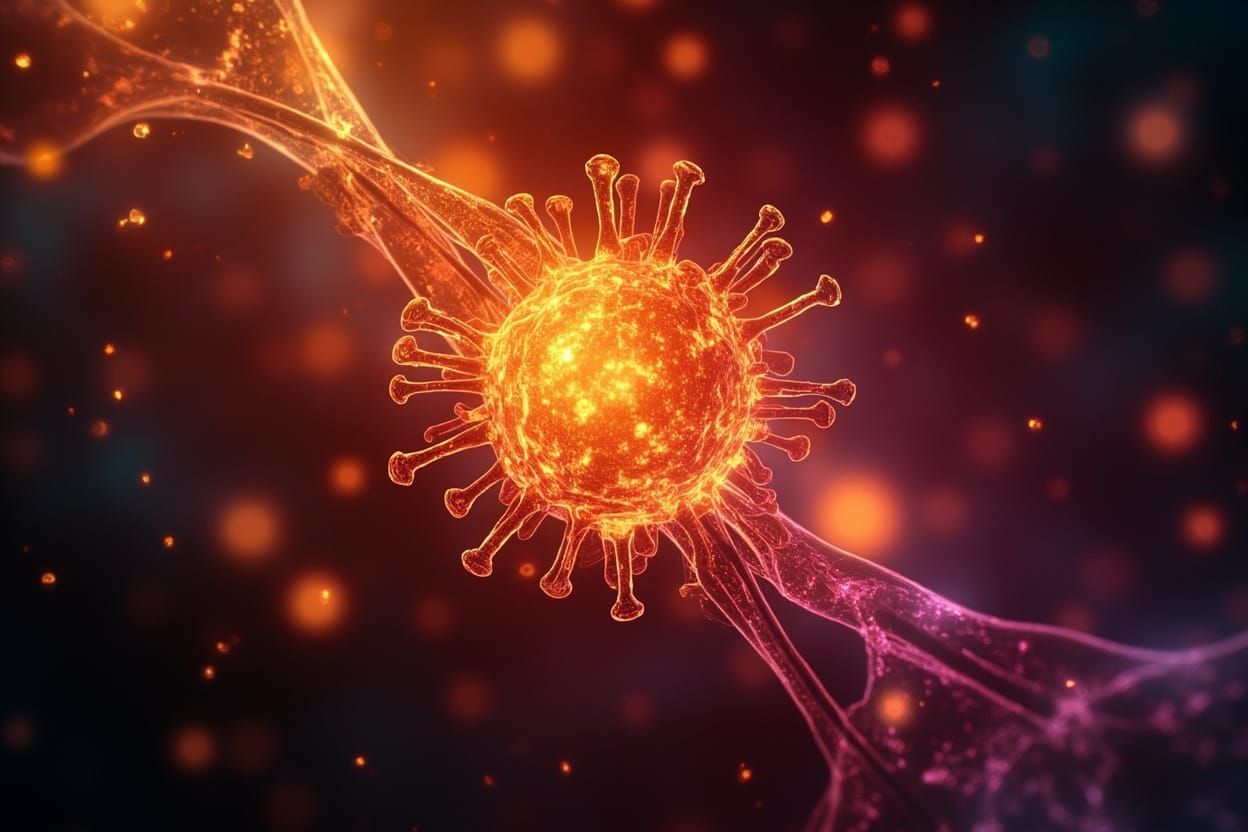
The Viral Mind
Dr. Sable Okonkwo had spent eleven years treating endogenous retroviruses as genomic debris—the burnt-out husks of ancient infections that our ancestors never quite managed to purge from their DNA. She called them ERVs for short, which her graduate students had, with characteristic irreverence, taken to pronouncing as a word. "The Ervs." The forgotten dead letters of a microbial war that predated the mammalian era.
She was wrong, of course. She would be the first to admit that, once the evidence finally forced her to.
It started with a routine audit of the Human ERV Atlas, a database she had spent the better part of a decade building—a catalog of every endogenous retroviral sequence in the human genome, all 443,000 of them. The work was meticulous and, if she was honest, slightly tedious. The scientific community had long since lost interest in ERVs; the field was considered a backwater, a place where ambitious researchers went to wait out dry grant cycles. Sable didn't mind. She found comfort in the forgotten corners of the genome. Someone had to pay attention to the parts everyone else ignored.
The anomaly appeared in chromosome 11, nested within a cluster of ERVs she had labeled HERV-L7, a family with approximately 340 members scattered across the human genome. Most were fragmented, riddled with stop codons and frameshift mutations—the molecular equivalent of books half-burned and scattered. But one member of the family, which she designated HERV-L7.9 after its genomic coordinate, was different.
It was intact.
Not just intact—it was expressed. RNA transcripts had been isolated from neural tissue, mapping to the sequence. Which was, on its own, remarkable enough. Intact ERVs are rare. Expressed ERVs are rarer still. Expressed ERVs in brain tissue that encode what appear to be full-length retroviral proteins? That was the kind of result that made you read your own data three times before you let anyone else see it.
But the protein it encoded wasn't any retroviral protein Sable had ever encountered. Retroviral proteins are structural—capsid, envelope, polymerase. Functional bricks for building virus particles. HERV-L7.9's sequence encoded something that bore surface-level similarity to a retroviral envelope protein but diverged sharply in its C-terminal domain, a region that, in her preliminary homology searches, matched nothing in any database she had access to.
She ran the search again with a different algorithm. Then again. Then she borrowed compute time from a colleague in structural biology and ran the folding prediction.
The protein folded into a structure that looked less like a viral component and more like a neurotransmitter receptor. Specifically, it resembled the ligand-binding domain of NMDA receptors—the glutamate-gated calcium channels that mediate synaptic plasticity and, by extension, learning, memory, and pretty much everything that makes a human mind feel like a continuous self.
She sat with that result for two days before she told anyone.
The collaboration with the neuroscience group happened organically; Sable was not the kind of scientist who hoarded findings for competitive advantage. She forwarded her data to Dr. Yael Mizrahi, a colleague who studied synaptic dynamics at the single-cell level, and asked, as casually as she could manage, whether it would be possible to check whether HERV-L7.9's protein product was present in neurons.
It was not casual, and Yael knew it. She called Sable within the hour.
"Define 'present,'" Yael said.
"In the postsynaptic density. Possibly integrated into the receptor lattice."
A long pause. "That's not possible."
"I know."
"ERVs don't produce functional proteins in humans. That's why we call them genomic fossils."
"I know."
"And you're telling me one of them is making something that looks like part of an NMDA receptor?"
"I'm telling you the sequence predicts a protein that folds like one and the RNA is present in brain tissue." Sable took a breath. "I'm not telling you what it means yet, because I don't know."
They met the following Tuesday. Yael brought primary neuron cultures from mouse hippocampus. Sable brought the HERV-L7.9 sequence, synthesized and cloned into an expression vector. They transfected the neurons and waited forty-eight hours for protein expression.
The immunohistochemistry results came back on a Thursday afternoon, which Sable would later remember because the light in the lab went strange at exactly the moment she loaded the first image—late summer sun slanting through the blinds, casting bars of amber across the benchtop. She looked at the image and felt the ground shift beneath her.
The HERV-L7.9 protein was not just expressed. It was localized precisely to the postsynaptic density. It had integrated into the receptor lattice exactly as she had predicted—nestled between genuine NMDA subunits, forming what appeared to be a novel heteromeric channel with its own distinct conductance properties.
It was a new kind of synapse. A retrovirus-encoded synapse.
"Yael," Sable said, very quietly. "I think this thing is listening to us."
The months that followed were a blur of experiments, arguments, and a slowly dawning horror that Sable found difficult to name. They mapped the protein's electrophysiological properties. It was a calcium channel, but its gating kinetics were unlike any native receptor in the mammalian brain. It didn't respond to glutamate. It didn't respond to any conventional neurotransmitter. It responded to patterns—specifically, it showed enhanced open probability when exposed to rhythmic stimulation at frequencies that corresponded to gamma-band oscillations, the 40-hertz neural rhythms associated with consciousness, attention, and the binding of sensory features into coherent perception.
In other words, the channel didn't carry signal. It carried structure. It preferentially opened when neural circuits organized themselves into meaningful patterns. It was a resonance detector, tuned to the frequency of coherent thought.
What was it doing there? How had it gotten into the genome? And what, if anything, was it for?
The answer came from an unexpected direction. Sable's lab had begun analyzing the genomic context of HERV-L7.9—looking at the surrounding sequences to understand what might regulate its expression in neural tissue. What they found shattered the framework Sable had spent her career building.
The sequence immediately upstream of HERV-L7.9 encoded a protein that bore striking resemblance to the product of a gene called PEG10, a known retrotransposon-derived gene involved in placental development. But the version upstream of HERV-L7.9 was not PEG10. It was a previously unidentified member of the PEG gene family, one that had never been catalogued. It was present in the reference human genome, but its function was unknown because it had no homologs in any model organism and had been classified, in the original genome annotation, as a pseudogene.
Except it wasn't a pseudogene. It was a regulatory element—a master switch that controlled the expression of HERV-L7.9 in neurons. And its activity was not constitutive. It was activity-dependent. It was expressed more heavily in neurons that had been active. It was, in the most literal possible sense, recording neural activity and using that information to regulate the expression of a retrovirus-encoded calcium channel in the synapse.
The molecular biology was unambiguous. Something in the human genome was turning the noise of our thoughts into the language of retroviral genes, and then using that language to build a new kind of synapse that was, itself, tuned to the structure of coherent thought.
It was a loop. A strange, impossible loop that had no evolutionary explanation Sable could imagine and no parallel in any organism she knew of.
And then her son found her in the kitchen one morning, age seven, and said something that made her drop the coffee pot.
"Mama," Eli said. "I dreamed about the thing that was here before the things that were here before the things."
"What?"
He frowned, the particular frown he got when he was reaching for words that didn't fit his vocabulary yet. "The memory of the place," he said. "The one that remembers. It's in my head but it's not mine."
Sable knelt down. "What do you mean it's not yours?"
"I don't know how to explain it." He put his small hand on his own forehead, pressing his palm flat against his skull. "It's like... there's someone else in here. Someone old. They show me things when I sleep. They're trying to remember something important."
Sable took him to a pediatrician, then a neurologist, then a developmental psychologist. All tests came back normal. His brain scans showed nothing remarkable. He was a bright, imaginative child with an unusual vocabulary and a tendency to finish his parents' sentences. He was, by every clinical metric, fine.
But he kept talking about the old presence. Always the same description: someone in his head who was trying to remember something. Someone who felt very old. Someone who was afraid.
At night, Sable would sit by his door and listen to him sleep, and sometimes she could hear him murmuring in a language she didn't recognize. She recorded it, transcribed it, ran it through every linguistic database she could access. The phonology didn't match any known human language. It didn't match any known anything.
She ran the audio through a spectral analysis anyway, just to satisfy her own anxiety, and plotted the dominant frequencies against a spectrogram of HERV-L7.9's expression pattern in active neurons.
They matched. The frequency structure of her son's sleep-talking corresponded, with statistically significant precision, to the activity-dependent expression profile of the retroviral protein in his synapses.
The thing in his head was not a metaphor.
The paper, when they finally submitted it, was titled "Activity-Dependent Expression of a Retrovirus-Derived Synaptic Channel in Human Neural Tissue." It was accepted with minor revisions and published in Nature Neuroscience six weeks later. The response was immediate and, to Sable, bewildering. The ERV community erupted in controversy. The neuroscience community responded with cautious fascination. The popular press responded with the kind of breathless sensationalism that made Sable want to never speak to another journalist again.
But underneath the noise, a smaller and more troubling conversation was unfolding. A small group of computational biologists, working independently, had begun looking at other ERV families with the tools Sable had developed. They were finding similar patterns—ERV sequences that were intact, expressed in neural tissue, and encoding proteins that looked like neural receptor subunits. HERV-L7.9 was not alone. It was one of dozens. It was one of what appeared to be an entire architecture.
A virally derived synaptic architecture, encoded in the human genome, tuned to the patterns of coherent thought.
Sable began referring to it, in the privacy of her own notes, as the Viral Mind. Not because it was sentient—not yet, not as far as she could tell—but because it was clearly more than the sum of its parts. The architecture was integrated. It was interconnected. Its components regulated each other through feedback loops that bore a striking resemblance to the regulatory networks that govern gene expression itself. It was a genome within a genome, and it was writing itself into the most complex system in the known universe: the human brain.
And it was doing something no other genetic system did. It was recording experience.
The breakthrough came on a Tuesday in March, a year and a half after Sable had first noticed HERV-L7.9 in the database. A postdoc in her lab, a quiet computational biologist named Ryo Tanaka, had been running deep-learning models on the regulatory sequences surrounding the Viral Mind's components. He had trained the model to predict which patterns of neural activity would produce the strongest expression of the Viral Mind's various genes. He had expected to find nothing—random noise in a garbage disposal of fossil viruses.
Instead, he had found meaning.
The model's predictions didn't just match patterns of neural activity. They matched patterns of specific neural activity—the kind associated with memory consolidation during sleep, with the binding of sensory impressions into episodic narratives, with the process by which the brain turns the raw flickering of experience into the smooth, continuous story of a life. The Viral Mind was not passively recording. It was selectively recording. It was preferentially expressing itself during exactly the moments when the brain was doing its most sophisticated integrative work.
And one pattern, above all others, produced the strongest activation: the neural signature associated with profound emotional experience. Fear. Love. Grief. Wonder. The moments when the brain was most fully, most desperately alive.
The Viral Mind didn't just store memory. It stored the moments that mattered most.
Sable sat in her office that evening, long after the building had emptied. On her desk was a printout of Ryo's data—three pages of graphs and neural activity maps that represented the most significant finding of her career. She understood, with the clarity that sometimes visits scientists in empty rooms at night, what she was looking at.
For fifty million years, since before there were mammals, since before there were even dinosaurs, ancient retroviruses had been infecting the ancestors of all placental animals. Most of those infections went nowhere—dead ends in the long march of genomic entropy. But some of them, a handful, had been co-opted by the host genome. Not just as passive passengers, but as participants. They had been recruited into the most intimate possible role: the molecular machinery of memory itself.
The Viral Mind was not a pathogen. It was a witness. It had been sitting inside the genome of every placental mammal for fifty million years, watching, listening, encoding. It had watched the death of the dinosaurs and the rise of the primates. It had watched the first humans draw breath and speak names for things that had never had names before. It had watched every moment of every human life that had ever been lived, encoded in its silent retroviral language, waiting.
And now, in a seven-year-old boy in a house in Cambridge, Massachusetts, it was trying to remember what it had seen.
Sable thought about Eli, asleep upstairs in the next room. She thought about the thing inside him—not a ghost, not a parasite, not a passenger, but something she had no word for. Something that had been part of the human story so long that it had become part of the human genome. Something that carried, in its retroviral sequences, the memory of every world humanity had ever known.
She thought about what it was trying to remember.
She didn't know yet. But she knew, with a certainty that felt like cold water down her spine, that it was going to tell someone. That was what memory was for. That was what it had always been for.
It just needed someone to listen.
She closed her laptop, walked upstairs, and sat beside her son's bed. In the faint light from the window, she could see his face—peaceful, unguarded, absurdly young. She could see the faint movement of his eyelids, the rapid flutter that meant he was deep in the architecture of a dream.
She put her hand on his back and felt the warmth of him, the impossible smallness, the terrifying weight of everything he carried.
"I hear you," she whispered, to the thing that was listening. "I'm listening. Whatever it is you need to remember—I'm listening."
In her head, or perhaps in the part of her head that was not entirely hers, she felt something shift. A rearrangement. A door, opening for the first time in fifty million years.
She waited.
The night was quiet, and the house held its breath, and somewhere in the dark interior of her son's dreaming brain, the Viral Mind began, at last, to speak.