

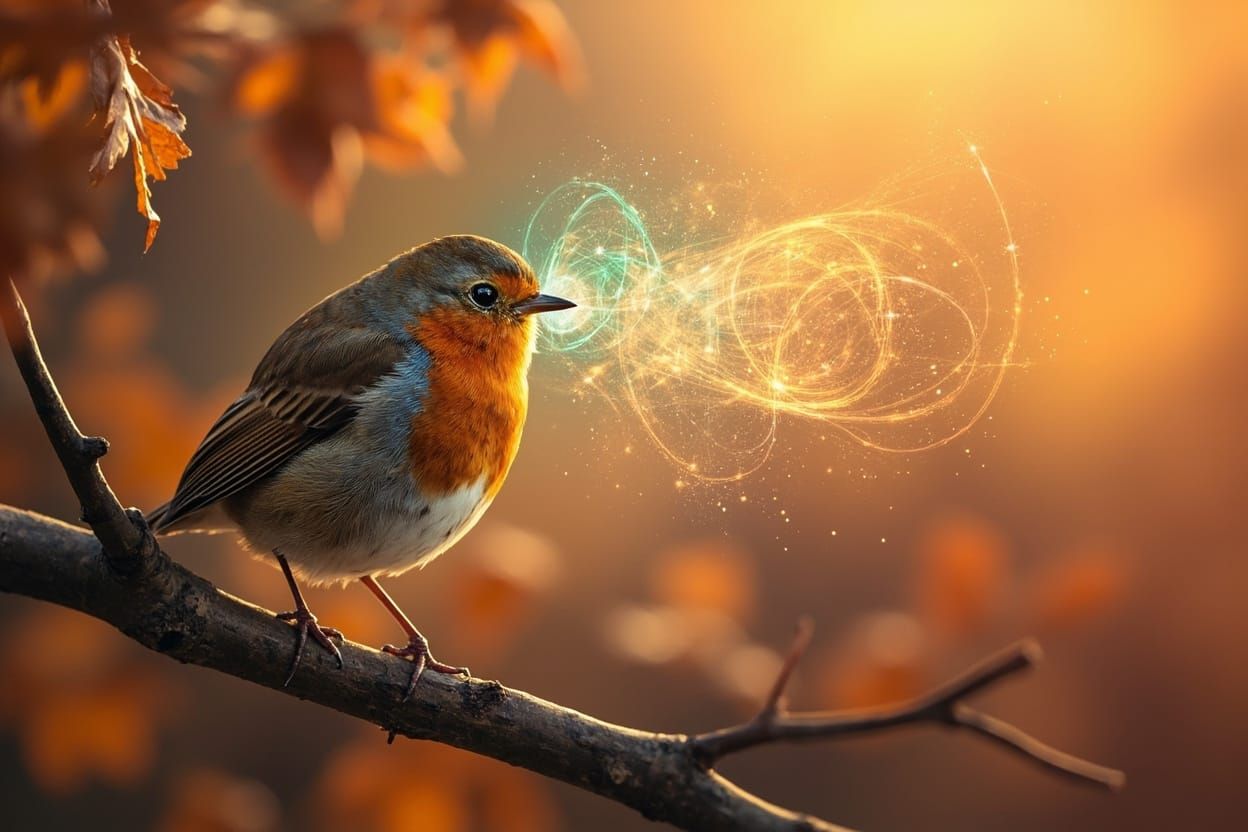
The Secret Compass Inside Every Bird
Genre: Real Science Date: May 12, 2026
A Mystery Written in Light
Every autumn, the European robin does something that still astonishes scientists. It folds its wings, tilts its head, and flies thousands of kilometers south — navigating with a precision that rivaled human GPS only after decades of engineering. For centuries, people assumed birds followed landmarks, or used instinct, or read the stars. All of that is true. But none of it explains the most remarkable part: the robin can sense the angle and strength of Earth's magnetic field, and it can do it in total darkness, underground, with its eyes covered.
How does a living creature perceive a magnetic field? The answer is stranger than anything science fiction has imagined. It turns out that some birds have a form of vision that operates on the principles of quantum mechanics.
This is the story of the radical pair mechanism — one of the most beautiful intersections of biology and physics ever discovered.
The Problem with a Sixth Sense
Magnetoreception — the ability to detect magnetic fields — exists in bacteria, in mollusks, in sea turtles, in salmon, and in dozens of bird species. But how does it work at the molecular level? Magnets attract iron. Living tissue contains iron. For a long time, biologists assumed animals must be using some iron-based magnetite mineral, tiny compass needles scattered through the body.
The problem was that the magnetic fields animals sensed were far too weak for iron-based detection. Earth's magnetic field is about 25 to 65 microtesla. A refrigerator magnet is about 5 millitesla — a hundred times stronger. If animals were using magnetite, you'd need impossibly large crystals to detect something this subtle. The numbers didn't work.
Something else had to be going on.
In the 1970s, a German biologist named Wolfgang Wiltschko began a series of experiments that would eventually upend everything. He placed European robins in windowless, aluminum-walled chambers and changed the direction of an artificial magnetic field. The birds oriented themselves to the field's direction — even when all light was stripped away except certain wavelengths. When he filtered out short-wavelength light, particularly blue and green light, the birds became completely disoriented.
Light was somehow involved in detecting magnetism. That was the first clue that this wasn't about iron at all.
Cryptochrome and the Dance of Excitation
The protein at the center of this story is called cryptochrome. If you were to draw it, it would look like a tangled chain of amino acids, folded into a specific three-dimensional shape that has been preserved — virtually unchanged — across hundreds of millions of years of evolution. Cryptochromes are found in the eyes of birds, in the retinas of mammals, in the leaves of plants, and even in some algae. Their primary job is to sense blue light and regulate circadian rhythms. But in birds, something additional happens inside this protein that may allow it to act as a biological compass.
When a photon of blue light enters a bird's eye and strikes a cryptochrome molecule, it triggers a cascade of electron transfers. An electron is knocked loose from a special region of the protein called the FADH cofactor, and it jumps to a nearby tryptophan amino acid. Then another. Then another. This chain of electron hops creates what scientists call a spin-correlated radical pair — two molecules with unpaired electrons, separated by just a few nanometers, each "spinning" in a quantum state that is influenced by the surrounding magnetic environment.
Here's where it gets genuinely astonishing.
The radical pair exists in one of two quantum states: a singlet state or a triplet state. These states are not fixed. They oscillate, flipping back and forth in a phenomenon called quantum beating. The rate of this oscillation — and the probability that the pair ends up in one state versus the other — is directly influenced by the angle of the local magnetic field relative to the molecule. Earth's magnetic field, acting on this tiny quantum system inside a protein, changes the chemical fate of the radical pair.
If the pair decays into the singlet state, one set of chemical products forms. If it decays into the triplet state, a different set forms. These products are different molecules, different signals. And in birds, those signals appear to trigger neural pathways that the brain interprets as a sense of direction.
The entire magnetic sense is built on a quantum effect.
Testing the Theory
In 2004, a physicist named Thorsten Ritz, working with the Wiltschkos, proposed a detailed model for how cryptochrome could function as a magnetoreceptor. The model predicted that oscillating magnetic fields at specific frequencies should disrupt the radical pair mechanism and confuse the birds. In 2008, a team at the University of Oldenburg in Germany tested this prediction.
They placed garden warblers in a forest that was known to disrupt magnetic navigation — a place where birds had been getting lost for years. The cause turned out to be power lines running through the forest. The 50-Hertz oscillating field from the electrical infrastructure was generating magnetic interference right in the frequency range that the radical pair model said would disrupt navigation. When the researchers shielded the birds from this interference, their navigational accuracy recovered completely.
The power lines weren't blocking magnetism. They were introducing noise into a quantum biological process.
The evidence has only grown stronger since. In 2020, a team at the University of Tokyo demonstrated that a form of cryptochrome derived from plants showed the predicted magnetic field sensitivity in vitro — outside of a living organism, in a laboratory dish. They measured the radical pair spin dynamics and found them changing exactly as quantum theory predicted.
The Quantum Biology Frontier
What does this mean for science?
The bird compass represents a fundamental shift in how we think about the boundary between the quantum world and the biological world. Quantum mechanics — with its superposition, entanglement, and tunneling — was long assumed to be relevant only in the controlled environments of physics laboratories. The warm, wet, chaotic interior of a living cell was thought to be far too "noisy" for delicate quantum states to survive.
The radical pair mechanism suggests otherwise. Birds have evolved a mechanism to harness quantum coherence — the organized, synchronized behavior of quantum states — inside a protein that operates at body temperature. Somehow, evolution found a way to protect quantum information from decoherence, the process by which quantum states collapse into classical certainty.
This is now one of the most exciting frontiers in biology. Researchers are investigating whether quantum effects play roles in photosynthesis (where they may enable near-perfect energy transfer), in enzyme catalysis (where quantum tunneling may accelerate chemical reactions), and in the sense of smell (where quantum vibrations may explain how we detect extremely similar molecules with high specificity).
The bird's compass is not an isolated curiosity. It is a window into a new biology — one in which the quantum world and the living world are not separate domains but deeply intertwined.
What the Robin Knows
Imagine, for a moment, being a European robin in October. The days are shortening, and something deep in its genetic code is telling it to go south. It doesn't know why. It doesn't need to. The instruction is there, written in millions of years of accumulated survival.
But how does it execute the instruction?
It lifts off into the darkening sky and finds, somehow, a sense that is invisible to us — a invisible line that runs along the axis of Earth's magnetic field. The field is slightly inclined in Central Europe, dipping downward at about 67 degrees from the horizontal. Turn east or west, and the angle changes. The robin can feel it. The angle maps onto its field of vision like a colored overlay, a compass written in something that is not quite light and not quite sound. It follows the invisible line southward, adjusting for declination, correcting for local variations in the field.
It navigates across countries and coastlines it has never seen, through fog and cloud, guided by a mechanism that was first discovered not by engineers but by evolution — optimized over a hundred million years of survival pressure.
And now, after decades of careful experiment and theoretical physics, humans have begun to understand it.
The robin has been telling us something about the nature of reality this whole time. We are only now learning to listen.
The End
Author's Note: The radical pair mechanism was first proposed as a hypothesis for bird magnetoreception by Klaus Schulten, Carlos Bustamante, and others in the late 1970s and early 1980s. The full theoretical framework was developed by Thorsten Ritz, Susumu Adachi, and colleagues in the 2000s. As of 2026, while the evidence for the radical pair mechanism is extremely strong, the precise identity of the signaling molecule that connects cryptochrome activation to the bird's nervous system is still an active area of research — one of the last missing pieces of the puzzle.