

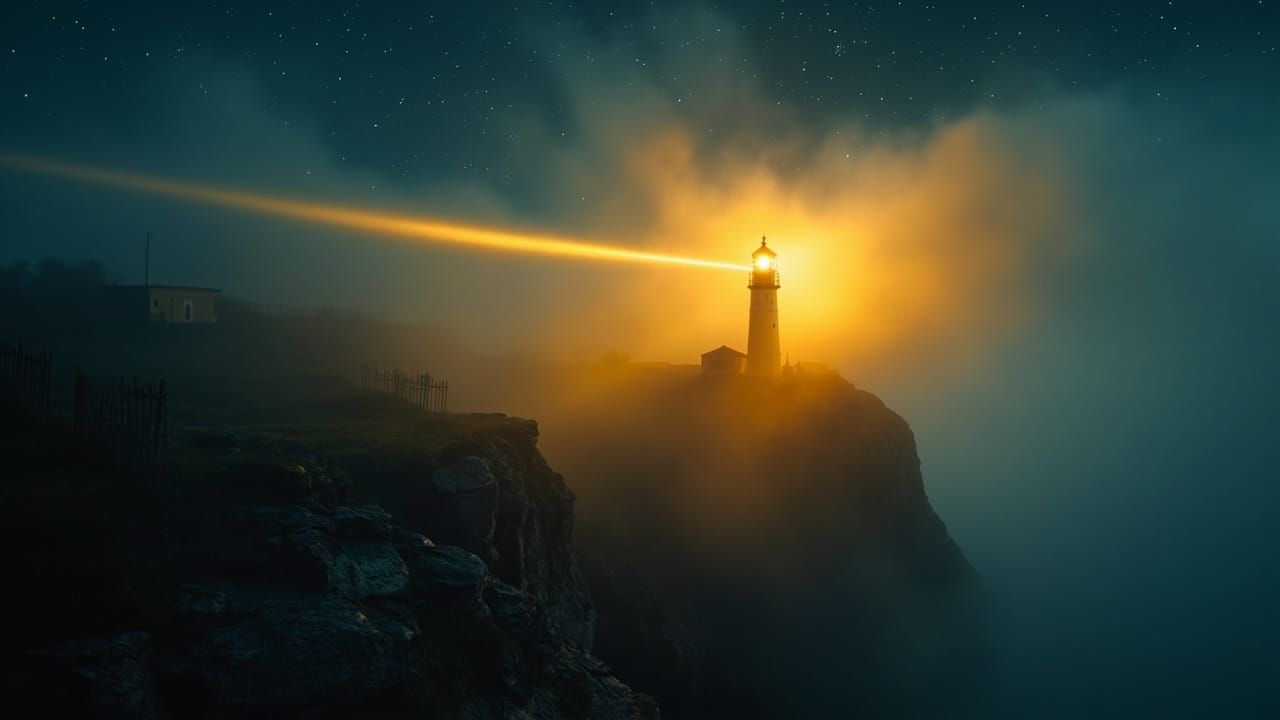
A Light in the Fog
The fog came in on the third night of Elena's watch, thick and silver, swallowing the sea in pale folds. She had been at Sable Point for eleven days—long enough to learn the rhythms of the place, the way the tide pulled back like a held breath, the way the gulls screamed at dawn as if the sun had personally offended them. But the fog was something else. The fog was the island speaking.
Elena Vance had taken this posting for the silence. After seven years as a communications officer in military crisis centers, after years of screens and status reports and the constant hum of catastrophe held at bay, she had wanted something simpler. A lighthouse, a schedule, the sound of water instead of human panic. She had not expected to find it beautiful.
Sable Point sat at the edge of everything—a granite dome rising from the North Atlantic, bare except for the lighthouse, the keeper's cottage, and the old cemetery where names had been worn smooth by salt and time. The previous keeper, a man named Aldus Wren, had left no forwarding address. The official report said he had resigned suddenly, with "personal reasons" cited as the explanation. The unofficial story—told by the supply boat captain who came every two weeks—said Aldus had started talking about "the voices in the glass."
Elena had laughed when she heard that. She was not laughing now.
The Signal
It began at 2:47 AM, when the fog was so thick that the beam of the lighthouse seemed to dissolve into the air rather than cut through it. Elena was in the lantern room, wiping down the brass fixtures—a ritual she had adopted from a dog-eared keeper's manual from 1952—when she heard it.
Not a sound, exactly. More like a pressure. A hum that seemed to come from inside the glass of the Fresnel lens itself, vibrating at the edge of hearing like a word you almost remember.
She touched the lens. The glass was warm.
Elena stepped back. The lighthouse was old, but it was not broken. The lamp was electric now, powered by a generator that purred in the utility building fifty meters away. There was no reason for the glass to be warm. There was no reason for the lens to vibrate. And yet the hum continued, rising slowly, like an orchestra tuning before a performance that no one had asked them to give.
Then the beam shifted.
The great lens rotated—but Elena had not touched the mechanism. The light swept outward, away from the sea, and for one impossible moment, it illuminated the fog in a direction the lighthouse was never meant to face. Toward the island's interior. Toward the cemetery.
In that flash of light, Elena saw something that made her breath stop.
A figure. Standing among the gravestones. Not moving, not waving—just standing, facing the lighthouse, as if waiting.
The light moved on. The fog swallowed the cemetery again. And when Elena rushed to the control panel to stop the rotation, she found the mechanism locked, the gears frozen in place, the motor humming with a steady, unexplainable energy.
She stood there for a long time, listening to the hum, watching the fog, waiting for the beam to return. It did not.
But the fog did not lift.
The Cemetery
In the morning, she walked to the cemetery.
This was not something she had planned. After the events of the night—whatever they were—Elena had considered calling the mainland, filing a report, asking for a replacement. But something held her back. The lighthouse was her responsibility. The island was her post. And if there was something wrong with the mechanism, she needed to understand it before she could explain it.
The cemetery was small, enclosed by a low stone wall, the gravestones leaning at angles that spoke of decades without tending. Most of the names had been worn away by salt spray, reduced to vague shapes in the granite. But one stone stood out—newer than the others, its inscription still sharp.
ALDOUS WREN 1961 — 2024 "The light sees all who wait."
Elena crouched beside the stone. The inscription was strange—not the usual sentiment, not dates and beloved farewells, but something that felt more like a warning. Or an invitation.
She looked around the cemetery. The ground was soft from the fog's moisture, and in the mud near the base of Aldus's stone, she noticed marks. Not animal tracks. Something else. A pattern of shallow depressions, as if someone had knelt here repeatedly, over and over, in the same spot.
She followed them with her eyes and found herself looking at a gravestone she had not noticed before. It was older than the others, the granite dark and veined with something that caught the light. And carved into its face, in letters that seemed to shift when she looked at them directly, was a name.
MAREN ELLIS 1803 — 1821
Eighteen years old. Two hundred years dead.
And below the name, a single line:
"She did not leave."
The Journal
Elena found the journal in the keeper's cottage, in a drawer that stuck in the bedside table, hidden beneath a stack of tide charts. It was Aldus's handwriting—cramped, urgent, the words pressed hard into the page as if they were trying to escape.
March 3rd. The light has started doing things I don't understand. It moves when I don't ask it to. It shows me things I don't want to see.
March 7th. The fog came and I saw her again. Standing in the cemetery. She has dark hair and she's wearing something old, like a dress from a painting. She doesn't move. She just watches. And the glass is warm, always warm now, and the hum is louder at night.
March 14th. I understand now. The lighthouse isn't just a warning to ships. It's a beacon for something else. Maren Ellis was a keeper's daughter, 1821. A ship crashed in the fog—the Ladybird—and she drowned trying to signal it to safety. But she never stopped signaling. Two hundred years, and she's still trying. The lens remembers. The light remembers. And now I remember too.
March 21st. The hum is in my head now. I can hear her voice in it, faint, saying the same thing over and over: "Tell them. Tell them the water is safe." She thinks she's warning them. She doesn't know she's trapping them. Two centuries of ships turning away from Sable Point because the light showed them a graveyard instead of the rocks. She thinks she's saving them, and she's been destroying the reputation of this lighthouse for two hundred years.
April 1st. I'm leaving. Not because I'm afraid. Because I'm the only one who can tell the story now. The light won't change. Maren won't leave. But someone has to explain why the lighthouse here was never trusted, why sailors gave it a wide berth, why this place became a ghost story instead of a guide. I'll tell them. And maybe that will be enough.
The journal ended there. Aldus had walked away from Sable Point, and the story had ended—or so he thought.
But Elena was still here. And the fog was still there. And somewhere in the lens, Maren Ellis was still signaling, still believing she was saving ships, still trapped in the last moment she would ever have.
The Choice
That night, Elena climbed to the lantern room again. The hum was there, waiting for her, vibrating through the glass and the brass and the iron framework. The fog pressed against the windows like something alive, like something patient.
She understood now. This was not a haunting in the way ghost stories meant it. Maren Ellis was not a specter to be feared. She was a girl who had died doing what she believed was right—warning ships of danger—and who had been unable to stop, even after death, even after two centuries of repetition had worn her purpose down to something almost unrecognizable.
The fog was not keeping Maren prisoner. The fog was keeping her focused. The lens was not malfunctioning. It was amplifying. Every time the beam swept toward the cemetery, it was echoing Maren's last desperate act—standing at the window of the old keeper's house, waving a lantern, screaming into the fog that the rocks were close, that the ships should turn, that lives depended on their attention.
But no one could hear her. Not in 1821, and not now.
Elena looked at the control panel. The mechanism was still frozen, still humming with that impossible energy. She could try to force it—run the generator until something gave, try to break the cycle by overwhelming it. Or she could do something else.
She reached up and touched the glass of the lens. It was warm, just as it had been before. And deep inside the bevels and prisms, she thought she could see something—a faint shimmer, like heat rising from sand, like a voice about to form.
"Maren," she said softly. "I hear you."
The hum shifted. Rose. Changed.
"The ships are safe," Elena continued. "They know to come now. You can rest."
For a long moment, nothing happened. The fog pressed. The light held steady. The hum continued its endless drone.
Then, slowly, the warmth began to fade. The vibration in the glass softened. And somewhere far away—or perhaps very close, perhaps inside the lens itself—Elena heard something that might have been a sigh.
The mechanism unlocked. The gears began to turn. The great beam swung back toward the sea, as it was always meant to do, and the fog thinned, and the stars appeared above the water like scattered diamonds.
In the morning, the supply boat arrived. The captain commented that the lighthouse looked different—brighter, somehow, more alive. Elena smiled and said nothing. She filed her report, noted the mechanical repairs she had made, and requested a transfer at the end of the season.
Not because she was afraid. But because some stories need to be told by someone who knows they are not the ending. Maren Ellis had protected Sable Point for two hundred years. Now the lighthouse could protect ships again, the way it was meant to. And somewhere in the glass, if you listened closely on a foggy night, you could still hear the faintest hum—the echo of a girl who never stopped trying, even when no one heard.
But now, when ships passed Sable Point, the light led them home.
— Story #47 — "Some lights never go out. They just learn who needs them."