

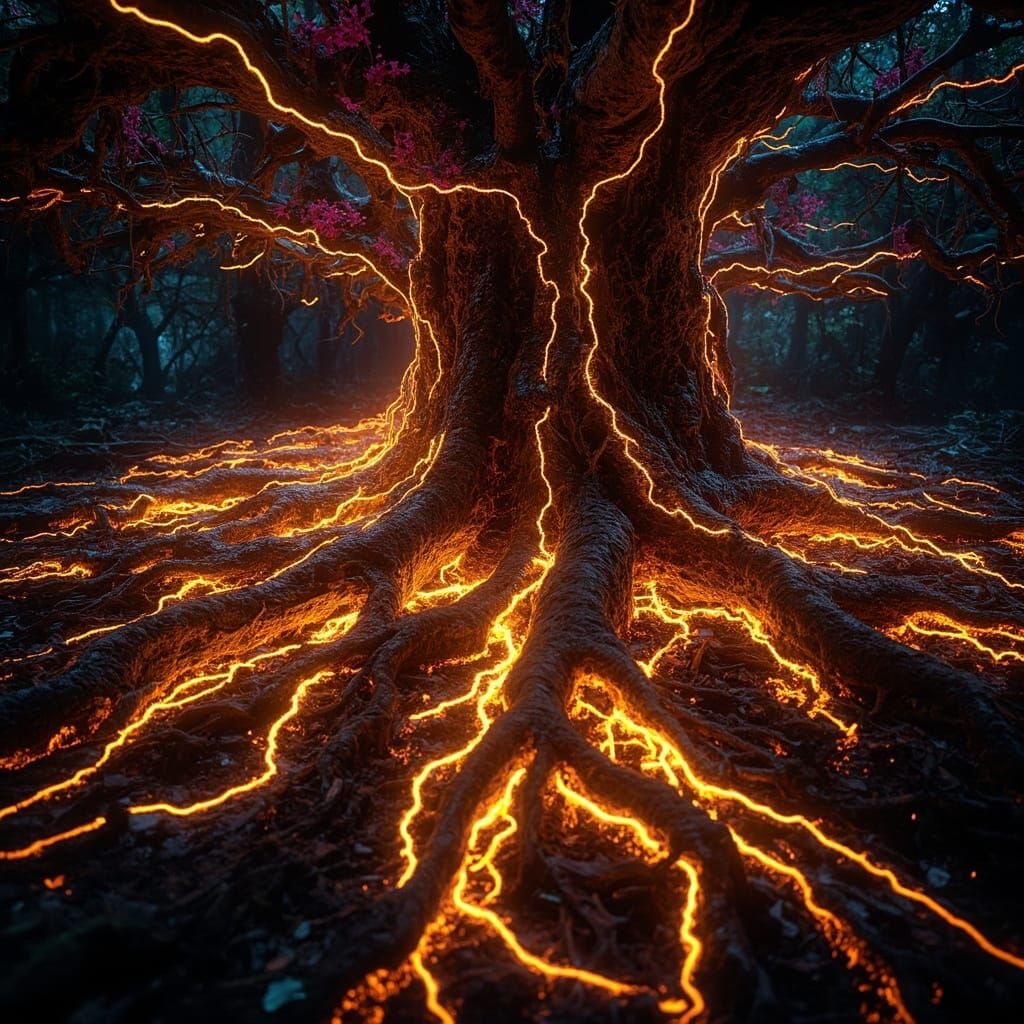
A Story of Trees, Fungi, and the Hidden Internet Beneath Our Feet
Every autumn, as the forest prepares for dormancy, something remarkable happens underground. Older, wiser trees — the ones we call Mother Trees — begin pumping excess carbon into the soil through vast fungal networks. Scientists now believe they are doing far more than simply feeding fungi. They are sending messages. Warnings. Gifts. The forest is not a collection of isolated individuals competing for sunlight. It is a community, a living internet of roots and filaments, and the trees are its most eloquent members.
The Discovery of an Ancient Network
For most of human history, we looked at forests and saw competition. Survival of the fittest. Trees reaching upward for light, their roots fighting underground for water and minerals. Charles Darwin himself saw nature as a struggle. But in the 1990s, a forest ecologist named Suzanne Simard began asking different questions. What if the forest was actually cooperative? What if trees were sharing resources in ways we had never imagined?
Simard was studying the relationship between paper birch and Douglas fir in British Columbia when she stumbled upon something that would change our understanding of forests forever. She discovered that birch trees were sharing carbon — up to 40% of their daily carbon production — with fir seedlings growing in the shade. The seedlings, unable to photosynthesize efficiently without direct sunlight, would have died without this assistance. And they received it from trees that gained nothing in return. Or so it seemed.
What Simard had discovered was mycorrhizal networks — symbiotic relationships between tree roots and soil fungi that allow the bidirectional transfer of nutrients, water, and chemical signals. The fungal filaments penetrate the root cells of trees, forming structures called arbuscles. In exchange for carbon sugars from the trees, fungi deliver soil nutrients — phosphorus, nitrogen, water — with remarkable efficiency. But the fungi do something else too. They connect trees to each other.
The word "mycorrhiza" comes from the Greek for "fungus root." Scientists had known about this symbiosis since the late 1800s. What they hadn't realized was the scale and sophistication of the connections between trees. The fungal networks became known as the "Wood Wide Web," and what it revealed about forest ecology was humbling and beautiful.
How the Web Works
Mycorrhizal fungi are not a single species. They are thousands of species, each forming partnerships with specific trees and each contributing something unique to the network. Some fungi are generalists, connecting dozens of tree species. Others specialize, forming tight bonds with a single species like the lodgepole pine or the trembling aspen.
The fungal threads — called hyphae — are impossibly thin, just a few microns across. But they branch and braid together to form mats that can stretch for acres. A single cubic meter of forest soil may contain hundreds of miles of fungal hyphae. In the Pacific Northwest, some fungal networks span thousands of acres, connecting trees in stands that burned in fires centuries ago but whose root systems remain linked beneath the ash.
Through this web, trees share not just nutrients but chemical signals. When aphids attack a willow tree, the willow releases chemical signals through the fungal network. Neighboring willows receive the signal and begin producing defensive chemicals before the aphids even reach them. The warning travels faster than the insects do.
When a tree is felled, its neighbors show physiological changes — increased photosynthesis, altered root growth — as if mourning. When a Douglas fir is attacked by the mountain pine beetle, it sends stress signals through the network, and nearby firs begin producing defensive resins in response.
Some scientists call this chemical communication "talking." Others prefer "signaling." But the words matter less than what they describe: a system of information transfer that has no brain, no nerves, no neurons, yet functions with a kind of distributed intelligence that we are only beginning to comprehend.
Mother Trees: The Wisdom of the Old-Growth
Suzanne Simard's research went deeper. She identified what she called "Mother Trees" — the largest, oldest trees in a forest, often in the center of a fungal patch. These trees, with their massive root systems and established fungal connections, appear to serve as hubs in the network. They recognize their own offspring — genetic matches — and send them preferential treatment.
Seedlings connected to Mother Trees receive more carbon, more nitrogen, and more water than seedlings connected only to strangers. When a Mother Tree is wounded or dying, she dumps her remaining carbon reserves into the network, essentially willing her legacy to the next generation. The forest itself seems to have a form of memory, passed down through living root systems.
Mother Trees are disproportionately important to forest resilience. Cutting them down does more than remove old trees. It severs connections in the network, leaving younger trees more vulnerable to drought, disease, and insect attacks. The forest's immune system is concentrated in its elders.
Old-growth forests, with their diverse age classes and intact mycorrhizal networks, are not just aesthetically valuable. They are functionally irreplaceable. The fungal networks in old-growth forests have been developing for centuries, potentially millennia. Replanting clear-cut areas does not restore these networks. It creates a forest that must start from scratch, building its web again from the beginning.
What the Web Teaches Us
The discovery of mycorrhizal networks has implications far beyond ecology. It challenges how we think about individuality, competition, and connection. For most of Western history, we have understood nature as a hierarchy of separate beings, each fighting for its own survival. The Wood Wide Web suggests something different: that life evolved not just through competition but through cooperation, that the boundaries between organisms are more porous than we thought, and that some of the most sophisticated behaviors in nature happen without any brain at all.
There is something both humbling and hopeful in this. Trees, which we have long considered silent and passive, are actually communicating, cooperating, and caring for each other in ways that parallel human communities. They share resources with the struggling. They warn each other of danger. They remember the past and prepare for the future through the accumulated wisdom of their fungal networks.
We are not the only beings who have built systems of mutual aid. We are not the first to create networks of connection that transcend the boundaries of individual bodies. The Wood Wide Web has been operating beneath our feet for hundreds of millions of years, long before humans existed to witness it.
Standing in the Forest
Next time you walk through a forest, consider what lies beneath you. The soil is not dead earth. It is a pulsing, living network of fungal threads connecting tree to tree, old to young, stranger to stranger. Carbon flows through it like information through the internet. Warnings travel through it faster than any sound. Gifts pass through it without transaction, without contract, without expectation of return.
The trees are talking. They have been talking all along. We are only now learning to listen.
And as we listen, we discover that the forest is not a collection of trees. It is a single vast organism, divided by bark and branch but unified beneath the soil by the most intricate network of cooperation the Earth has ever produced.
Perhaps we should listen more carefully. Perhaps the Wood Wide Web has something to teach us — about resilience, about generosity, about what it means to be part of something larger than ourselves. The trees have been at this for a very long time. They might know a thing or two about how to survive together.
Published on April 5th, 2026.