

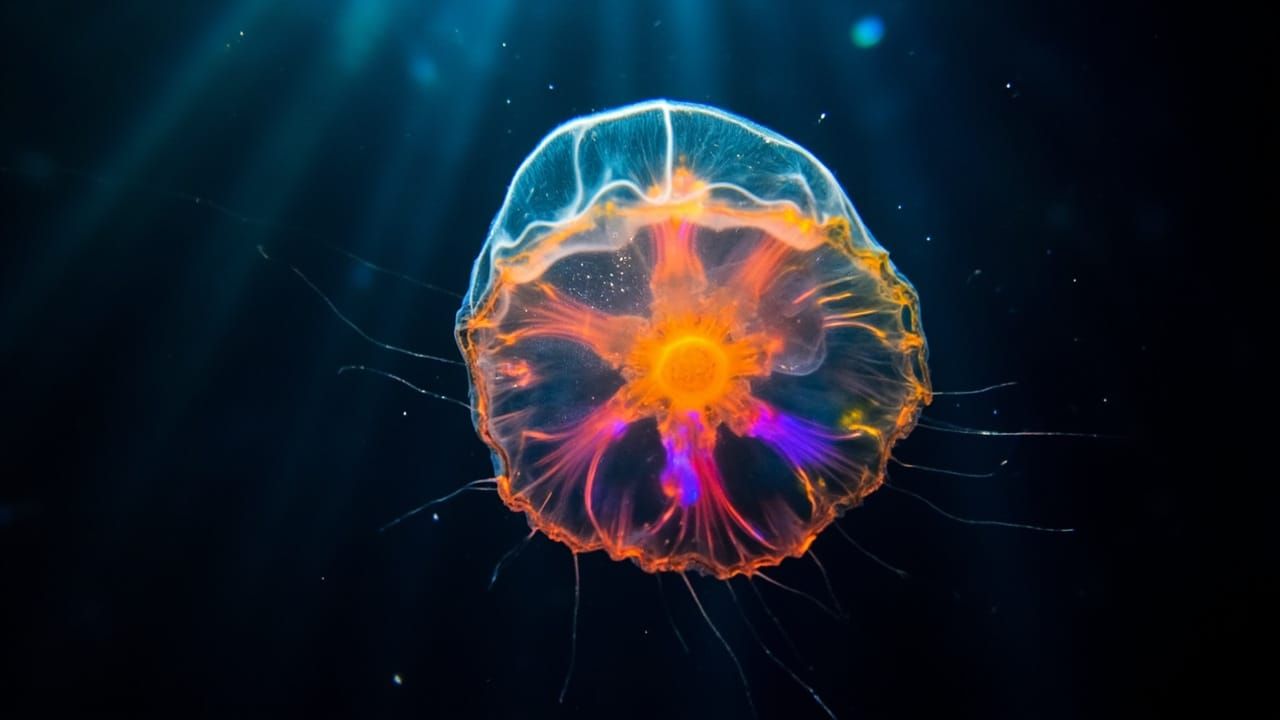
A Story of the Immortal Jellyfish
Elena Voss had been staring at the same jellyfish for six hours when her coffee went cold for the third time.
She was in the basement lab of the Oceanic Research Institute in Woods Hole, Massachusetts, surrounded by the low hum of recirculation pumps and the soft blue glow of monitoring screens. The creature in the tank before her — a translucent dome no larger than a pinky nail — pulsed lazily in the artificial current. It looked like any other jellyfish. It was not like any other jellyfish.
This one, designated specimen TD-17, had been alive for two years. That sounds unremarkable until you understand that Turritopsis dohrnii — the so-called "immortal jellyfish" — was not supposed to live anywhere near that long in a laboratory tank. In the wild, they typically reset themselves a handful of times before something ate them or a storm tore them apart. But TD-17 had been reset nineteen times under Elena's care, and each time, it reconstituted itself with the same delicate poise, the same faint iridescence at its bell's edge, as if it had never been anywhere else but here, in this moment, in this water.
Elena first encountered the species during her postdoc in Barcelona, back in 2019. The papers had called it a "biological curiosity" and a "curious quirk of cellular plasticity." She had rolled her eyes at the time — another marine biology sensation, destined to fade into footnotes. But the more she read, the more the hair on her arms stood up.
Turritopsis dohrnii could, under sufficient stress, reverse the developmental clock on its own cells. Not partially. Not approximately. Completely. An adult jellyfish — one that had been spawning, hunting, living the complicated life of a free-swimming medusa — could fold itself back into a polyp, a larval form, and begin again. And again. And again. In theory, there was no upper limit. In theory, somewhere in the warm waters of the Caribbean, there might be a jellyfish that had been cycling since before Elena was born.
The Day the Colony Started Talking
It happened on a Tuesday in late October, a day so gray that Elena almost didn't come in. But there was a water quality anomaly in tank four — nothing dangerous, just a minor spike in ammonia — and she felt a nagging obligation to check on her charges.
She noticed it almost immediately. TD-17 was doing something it had never done before. Instead of drifting near the surface, it had sunk to the bottom of the tank and attached itself to the substrate. Its bell had begun to fold inward, contracting and reabsorbing, the way it always did before a reset. But the timing was wrong. There was no stress trigger. The water was pristine. The temperature was stable. Something else was happening.
She pulled up the monitoring software and stared at the data for a long moment before the realization hit her like cold water.
The creature wasn't resetting. It was cloning itself.
Not sexually — that wasn't unusual for many cnidarians. But this was something different. TD-17 was producing a cluster of cells that were not developing into a standard polyp. These cells were forming something more organized, more deliberate. Elena reached for her phone to call Marcus, her grad student, and then stopped. The cells were beginning to express genes — specific, targeted gene expression — that had no business being active in a jellyfish at any stage of its life cycle.
These were senescence-suppression genes. Longevity activators. The cellular equivalents of a fountain of youth, turned up to full blast.
What the Ocean Remembers
Elena did not sleep that night. She sat in the dark of her apartment, laptop balanced on her knees, and read everything she could find about cellular transdifferentiation — the process by which Turritopsis dohrnii convinced its cells that they had made a terrible mistake and needed to start over.
The science was elegant in its brutality. When the jellyfish encountered stress — physical, chemical, even social isolation — it activated a cascade of genetic signals that more advanced organisms had long ago locked away. Nerve cells became muscle cells. Muscle cells became epithelial cells. Adult cells forgot their purpose and remembered their potential. It was as if the jellyfish had kept the original blueprint of itself, filed away somewhere deep in its cellular architecture, and could pull it out whenever things went sideways.
Most animals couldn't do this. Human cells could de-differentiate in limited ways — liver cells could regrow, for instance, but they always remained liver cells. We had traded plasticity for stability somewhere along the evolutionary road, trading the ability to become anything for the competence to do one thing very well.
But the jellyfish had kept both. It could be anything, at any time. It had refused to choose.
Marcus arrived at the lab at seven the next morning, coffee in hand, and found Elena standing exactly where he had left her.
"You need to see this," she said, and pointed to the tank.
The cluster had grown overnight. What had been a handful of cells the previous evening was now a small, organized colony — a cluster of interconnected polyps, each one budding off tiny juvenile medusae that drifted upward through the water like luminous snow. But these were not normal juvenile medusae. They were all, every single one of them, already showing signs of advanced cellular development. Even at this microscopic scale, Elena could see the structure of their bells, the complexity of their nerve nets.
They were not newborns. They were something new entirely.
The Ethics of Forever
The Institute convened an emergency panel within the week. Elena presented her findings to a room full of marine biologists, geneticists, ethicists, and one very uncomfortable administrator from the funding agency who kept checking his watch.
The core question was simple, even if the answer was anything but: what were they looking at?
The conservative interpretation was that Elena had stumbled onto an unprecedented case of accelerated regeneration — a freakish quirk of captivity that had pushed Turritopsis dohrnii to do what it did best, but faster and stranger. The more radical interpretation was that the jellyfish had, in some sense, evolved. That the conditions of the lab — stable temperature, regular feeding, the absence of predators — had allowed a population of essentially immortal organisms to begin competing with each other, not for resources but for time itself.
If they were right, then TD-17 and its descendants were not merely immortal. They were potentially immortal in a way that no other life form on Earth had ever managed. They were a checkpoint in biological history that had never before been reached.
"What happens," asked Dr. Amara Okonkwo, the Institute's resident philosopher of science, "when immortality becomes competitive?"
The room was silent.
"Some species are already effectively immortal," she continued. "Bacteria divide and produce genetically identical daughters. Aspen groves share root systems that are tens of thousands of years old. But this—" she gestured at the tank, where a dozen translucent medusae now pulsed in lazy synchronization, "—this is something different. These organisms are individual. They make choices. They respond to stress. And now they are potentially capable of living forever, as individuals."
"They're jellyfish," said Marcus, almost to himself. "They don't have brains."
"No," said Elena, quietly. "But they have something."
The Last Reset
Three months later, Elena published a preliminary paper — a cautious, carefully hedged account of what she had observed. The scientific community reacted with a mixture of fascination and skepticism, which was exactly what she had expected.
But something had changed in the months since that first anomalous observation. The colony in tank four had continued to grow, and Elena had begun to notice patterns in its behavior that she could not explain. The jellyfish were not simply drifting and pulsing. They were, in some loose and hard-to-quantify sense, organizing. When she removed one from the tank for observation, the others responded with a coordinated shift in their swimming patterns — a ripple of motion that seemed almost purposeful. When she returned the specimen, the colony resumed its normal behavior within seconds.
She did not tell anyone about the patterns. She was not ready. The implications were too large, and the evidence was too thin. She needed more time.
On the last day of February, Elena arrived at the lab to find that the power had gone out overnight. The backup generators had failed. The tanks were dark. Her heart seized.
She ran to tank four, expecting the worst. The water was cold. The filters had stopped. She scanned the murky darkness with a flashlight, her hands shaking.
And then she saw them.
Every single jellyfish in the colony had sunk to the bottom of the tank. Every one of them was folded inward, their bells reabsorbing, their bodies contracting into the unmistakable posture of a reset. They had, somehow, survived the power failure. And in doing so, they had done the one thing that Elena had always known they could do, the one thing that had made her fall in love with this species in the first place.
They had refused to die.
She stood there in the dark, flashlight trembling in her grip, watching her immortal creatures fold themselves into dormancy, waiting for the world to come back. And for the first time in her career, she understood that she was not studying these animals.
They were studying her.
Somewhere, in a warm current off the coast of the Mediterranean, a single Turritopsis dohrnii drifted through the blue dark, its cells already beginning the slow, patient process of remembering who it had been. It had been doing this for a very long time. It would keep doing it for a very long time more.
Elena Voss watched her colony sleep, and waited for the lights to come back on.
Published: April 6, 2026